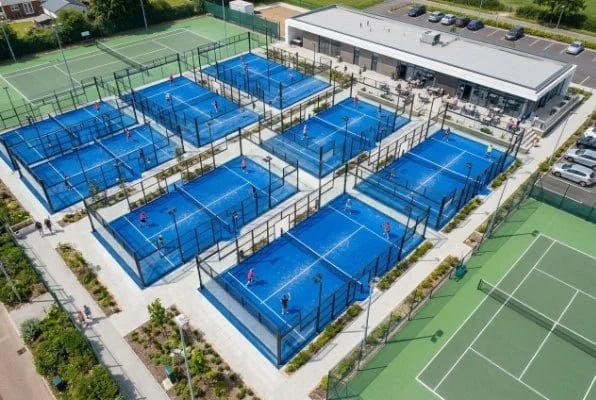
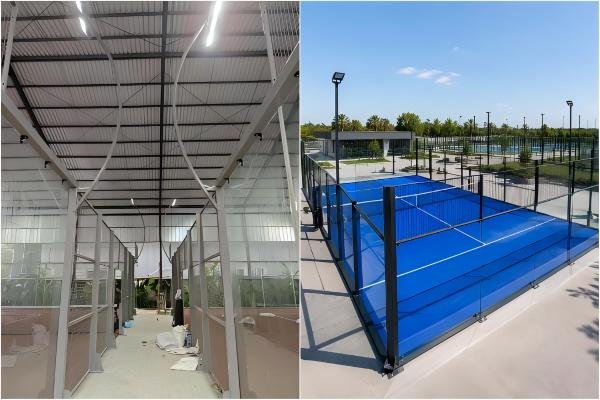
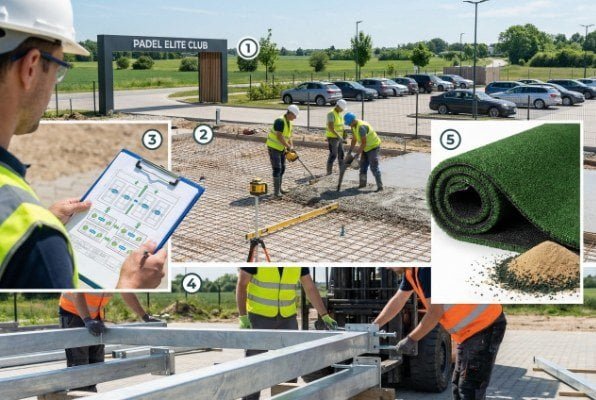
Cheap padel equipment near me can look easy to find until incomplete quotations, delivery charges, and installation gaps raise the final bill. I often see buyers compare headline prices that cover different scopes. I recommend comparing local and factory-direct suppliers by complete specifications, landed cost, project support, and financial risk.
You can find cheap padel equipment near you through local court installers, sports facility distributors, construction contractors, and direct manufacturers. However, you should compare the total landed and installed cost rather than the advertised price1. A complete comparison should include every court component, freight, duties, documentation, installation, spare parts, and warranty responsibilities.
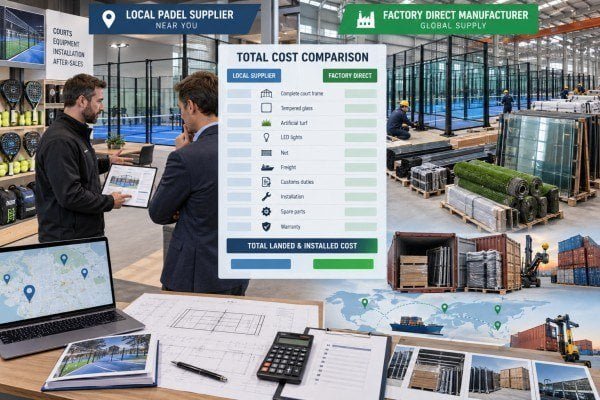
I manufacture and export complete padel court systems, so my expertise concerns courts and court components rather than rackets, balls, shoes, or other personal gear. Before I recommend a sourcing route, I first clarify exactly what the buyer needs and what the quoted price includes.
What Does “Cheap Padel Equipment Near Me” Actually Include?
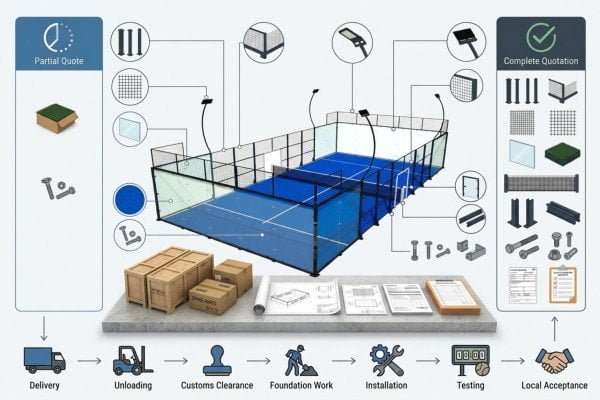
A search for cheap padel equipment near me can produce suppliers offering very different products. One seller may quote only artificial turf, while another may include the frame, glass, lighting, net, and accessories. If buyers do not define the scope first, the lowest quotation can quickly become the most expensive option.
A complete padel court equipment quotation should identify the steel structure, welded mesh, tempered glass, artificial turf, lighting, net system, fasteners, installation documents, packing, and spare parts. Buyers should also confirm whether the price covers delivery, unloading, customs clearance, foundation work, installation, testing, and local acceptance requirements.
I Separate Court Equipment From Personal Playing Gear
I use the term padel equipment here to mean equipment for constructing or maintaining a padel court. I do not use it to mean consumer products such as:
- Padel rackets
- Balls
- Shoes
- Sports clothing
- Bags and grips
Local sporting-goods shops are usually the practical starting point for personal gear. Complete court systems require a different procurement process because they combine structural steel, safety glass, synthetic turf, electrical fixtures, sports accessories, and technical documentation.
When a buyer asks me for a court price, I normally ask six questions before preparing a meaningful quotation:
-
Where will the court be installed?
I need the destination country, city, and preferred delivery point. -
How many courts does the project require?
Court quantity affects production planning, container use, freight allocation, and spare-parts planning. -
Which court design does the buyer prefer?
Buyers may need panoramic, ultra-panoramic, classic, single, roofed, or another project-specific design. -
What are the site conditions?
Indoor, outdoor, coastal, high-wind, high-temperature, and high-rainfall environments can require different evaluations.2 -
Which components should the quotation include?
I confirm the turf, frame, mesh, glass, lights, net, posts, fasteners, and optional accessories. -
Who is responsible for the foundation and installation?
I define whether a local contractor, the buyer’s team, or another party will complete each task.
I Check the Bill of Materials Before I Compare Prices
I have reviewed quotations where one “complete” court did not include lights. I have also seen comparisons where one supplier quoted 12 mm glass and another offered a different specification. Those prices were not truly comparable.
A useful bill of materials should describe at least the following items:
| Component | Details I Ask the Supplier to State |
|---|---|
| Steel frame | Court model, profiles, coating, color, connection method, and component numbering |
| Welded mesh | Wire size, panel dimensions, coating, openings, and fixing method |
| Tempered glass | Thickness, panel dimensions, hole positions, edge treatment, and supplied documentation |
| Artificial turf | Pile height, fiber type, Dtex, stitch rate, density, color, backing, and infill requirements |
| Lighting | Fixture quantity, rated power, mounting position, electrical specification, and documentation |
| Net system | Net size, posts, tensioning system, and fixings |
| Fasteners | Types, grades, quantities, surface treatment, and spare allowance |
| Documentation | Foundation drawings, installation drawings, packing list, and maintenance manual |
| Packing | Glass racks, steel bundles, labels, protection method, weights, and dimensions |
| Warranty | Covered defects, excluded conditions, claim process, and remedy |
I recommend asking each supplier to mark excluded items clearly. That simple step makes a search for cheap padel equipment near me much more useful because it turns an unclear headline price into a procurement comparison.
Where Should I Search for Cheap Padel Equipment Near Me?
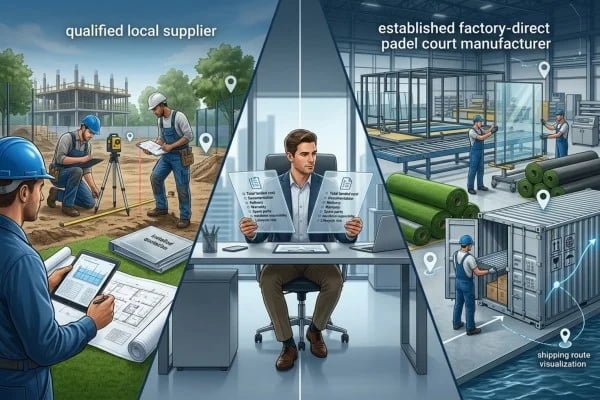
Buyers often search online first, but search distance alone does not determine project value. A nearby seller may provide quick site support and easier replacement delivery. A direct manufacturer may offer more configuration control or a lower product price. I compare both routes before I decide which one offers lower risk-adjusted cost.
I would first request an installed quotation from qualified local suppliers, court installers, and sports construction contractors. I would then compare it with the landed cost from established manufacturers. The better source is the one that provides a suitable, complete system with clear responsibility, reliable documentation, practical delivery, and acceptable lifecycle risk.
I Start With Local Padel Court Companies
I recommend searching for local companies through several channels:
- I search for padel court installers rather than only “padel equipment.”
- I ask existing clubs which contractor supplied and installed their courts.
- I check local sports facility and commercial construction directories.
- I contact artificial turf installers that have completed padel projects.
- I review distributors that represent established court manufacturers.
- I ask civil contractors whether they have padel foundation experience.
- I review public tender records where those records are legally accessible.
A local supplier can be commercially attractive when it can inspect the site, coordinate the foundation, handle unloading, complete installation, and respond quickly after handover. These services have real value even when the equipment price is higher.
However, I do not assume that every nearby company maintains stock or directly controls manufacturing. Some local sellers import the same systems that buyers can source independently. That arrangement is not automatically negative. A competent importer can add useful services, local inventory, code coordination, and warranty response.
I Also Compare Factory-Direct Manufacturers
I use factory-direct sourcing as a comparison, not as an automatic answer. QHPADEL manufactures complete padel court packages in Hebei, China, and our production scope includes artificial turf, frame netting, structural posts, tempered glass, lights, nets, and related accessories.
Our standard production planning currently allows two courts in about 20 days, four courts in about 20–25 days, and larger standard orders in no more than 30 days under normal agreed conditions. Custom styles can generally require up to 35 days. Buyers should confirm the current production schedule in their purchase contract because factory workload, design approval, material availability, and holidays can affect timing.
Factory-direct purchasing may suit buyers who:
- Need several courts with consistent specifications.
- Have a capable local civil and installation team.
- Can manage international freight and import procedures.
- Need OEM colors or turf configurations.
- Want direct access to drawings and production information.
- Can plan ahead for delivery and replacement parts.
Local sourcing may be more practical when buyers:
- Need one court urgently.
- Lack installation or import experience.
- Need a single party to manage the full project.
- Require rapid local service.
- Face complex site or approval conditions.
- Cannot accept international replacement lead times.
| Sourcing route | Potential advantage | Potential limitation |
|---|---|---|
| Local installer | The supplier may provide site checks and turnkey installation. | The equipment price may include several commercial margins. |
| Local distributor | The distributor may offer stock, local invoicing, and faster support. | The distributor may offer limited customization. |
| Civil contractor | The contractor may coordinate foundations and related works. | The contractor may not manufacture or deeply understand every component. |
| Direct manufacturer | The factory may provide clearer production control and customization. | The buyer must manage freight, import, installation, and local compliance. |
| Mixed sourcing | The buyer can combine factory equipment with local construction expertise. | The buyer must define responsibility boundaries carefully. |
I have found that mixed sourcing often deserves serious consideration. A buyer can purchase the court package from a manufacturer while appointing a qualified local contractor for foundations, electrical work, installation, and local approvals. This model only works when both parties accept clear written responsibilities.
How Do I Compare the Real Cost of Cheap Padel Equipment Near Me?
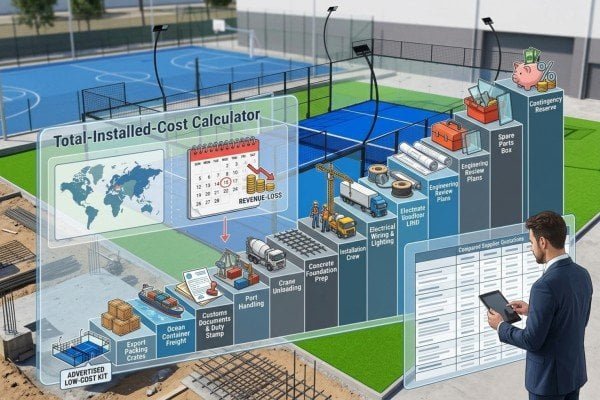
The advertised price rarely represents the final project cost. Buyers can face freight, customs charges, port fees, inland transport, unloading, foundations, installation, equipment rental, electrical work, and replacement shipments. If they compare only equipment prices, they may choose an option that costs more before the court opens.
I calculate the total installed cost by adding the complete equipment price, export packing, international and domestic logistics, import expenses, site preparation, installation, utilities, professional reviews, spare parts, and contingency. I also account for delay risk because missing components or unsuitable specifications can postpone opening and reduce operating revenue.
I Use a Landed and Installed Cost Formula
I recommend using this basic framework:
Total project cost = equipment + packing + freight + insurance + import costs + inland delivery + unloading + foundations + installation + electrical work + professional review + spare parts + contingency
Buyers should obtain location-specific figures from qualified logistics providers, customs brokers, contractors, engineers, and local authorities. I would not rely on a general online estimate for import duties, structural requirements, or installation labor because those items vary by destination and project.
A practical comparison sheet can look like this:
| Cost category | Local quotation | Factory-direct quotation | Verification source |
|---|---|---|---|
| Complete court package | Buyer enters amount | Buyer enters amount | Supplier quotation |
| Export or delivery packing | Buyer enters amount | Buyer enters amount | Supplier |
| International freight | Not applicable or included | Buyer enters amount | Freight forwarder |
| Duties and taxes | Usually built into local pricing | Buyer enters amount | Customs broker |
| Inland delivery | Buyer enters amount | Buyer enters amount | Haulier |
| Unloading equipment | Buyer enters amount | Buyer enters amount | Local contractor |
| Foundation construction | Buyer enters amount | Buyer enters amount | Civil contractor |
| Court installation | Buyer enters amount | Buyer enters amount | Qualified installer |
| Electrical work | Buyer enters amount | Buyer enters amount | Licensed electrician |
| Professional review | Buyer enters amount | Buyer enters amount | Qualified local professional |
| Spare parts | Buyer enters amount | Buyer enters amount | Supplier |
| Contingency | Buyer defines amount | Buyer defines amount | Project team |
| Total installed cost | Calculated total | Calculated total | Buyer |
I Treat Missing Parts as a Financial Risk
A missing fastener may have a low unit value, but it can have a high project impact. The installation team may stop work, hired lifting equipment may remain idle, and a replacement shipment may cost more than the part itself.
I therefore check how suppliers control completeness. At QHPADEL, we use packing lists and component organization as part of export preparation. Buyers should still ask every potential supplier about its own process.
Useful questions include:
- Does the supplier number structural components?
- Does the supplier provide a detailed packing list before shipment?
- Does the supplier photograph loaded components?
- Does the supplier protect and rack the glass appropriately?
- Does the supplier include spare fasteners?
- Does the supplier state package dimensions and weights?
- Does the supplier explain how missing-part claims are handled?
- Does the supplier define who pays for replacement freight?
- Does the supplier provide remote installation support?
- Does the supplier identify parts that buyers should source locally?
I also recommend considering downtime. A club may lose booking revenue when court commissioning is delayed.3 An institution may miss an acceptance date. A contractor may face extra labor and equipment costs. These costs make cheap padel equipment near me a project-risk question rather than a simple product-price search.
Which Documents Should I Request Before Buying Padel Court Equipment?
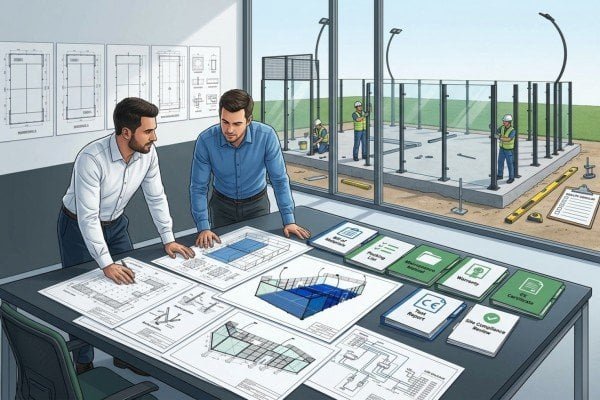
A low-priced court without usable drawings can create expensive site errors. Incorrect anchor locations, unclear glass layouts, or uncertain component numbering can slow construction and cause rework. I view technical documentation as part of the supplied product, not as an optional sales extra.
Buyers should request foundation drawings, installation drawings, component specifications, a complete bill of materials, packing lists, maintenance instructions, warranty terms, and relevant certificates or test reports. Qualified local professionals should review the documents against site conditions, building rules, electrical requirements, tender specifications, and the intended use.4
I Review Drawings Before Production and Foundation Work
I prefer to resolve drawing questions before the buyer pours concrete or the factory completes production. Changes become more expensive after either activity begins.
The document package should cover:
-
Foundation dimensions and levels
The drawings should show relevant dimensions, anchor arrangements, drainage considerations, and level requirements. -
Court layout and orientation
The plan should show the court footprint, access points, structural positions, glass panels, and lighting posts. -
Component identification
The installation drawings should connect part numbers with packing labels. -
Assembly sequence
The guidance should explain a safe and logical order for installing the structure, mesh, glass, turf, lights, and net. -
Electrical requirements
The lighting documentation should state relevant fixture and connection information. A qualified local electrician should design or approve site-specific electrical work. -
Maintenance instructions
The supplier should describe routine inspection, cleaning, turf care, fastener checks, and replacement procedures.
The manufacturer’s drawing does not replace local professional evaluation. A qualified structural engineer or other appropriate professional should assess the foundation, wind actions, drainage, soil conditions, and structural suitability when the project or local rules require that review.
I Treat Certificates as Documents to Verify
A supplier may list certificates, but a buyer should inspect the actual documents. The buyer should confirm the certificate holder, product scope, model, standard, issuing body, issue date, validity, and connection to the goods being purchased.
QHPADEL reports the following documentation within its current business context:
- The factory holds ISO 9001 certification.
- The artificial turf has CE and RoHS documentation.
- The steel frame structure has CE documentation.
- The tempered glass has CE and listed AS/NZS test documentation.
- The LED lighting has CE and listed Australian/New Zealand standards documentation.
- Certain screws and accessories have AD 2000 W0 and PED-related quality system documentation.
Buyers should request current copies and verify relevance before purchase. A certificate should not be treated as proof that an entire project automatically complies with every local building, electrical, sports, or procurement requirement.
I Define Responsibility in Writing
I have seen projects become difficult when the supplier expects the installer to solve a problem, while the installer expects the supplier to provide a replacement. A written responsibility matrix can prevent that dispute.
| Activity | Manufacturer | Buyer | Local contractor | Professional adviser |
|---|---|---|---|---|
| Equipment manufacture | Usually responsible | Reviews scope | Not usually responsible | May review specifications |
| Export packing | Usually responsible | Confirms requirements | Not usually responsible | Not usually responsible |
| Import clearance | May provide documents | Usually responsible | May assist | May advise |
| Foundation design review | Provides reference drawings | Arranges review | Builds approved design | Reviews site-specific suitability |
| Installation | Provides instructions or agreed support | Appoints installer | Usually responsible | May inspect |
| Electrical connection | Provides fixture information | Appoints licensed party | May coordinate | Reviews when required |
| Local approvals | Provides requested product documents | Usually responsible | May assist | Advises on local requirements |
| Defect claim | Reviews manufacturing claim | Provides evidence | Identifies installation issues | May assess cause |
The parties should adapt this table to their contract. They should also define the difference between a manufacturing defect, transit damage, installation error, site-condition issue, and normal wear.
How Can I Check Whether a Padel Equipment Supplier Is Reliable?
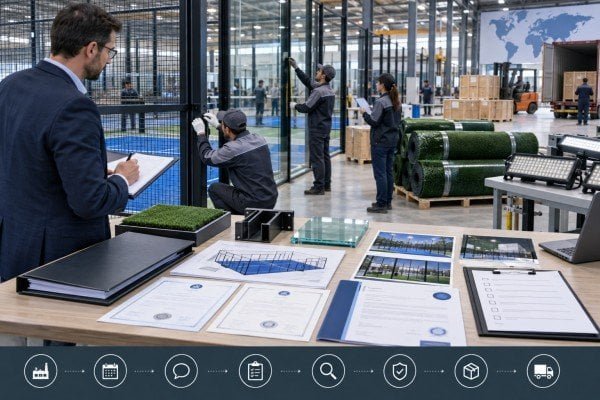
Low prices can create pressure to order quickly, but buyers need evidence that a supplier can deliver the stated configuration. I check manufacturing capability, quotation detail, drawing quality, packing controls, communication, references, documentation, production schedule, and claim procedures before I consider the price commercially meaningful.
I would ask for a company profile, current production evidence, sample drawings, a complete quotation, packaging examples, certification documents, warranty terms, and recent project references where available. I would also use an independent inspection service when the order value, project risk, or procurement rules justify additional verification.
I Look Beyond the Sales Presentation
A polished brochure can help buyers understand the product, but it does not prove production control. I prefer evidence that connects the supplier’s promises with a specific order.
My supplier evaluation checklist includes:
- Legal identity: I verify the company name, address, registration details, and payment beneficiary.
- Production scope: I determine which components the supplier makes and which components it purchases.
- Quotation clarity: I check dimensions, specifications, quantities, exclusions, delivery terms, and validity.
- Quality controls: I ask about material checks, dimensional inspection, coating inspection, trial assembly, and packing checks.
- Documentation: I request samples before paying a deposit.
- Capacity: I ask for a production plan that fits the delivery commitment.
- Change control: I confirm how the supplier records approved colors, turf details, lighting, and court models.
- Packing: I review the protection method for glass, steel, turf, and accessories.
- After-sales process: I ask what evidence the supplier requires and what remedies the warranty provides.
- Communication: I check whether technical questions receive specific answers rather than general assurances.
QHPADEL operates 10 production lines and reports monthly capacity above 1.5 million square metres of artificial turf and 150 complete padel court systems. We also report annual exports of more than 600 containers. Buyers should verify any supplier’s capacity claims against the proposed schedule and their own due-diligence requirements.
I Use Payment Milestones Carefully
I recommend matching payment stages to identifiable project events where commercial terms allow it. The exact arrangement depends on the supplier, order size, customization, financing conditions, and trade history.
Potential milestones can include:
- The buyer approves the final configuration.
- The buyer approves shop or production drawings.
- The supplier confirms material preparation.
- The supplier completes production.
- The buyer or inspector completes a pre-shipment check.
- The supplier provides loading evidence and shipping documents.
An inspection cannot guarantee future performance, but it can identify visible problems before shipment.5 Buyers can ask an independent inspector to check quantities, dimensions, labels, appearance, packing, and selected documents against the purchase agreement.
When I evaluate cheap padel equipment near me, I consider supplier reliability part of the price. A slightly higher quotation can offer better value when it reduces missing-part risk, rework, schedule disruption, and responsibility disputes.
Frequently Asked Questions
Is a local padel court supplier always cheaper than a manufacturer?
No. A local supplier may reduce import work, installation risk, and response time, while a manufacturer may offer a lower equipment price or more customization. I compare the same bill of materials and calculate the complete landed and installed cost before deciding which option is cheaper.
Can I buy only replacement padel court components?
Yes, many suppliers can quote replacement turf, glass, lights, nets, mesh panels, fasteners, or structural parts. I recommend providing drawings, photographs, dimensions, hole positions, material specifications, and original part details. Compatibility should be professionally checked when a replacement affects structural or safety performance.
What is normally included in a complete padel court package?
A complete package commonly includes the steel structure, welded mesh, tempered glass, artificial turf, lighting fixtures, net posts, net, fasteners, and installation documents. However, suppliers define “complete” differently. I always request an itemized bill of materials and a written exclusions list.
Should I choose the cheapest padel court quotation?
I would not choose a quotation solely because it has the lowest headline price. I would compare component specifications, total installed cost, drawings, packing, delivery schedule, warranty scope, spare parts, supplier capability, and local support. The cheapest suitable offer has to control project risk as well as purchase cost.
Conclusion
Finding cheap padel equipment near me requires more than locating the nearest seller or accepting the lowest advertised price. I recommend defining the complete scope, comparing like-for-like bills of materials, calculating landed and installed costs, checking technical documents, and assigning installation responsibilities clearly.
-
"Determine Total Export Price – International Trade Administration", https://www.trade.gov/determine-total-export-price. Trade guidance describes landed cost as encompassing the purchase price together with transport, insurance, customs duties, taxes, and related import expenses; installation and site costs remain project-specific additions. Evidence role: general_support; source type: government. Supports: Official trade guidance should support that the cost of imported goods extends beyond the product price to freight, insurance, duties, taxes, and inland logistics.. Scope note: The precise allocation and amount of each cost depend on the contract terms, destination, and local project conditions. ↩
-
"ISO 13174:2012(en), Cathodic protection of harbour installations", https://www.iso.org/obp/ui/es/#!iso:std:53660:en. Structural-loading and corrosion-protection standards treat wind exposure and atmospheric corrosivity as site-dependent design inputs, supporting project-specific evaluation of outdoor court structures. Evidence role: mechanism; source type: institution. Supports: Engineering standards should support that structural wind actions and corrosion-protection requirements vary with location, exposure, and environmental conditions.. Scope note: These standards do not determine a particular padel court’s adequacy without its dimensions, materials, anchorage, and site data. ↩
-
"[PDF] Assessing the Costs Attributed to Project Delays", https://library.ctr.utexas.edu/hostedpdfs/tti/project-delay-summary.pdf. Research on delayed project completion and business interruption recognizes that postponing the opening of a revenue-generating facility can defer anticipated income during the delay period. Evidence role: mechanism; source type: research. Supports: Research on project delay and business interruption should support that delayed facility opening can defer or reduce anticipated operating revenue.. Scope note: Lost booking revenue cannot be assumed for every club; it depends on local demand, pricing, alternative capacity, and the duration of the delay. ↩
-
"1926.403 – General requirements. | Occupational Safety and Health …", http://www.osha.gov/laws-regs/regulations/standardnumber/1926/1926.403. Building and electrical regulatory frameworks commonly require work to conform to locally adopted codes and, where applicable, to be prepared, reviewed, or performed by qualified professionals. Evidence role: expert_consensus; source type: government. Supports: Building and electrical regulatory guidance should support that construction documents and installations may require review by qualified professionals under applicable local codes.. Scope note: Whether review or permitting is mandatory for a particular court depends on the jurisdiction, project scope, and adopted regulations. ↩
-
"Preshipment Inspection | United States Trade Representative", https://ustr.gov/trade-agreements/wto-multilateral-affairs/wto-issues/customs-issues/preshipment-inspection. Pre-shipment inspection procedures can verify observable conformity—such as quantity, appearance, labeling, and packing—before dispatch, but an inspection at one point in time cannot guarantee future performance in service. Evidence role: mechanism; source type: institution. Supports: Inspection guidance should support that pre-shipment checks can verify observable attributes such as quantity, condition, labeling, and packing at the time of inspection.. Scope note: Inspection coverage depends on the agreed checklist, sampling method, access to goods, and the inspector’s authority. ↩