Padel in Indonesia has become highly visible, but visibility alone does not prove that every new club will succeed. Social-media attention and rapid venue openings can hide weak off-peak demand or local oversupply. I recommend evaluating each city, catchment area, site, and project budget before treating national enthusiasm as a reliable investment signal.
Yes, padel is big in Indonesia in terms of visibility, player interest, and recent expansion. However, the commercial opportunity varies greatly by city and district. In 2026, investors should verify local court density, booking utilization, repeat play, pricing, competition, site costs, and total landed project expenses before developing another venue.
From our position as a padel court manufacturer and exporter, I see supplier inquiries and buyer conversations as useful directional signals. I do not treat them as national market statistics. The better question is not simply whether padel is popular, but whether a specific project can attract enough repeat customers at a sustainable cost.
How Big Is Padel in Indonesia in 2026?
New venue announcements can make the Indonesian market look universally attractive. That impression can become dangerous when investors assume that national momentum guarantees local demand. I separate the sport’s broad visibility from the commercial performance of individual courts, clubs, hotels, and residential projects.
Padel in Indonesia is large enough to support serious commercial interest, particularly in major urban, tourism, and affluent residential markets. However, no single national measure proves that a new project is viable. Investors need current, city-level evidence covering operating courts, booking rates, customer retention, playing frequency, and willingness to pay.
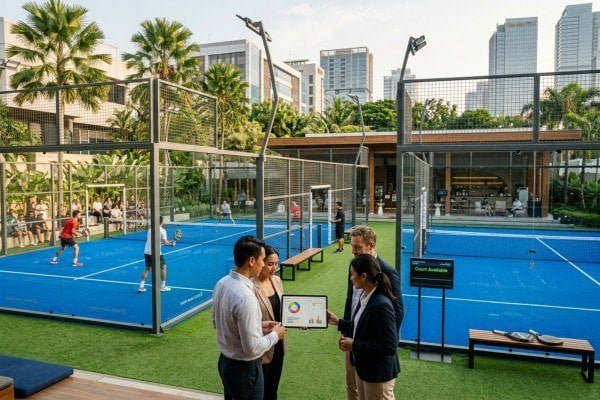
Visibility Is Not the Same as Utilization
I distinguish several indicators that are often grouped together:
- Social-media visibility shows awareness and curiosity.
- Venue openings show investor activity and access to capital.
- Trial bookings show initial customer interest.
- Repeat bookings show whether players are forming a habit.
- Peak-hour occupancy1 shows demand during convenient periods.
- Off-peak occupancy affects whether total revenue can cover fixed costs.
- Membership renewal gives stronger evidence of customer retention.
- Profitable operation requires revenue to exceed rent, payroll, maintenance, finance, and other expenses.
A club can look busy at 7 p.m. while its courts remain mostly empty during the day. That difference matters because operators pay for the site, staff, lighting, and maintenance throughout the week.
I also avoid repeating dramatic court-count claims unless the source provides a date, definition, and geographic scope. A count may include proposed courts, courts under construction, private residential courts, temporary facilities, or venues that are no longer operating. Those categories do not provide the same evidence of paid commercial demand.
What We See From the Supplier Side
QHPADEL has direct exposure to Indonesian inquiries, orders, shipment discussions, and local buyer feedback. In our conversations, buyers increasingly ask about more than the court price. They ask about:
- The complete bill of materials
- Shipping and container planning
- Foundation requirements
- Installation responsibilities
- Replacement glass availability
- Turf specifications and maintenance
- Local competition
- Spare parts and after-sales support
I view this change as a sign that buyers are becoming more careful. If supplier inquiries or orders soften during 2026, I would not describe that pattern as proof of nationwide decline. It could reflect normalization after rapid expansion, delayed financing, local oversupply, exchange-rate movements, project seasonality, or buyers taking more time to assess sites.
I treat manufacturer-side demand as one piece of evidence, not a substitute for independent Indonesian market research.
Has Historical Growth Made Padel in Indonesia Saturated?
Rapid development during 2024 and 2025 may encourage two opposite mistakes. Some investors assume that growth will continue everywhere, while others assume that every attractive district is already saturated. I find that both conclusions ignore the local nature of a padel catchment area.
Historical growth does not prove that padel in Indonesia is saturated in 2026. Saturation must be tested at city and district level. A crowded premium neighborhood may offer little room for another club, while an underserved city, hotel, residential development, school, or mixed-use property may still support a carefully designed project.
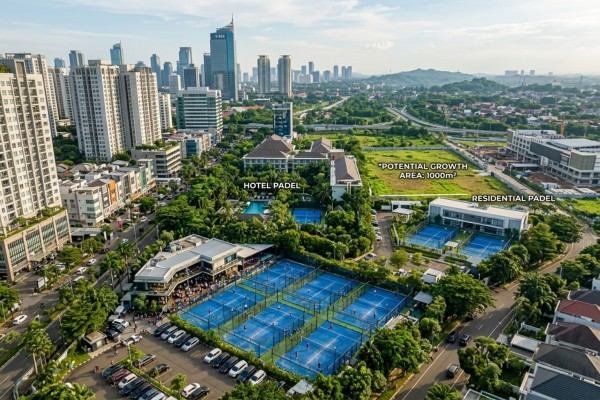
Indonesia Is Not One Uniform Market
Indonesia contains very different urban, tourism, and regional markets.2 A customer in a dense part of Jakarta may have several nearby venue choices. A customer in another city may need to travel a long distance to find a suitable court. Those conditions create different pricing power, booking behavior, and development risks.
I recommend mapping competitors within realistic travel times rather than using only administrative boundaries. Depending on congestion and local transport patterns, a five-kilometer journey may be convenient in one area and impractical in another.3
A useful competitor map should record:
| Indicator | What to Check | Why It Matters |
|---|---|---|
| Operating courts | Courts currently open and bookable | Proposed projects do not represent current supply |
| Courts under construction | Expected opening date and project credibility | Future supply can change the opportunity |
| Peak booking availability | Evenings and weekends | Limited availability may indicate unmet demand |
| Off-peak bookings | Weekday mornings and afternoons | Weak utilization can limit total revenue |
| Hourly price | Standard, peak, and promotional rates | Discounts may hide competitive pressure |
| Customer segment | Members, tourists, corporate groups, schools | Different segments have different retention patterns |
| Venue quality | Roof, drainage, lighting, parking, amenities | Customers compare the full experience |
| Travel time | Actual journey during busy periods | Convenience strongly influences repeat play |
Crowded and Attractive Can Exist Together
A district can have many active players and still be unattractive for a new operator. High demand often attracts more competitors, raises suitable land rents, and increases customer expectations. New clubs may need better parking, covered courts, coaching, leagues, food and beverage service, or a stronger community program to compete.
The reverse can also be true. A less visible city may have fewer existing players, but it may offer lower property costs and less direct competition. That opportunity still requires validation because limited supply does not automatically mean hidden demand.
I would therefore avoid both “Indonesia is still booming” and “Indonesia is saturated” as investment conclusions. Those statements are too broad. I would replace them with a measurable question: Can this site attract enough paying customers repeatedly, at prices that support the complete operating model?
How Should Investors Validate Demand for Padel in Indonesia?
A polished feasibility report can still fail if it relies on follower counts, one busy competitor, or informal enthusiasm. I prefer evidence that reflects actual customer behavior. Investors can reduce uncertainty by combining booking observations, player interviews, price tests, and small-scale pre-launch activity.
Investors should validate demand for padel in Indonesia by measuring nearby court supply, peak and off-peak availability, repeat playing frequency, customer travel time, acceptable hourly pricing, membership interest, and pre-opening commitments. They should collect evidence over several weeks instead of relying on one visit, opening-week demand, or social-media engagement.
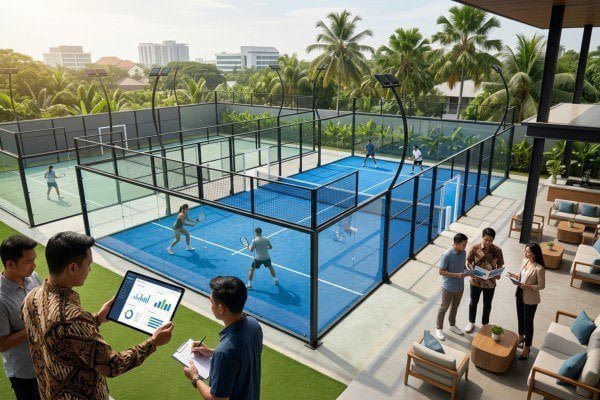
Use a Practical City-Level Demand Test
I suggest following a structured process before signing a long lease or ordering equipment.
-
Define the catchment area.
Investors should estimate how far target customers will travel during normal and peak traffic. They should distinguish residents, office workers, tourists, hotel guests, students, and corporate groups. -
Audit existing venues.
Buyers should record court numbers, prices, amenities, booking rules, coaching programs, events, and opening hours. -
Check real booking availability.
Investors should review public booking calendars at different times and on multiple days. A single fully booked Saturday evening does not establish weekly utilization. -
Interview likely customers.
Developers should ask how often people currently play, where they play, what they pay, and why they would switch venues. -
Test willingness to pay.
A survey answer can be optimistic. Paid deposits, founding memberships, corporate reservations, or pre-opening league registrations provide stronger evidence.4 -
Estimate repeat behavior.
One-time trial players have a different value from customers who play weekly and renew memberships.5 -
Model conservative utilization.
The financial model should include slower months, maintenance closures, promotions, weather effects, and a gradual launch.
Measure the Right Utilization Numbers
Monthly booking totals alone can hide risk. I recommend dividing available court hours into several categories:
- Weekday morning
- Weekday afternoon
- Weekday evening
- Weekend morning
- Weekend afternoon
- Weekend evening
For example, a four-court venue operating 16 hours per day has 64 available court-hours daily. Over 30 days, that venue has 1,920 potential court-hours before closures or maintenance. Investors should estimate how many hours can realistically be sold in each time band and at what net price after discounts.
I do not recommend using a universal utilization target because rent, staffing, financing, and pricing vary by location. The break-even point must come from the project’s verified cost model.
Look for Repeatable Demand
I consider repeat play more important than opening-month excitement. Useful evidence can include:
- Percentage of customers returning within 30 days
- Average sessions per active player
- Membership renewal rate
- League participation
- Coaching package renewals
- Corporate booking frequency
- Customer acquisition cost
- Cancellations and no-shows
A hotel may justify a court partly through guest experience rather than direct court revenue. A residential developer may use a court as a property amenity. A public institution may focus on access and participation. Each buyer should define success before choosing a configuration.
What Does an Indonesian Padel Court Project Really Cost?
An equipment quotation can appear manageable while the complete project remains underfunded. Problems often emerge after buyers add foundations, freight, customs, lifting equipment, labor, electrical work, drainage, and local approvals. I encourage buyers to compare total installed and operational cost, not only the factory price.
A realistic Indonesian padel court budget should include equipment, optional customization, export packing, freight, insurance, duties and taxes, port charges, inland transport, foundations, drainage, installation labor, lifting equipment, electrical connections, permits, professional engineering, maintenance, spare parts, and replacement materials. Site rent and operating expenses must be modeled separately.
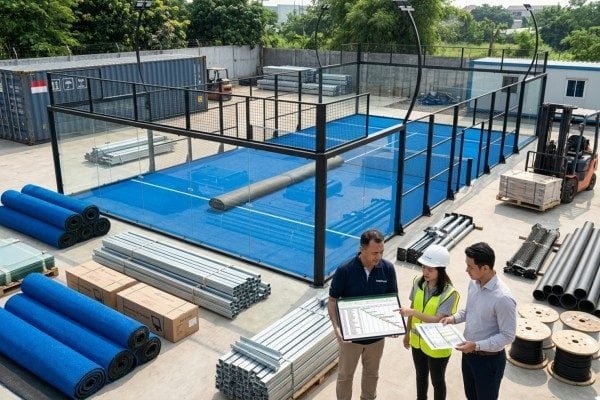
Build a Complete Cost Schedule
I use the following categories when discussing landed-cost planning with buyers:
| Cost Category | Typical Items to Include | Common Procurement Risk |
|---|---|---|
| Court equipment | Steel frame, glass, turf, lights, net and fasteners | Incomplete scope or unclear specifications |
| Export preparation | Packing, loading and documentation | Damage from unsuitable packing |
| International logistics | Ocean freight, insurance and surcharges | Freight changes and route delays |
| Import costs | Duties, taxes, clearance and port fees | Incorrect classification or missing documents |
| Local transport | Trucking, unloading and storage | Restricted access or delayed site readiness |
| Civil works | Slab, foundations, drainage and embedded items | Incorrect tolerances or poor drainage |
| Installation | Labor, crane or lift, tools and supervision | Responsibility gaps between parties |
| Utilities | Cabling, distribution board and lighting connection | Local electrical noncompliance |
| Professional services | Engineer, architect, permits and inspections | Late design changes |
| Operations | Staff, software, marketing, cleaning and utilities | Overly optimistic monthly forecasts |
| Lifecycle costs | Turf care, light replacement, glass and hardware | No local spare-parts plan |
The project owner should obtain advice from an Indonesian customs specialist, licensed structural professional, electrical professional, and local authority where required. A foreign supplier can provide drawings and product documents, but it should not replace local professional approval.
Match Configuration to the Site
A panoramic court may support spectator visibility and a premium customer experience. An ultra-panoramic design may further reduce visual obstruction. However, the most visually impressive option is not automatically the best commercial choice.
Buyers should consider:
- Indoor, covered, or outdoor installation
- Local wind and rain exposure
- Drainage conditions
- Corrosion protection
- Playing-area orientation
- Lighting spill and neighborhood impact
- Ceiling or roof clearance
- Access for unloading glass
- Future replacement access
- Required spectator visibility
For exposed or unusual sites, I recommend a project-specific structural assessment. Buyers should provide wind, foundation, soil, and site information to qualified engineers. They should not assume that a standard court configuration is suitable for every Indonesian location.
I also recommend keeping contingency funds. I would not assign one universal percentage because project maturity and site conditions differ, but the budget should acknowledge design changes, logistics delays, damaged components, and unexpected civil work.
How Can Buyers Procure Padel Courts for Indonesia With Less Risk?
Strong demand cannot rescue a project that arrives late, lacks essential fasteners, or cannot be installed on the prepared foundation. Procurement quality affects opening dates and long-term maintenance. I advise buyers to evaluate the complete delivery system rather than selecting a supplier through price and product images alone.
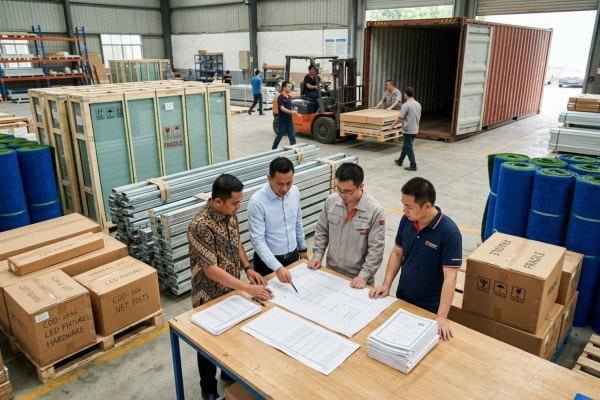
Buyers can reduce padel court procurement risk by defining the complete bill of materials, checking drawings before production, confirming local design requirements, verifying certificates and test reports, inspecting manufacturing quality, planning container loading, assigning installation responsibilities, and ordering critical spare parts. Contracts should clearly address defects, shortages, damage, and replacement timelines.
Evaluate the Supplier’s Technical Package
A useful quotation should identify more than the model name. I recommend checking:
- Steel grades, dimensions, and surface treatment
- Tempered glass thickness, size, edge finish, and drilling
- Artificial turf color, pile specification, Dtex, and density
- Lighting quantity, power, beam arrangement, and documentation
- Mesh and structural component dimensions
- Fastener grades and quantities
- Net and accessory specifications
- Packing method and package numbering
- Installation and foundation drawings
- Exclusions and buyer-supplied items
- Warranty scope and claim procedure
At QHPADEL, our complete packages can include artificial turf, welded frame netting, structural posts, tempered glass, lighting fixtures, nets, and accessories. We also provide installation drawings, foundation drawings, packing lists, and maintenance manuals. Buyers should still compare every offered bill of materials against their contract and local project requirements.
Verify Documents Rather Than Accepting Logos
QHPADEL reports an ISO 9001-certified factory and product documentation covering various CE and AS/NZS standards for components such as turf, frames, glass, lighting, screws, and accessories. However, I recommend that every buyer request and verify the actual certificates and reports relevant to the ordered product.
Buyers should check:
- Certificate holder and manufacturer name
- Product model covered
- Issuing or testing organization
- Standard number and edition
- Issue and expiry dates, where applicable
- Report scope and test conditions
- Authenticity through the issuing body when possible
- Acceptance by Indonesian authorities or project consultants
A document for one component does not automatically certify the complete installed facility.6 Local structural, electrical, fire, accessibility, planning, and building requirements may still apply.7
Control Production and Delivery
I recommend setting inspection points before shipment. An inspection plan can include material verification, hole-position checks, welding inspection, coating thickness checks, glass marking review, lighting function tests, package counts, and loading photographs.
Spare-parts planning also deserves early attention. Replacement glass can be difficult and expensive to transport urgently. Buyers should evaluate whether to order spare glass, additional turf material, lights, fasteners, net components, and touch-up coating with the initial shipment.
Our standard production information indicates approximately 20 days for two courts, 20–25 days for four courts, and no more than 30 days for larger standard orders. Custom styles can take up to 35 days. These are factory production ranges, not guaranteed total project timelines. Buyers must also allow for design approval, payment, inspection, shipping, customs, inland transport, civil works, and installation.
Frequently Asked Questions
Is padel popular in Indonesia?
Yes, padel has achieved strong visibility and commercial interest in Indonesia, especially in major cities, tourism destinations, and higher-income communities. However, popularity should be verified locally through booking data, repeat participation, venue density, and price acceptance. National attention does not guarantee success for every site.
Is Indonesia’s padel market saturated?
I would not describe the entire country as saturated without current and reliable city-level evidence. Some districts may already have intense competition, while other locations may remain underserved. Investors should map existing and planned courts, assess booking availability, and evaluate local customer demand before making that judgment.
How many padel courts are there in Indonesia?
Court counts change quickly, and published figures may use different definitions. Some sources may include planned, private, temporary, or non-operating courts. I recommend checking the source date, geographic coverage, and counting method before using any figure in an investment decision.
How much does it cost to open a padel club in Indonesia?
The cost depends on land or rent, court quantity, court design, foundations, roofing, drainage, freight, import charges, installation, permits, amenities, staffing, and marketing. A factory quotation covers only part of the investment. Buyers need local contractor quotations and professional advice to create a credible budget.
Which padel court design is best for Indonesia?
The best design depends on the site, customer positioning, weather exposure, structural requirements, maintenance plan, and budget. Panoramic courts often suit commercial clubs, while covered or specially engineered structures may suit exposed locations. A qualified local engineer should evaluate application-specific structural and foundation requirements.
Conclusion
Padel in Indonesia is clearly significant, but national popularity is not the same as a bankable site. I recommend testing city-level supply, booking utilization, repeat demand, customer pricing, total installed cost, and delivery risk before investing. Buyers should also verify technical documents and obtain qualified local structural, electrical, customs, and compliance advice.
If you are evaluating an Indonesian court project, contact Alice Chen at QHPADEL through alice@grass-supplier.com or WhatsApp +86 185 7566 0746 to request a court configuration, bill of materials, production plan, and shipping discussion.
-
"Indoor Sport Facility Feasibility Study", https://digitalcommons.georgiasouthern.edu/cgi/viewcontent.cgi?article=1086&context=amtp-proceedings_2018. Time-specific occupancy measures are commonly used in recreation-facility analysis because aggregate attendance can obscure substantial differences between peak and off-peak demand. Evidence role: general_support; source type: research. Supports: Research or facility-management guidance should support the use of time-specific occupancy data to assess demand for recreation facilities.. Scope note: This supports the measurement approach generally and does not establish utilization at any particular Indonesian padel venue. ↩
-
"Indonesia | World Bank Group", https://www.worldbank.org/ext/en/country/indonesia. International assessments describe Indonesia as a large archipelagic country with substantial differences among its regions in population concentration, urban development, tourism activity, and economic conditions. Evidence role: historical_context; source type: institution. Supports: An international institution should document Indonesia’s geographic scale, regional diversity, urbanization, and uneven economic development.. Scope note: National and regional indicators provide context and do not by themselves demonstrate demand for padel in a specific locality. ↩
-
"Project Information Document (PID)", https://documents1.worldbank.org/curated/en/099400101242216348/pdf/Project0Inform0t0Project000P169548.pdf. Transport-accessibility research generally measures access in travel time because congestion, network structure, and travel mode can make equal distances correspond to materially different journeys. Evidence role: mechanism; source type: research. Supports: Transport research should support the use of travel time rather than straight-line distance as an accessibility measure.. Scope note: The statement does not establish a universal travel-time threshold for padel customers or for any Indonesian city. ↩
-
"Revealed versus Stated Preferences: What Have We …", https://www.journals.uchicago.edu/doi/10.1093/reep/rez010. Research on stated and revealed preferences cautions that survey intentions may differ from actual purchasing behavior; deposits and paid reservations provide a more behaviorally committed signal of willingness to pay. Evidence role: mechanism; source type: paper. Supports: Behavioral and economic research should support the distinction between stated intentions and actions involving financial commitment.. Scope note: Pre-opening commitments can still be refundable, promotional, or unrepresentative of sustained post-opening demand. ↩
-
"Customer Lifetime Value: What It Is and Why It Matters – Wharton", https://executiveeducation.wharton.upenn.edu/thought-leadership/wharton-online-insights/why-customer-lifetime-value-matters/. Customer-lifetime-value research treats repeated purchasing and retention as central determinants of the economic value of a customer, distinguishing recurring users from one-time users. Evidence role: mechanism; source type: research. Supports: Marketing research should support the role of repeat purchasing and retention in customer lifetime value.. Scope note: The relative value of a weekly player depends on acquisition cost, pricing, capacity constraints, and the venue’s ancillary revenue model. ↩
-
"Building Codes, Standards, and Regulations: Frequently …", https://www.congress.gov/crs-product/R47665. Conformity-assessment practice distinguishes evidence for an individual product or component from evidence that an assembled system or completed installation meets all applicable requirements. Evidence role: definition; source type: institution. Supports: Conformity-assessment guidance should distinguish certification or testing of a product component from compliance assessment of an assembled installation.. Scope note: Which approvals are required depends on the applicable Indonesian rules, the project type, and the responsible local authority or professional. ↩
-
"Applying Indonesia Regulation on Fire Protection System …", https://www.academia.edu/108237965/Applying_Indonesia_Regulation_on_Fire_Protection_System_at_WTC_1_Building_in_Jakarta_through_Fire_Risk_Assessment_FRA_. Official building-regulation frameworks in Indonesia provide for compliance with applicable planning and technical requirements, which may include structural safety, utilities, fire safety, accessibility, and local approval conditions for a completed project. Evidence role: general_support; source type: government. Supports: Official Indonesian building-regulation materials should show that completed projects can be subject to multiple technical and planning requirements.. Scope note: Applicability and enforcement are project- and jurisdiction-specific; this does not determine the requirements for a particular padel installation. ↩