Padel popularity by country can look simple until an investor compares conflicting player totals, court databases, and social media trends. That confusion can lead to an oversupplied location or an unsuitable court package. I recommend comparing market maturity, local utilization, competition, procurement conditions, and city-level feasibility before choosing where to build or expand.
Padel popularity by country varies according to the metric used. Spain and Argentina are generally treated as mature padel markets1, while several European, Middle Eastern, and American markets show different stages of growth. However, national popularity does not prove local investment potential. Buyers should verify city-level court supply, booking activity, competition, regulation, and project costs.
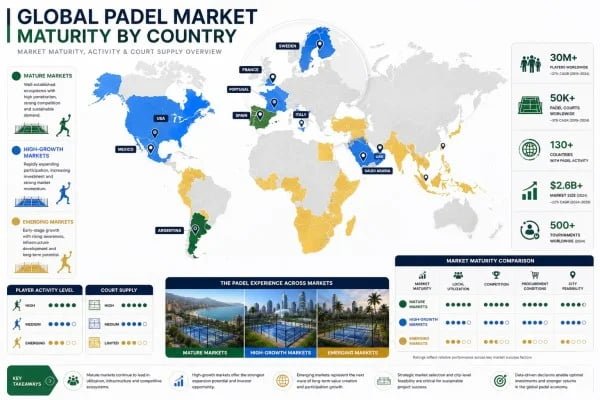
I see country-level interest as a useful filter, not a final investment answer. Our inquiries and export destinations reveal procurement patterns, but they do not measure national market share. I therefore cross-check commercial observations with federation reports, court databases, search data, and local due diligence before drawing conclusions.
How Should Buyers Compare Padel Popularity by Country?
A country may have many courts but weak utilization in a particular city. Another country may have relatively few facilities but strong waiting lists and limited supply. If I compare only national totals, I risk mistaking visible scale for unmet demand and overlooking the factors that determine whether a new club can attract repeat players.
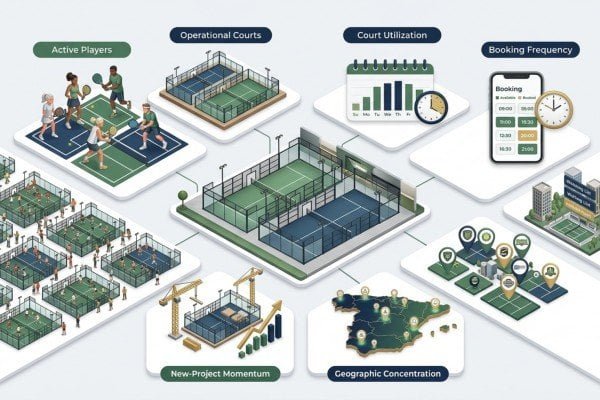
Buyers should compare padel popularity by country through several indicators: active players, operational courts, court utilization, booking frequency, new-project momentum, geographic concentration, and local competition. Each indicator measures something different. No single number proves that a country—or a specific city—offers a sustainable opportunity for a new padel facility.
Popularity and commercial opportunity are different
I separate popularity from opportunity at the start of every market review. Popularity describes participation, awareness, or existing infrastructure. Opportunity describes whether a buyer can serve demand at a workable cost and acceptable risk.
The following indicators should not be treated as interchangeable:
| Indicator | What it may show | What it does not prove |
|---|---|---|
| Registered players | Formal participation through a federation | Total casual participation or club profitability |
| Estimated active players | Broader participation beyond federation members | Reliable spending or booking frequency |
| Installed courts | Existing infrastructure and market scale | Utilization, maintenance quality, or unmet demand |
| Search interest2 | Public curiosity or growing awareness | Willingness to pay for regular bookings |
| Social media activity | Visibility and cultural momentum | Sustainable local demand |
| Tournament activity | Competitive ecosystem development | Commercial viability in every city |
| New court projects | Investor confidence and construction momentum | Whether future supply will exceed demand |
| Booking data | Actual usage within covered clubs | The whole market if the platform has limited coverage |
A national court count can also hide geographic concentration.3 For example, a large percentage of a country’s facilities may sit within a few metropolitan areas or tourist regions. A national average then says little about a secondary city.
I use a layered evaluation process
I normally advise buyers to review four layers:
-
National awareness
I check federation activity, tournament visibility, media coverage, and general search interest. -
Regional infrastructure
I look at where courts are concentrated, whether facilities are indoor or outdoor, and whether access differs by region. -
City-level utilization
I examine peak-time availability, membership plans, pricing, waiting lists, and the number of competing clubs within a realistic travel radius. -
Project feasibility
I review land, building suitability, planning requirements, climate, drainage, lighting restrictions, logistics, and installation capacity.
I treat country data as a screening tool. I treat city data as the basis for a commercial decision.
In my export work, inquiries from less-developed markets often focus on education, installation scope, and complete bills of materials. Buyers in more established markets tend to ask detailed questions about structural options, turf specifications, replacement parts, lead times, and design differentiation. These are bounded commercial observations from our own inquiries. They should not be interpreted as national demand statistics.
Which Countries Represent Different Padel Popularity Market Stages?
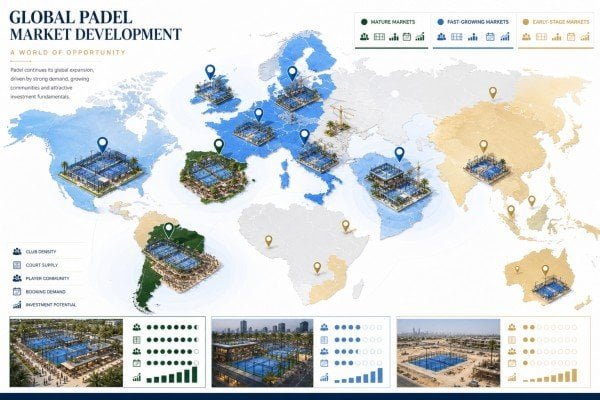
A simple global ranking creates false precision because sources use different definitions and update schedules. Some count courts, while others count clubs, players, bookings, or federation registrations. I prefer to group representative countries by market stage, then verify each classification against current and comparable sources before a buyer commits capital.
Representative markets can be grouped as mature, fast-growing, or early-stage. Spain and Argentina are commonly associated with established padel cultures. Markets such as Italy, France, the Netherlands, the United Kingdom, the United States, and parts of the Middle East may show different growth patterns. Every classification requires current, country-specific verification.
Mature markets
A mature market normally has several of the following characteristics:
- Widespread public awareness
- A large base of experienced players
- Established coaching and tournament systems
- Multiple court suppliers and installation contractors
- Competitive club pricing
- Experienced local operators
- Demand for replacement turf, lighting upgrades, and facility renovation
Spain and Argentina are often presented as reference markets because padel has deep participation and cultural recognition in both countries.4 However, I would still avoid calling either country the “best” market for a new club. Mature markets can offer dependable participation, but they can also have intense competition, higher customer expectations, and fewer underserved locations.
Portugal may share some mature-market characteristics in particular regions. Italy has also developed substantial infrastructure and organized participation.5 Yet national labels can become outdated quickly, so I would verify current conditions through the relevant federation, local club directories, booking platforms, and municipal records.
Fast-growing markets
Fast-growing markets often show:
- Rising public awareness
- Frequent new club announcements
- Increasing distributor and contractor activity
- Greater tournament visibility
- Growing demand for coaches
- Limited experienced installation capacity
- Uneven court distribution between cities
France, the Netherlands, Belgium, Germany, the United Kingdom, and selected Nordic markets frequently appear in European growth discussions. Mexico and the United States attract attention in North America6, while the United Arab Emirates, Saudi Arabia, Qatar, and Kuwait have contributed to padel’s visibility in the Middle East.7
These examples are illustrative rather than a current ranking. Buyers should verify their status with dated evidence. Some markets can move rapidly from shortage to oversupply, especially when many projects open within the same metropolitan area.
Sweden is a useful cautionary example. Public industry reporting has described a rapid expansion followed by financial pressure among some operators.8 I would not use that history to reject Sweden or any similar market. I would use it to show why court growth alone cannot confirm healthy utilization.
Early-stage markets
An early-stage market may have limited awareness, a small number of facilities, and little local installation experience. That situation can create a first-mover advantage, but it also increases risk.
Typical challenges include:
- Players need education and introductory programming.
- Banks and landlords may not understand the business model.
- Coaches may be difficult to recruit.
- Spare parts may take longer to source.
- Local contractors may lack padel-specific experience.
- Regulations may not clearly distinguish padel facilities from other sports buildings.
For importers, an early-stage market may offer distribution potential. For a club investor, the same market may require a larger marketing budget and a longer customer-development period.
I recommend checking the latest International Padel Federation resources, relevant national federations, and current industry reports such as the Global Padel Report from Playtomic and Strategy&. Buyers should read each source’s definitions, publication date, geographic coverage, and commercial limitations instead of copying headline figures.
What Does Padel Popularity by Country Mean for Different Buyers?
Padel market data does not have the same meaning for every decision-maker. A club operator needs evidence of repeat bookings, while a distributor needs enough project volume to support inventory. If I give both buyers the same national court chart, I may hide the commercial risks that matter most to each one.
Club operators should prioritize utilization and local competition. Importers should evaluate repeat project volume and product standardization. Contractors should examine technical documentation and installation capacity. Institutions should focus on procurement compliance, safety records, and lifecycle maintenance. Players may care more about court access, coaching, community, and booking affordability.

Club investors and operators
Club operators need to know whether people will book courts regularly at viable prices. National participation provides context, but a city-level study should include:
- Existing clubs within a practical drive-time area
- Number of courts at each competing facility
- Peak and off-peak availability
- Membership and pay-to-play prices
- Indoor versus outdoor supply
- Coaching and tournament programs
- Parking and public transport access
- Local population and target customer profile
- Seasonal weather and daylight conditions
- Announced projects that have not opened yet
I sometimes see buyers focus on a city where courts appear fully booked. That signal deserves attention, but it needs investigation. A booking calendar can look full because a club has only one or two courts, blocks time for coaching, or does not publish all available slots. I would speak with local players and operators before treating online availability as proof of unmet demand.
Distributors and importers
A distributor needs a repeatable product and a market large enough to justify sales support, samples, spare parts, and inventory. I would examine:
- Expected annual project pipeline
- Common court models and frame colors
- Local preferences for panoramic or classic designs
- Import duties and customs procedures
- Container economics
- Local installation partners
- Replacement-part demand
- Competitor pricing and warranty terms
- OEM labeling requirements
A popular player market does not automatically support a new distributor. Existing suppliers may already have strong relationships and local stock. In contrast, a smaller growing market may offer a clearer supply gap.
Engineering and civil contractors
Contractors face different risks. They need accurate drawings, defined tolerances, complete fastener packages, and clear responsibility boundaries.
Before a contractor orders a system, I recommend confirming:
- Foundation and anchor design responsibility
- Local wind, snow, seismic, and drainage requirements
- Court orientation and site levels
- Structural calculations required by local authorities
- Glass handling and installation procedures
- Electrical design and lighting compliance
- Component numbering and packing-list detail
- Replacement procedures for damaged or missing parts
Manufacturers can provide product documents, but a qualified local engineer should evaluate the site and applicable codes.
Public institutions
Schools, universities, and government buyers often need traceable procurement documents. They may request certificates, test reports, warranties, material specifications, and tender response schedules.
I advise institutional buyers to verify certificates directly, confirm that each document applies to the offered model, and check whether the issuing laboratory or certification body is accepted locally. A certificate logo in a catalog is not enough.
How Can Investors Validate Padel Popularity by Country at City Level?
National enthusiasm can hide weak local economics. A city may lack courts because demand is underserved, but it may also lack courts because land is expensive, planning is restrictive, or customer awareness is low. I use city-level validation to distinguish a credible supply gap from a market that simply appears empty.
Investors can validate a city by mapping existing and planned courts, reviewing booking patterns, interviewing players, testing price sensitivity, and estimating realistic drive-time demand. They should also examine property costs, planning rules, construction conditions, climate, and competitor pipelines. A feasibility study should combine public data with local professional advice.

Start with a local supply map
I would list every known club within several drive-time zones, such as 10, 20, and 30 minutes. The appropriate radius depends on traffic, population density, and local travel behavior.
For each facility, I would record:
- Operational court count
- Indoor or outdoor format
- Court condition
- Opening hours
- Membership structure
- Booking prices
- Peak-time availability
- Coaching services
- Food, beverage, gym, or retail facilities
- Customer reviews
- Announced expansion plans
The mapping process should distinguish between operational courts, courts under construction, and proposed projects. Press releases can exaggerate future supply if planning or financing is not complete.
Test demand rather than assuming it
A buyer can test interest before making a full construction commitment. Useful methods include:
- Running a geo-targeted waiting-list campaign
- Holding temporary demonstration events
- Surveying tennis, squash, and fitness members
- Interviewing local coaches and sports associations
- Testing corporate league interest
- Comparing weekday and weekend demand
- Asking potential customers about acceptable prices
Search data can support this work, but it has limitations. Google Trends provides relative search interest rather than absolute player numbers. Language differences can also distort comparisons. For example, users may search for local spellings, club names, or booking terms instead of the word “padel.”
Review the physical and regulatory constraints
A positive demand study does not guarantee a buildable project. Before ordering equipment, I recommend reviewing:
| Area | Questions to verify |
|---|---|
| Planning | Is sports use permitted at the site? |
| Structure | What wind, snow, and seismic loads apply? |
| Groundworks | Can the slab meet flatness and drainage requirements? |
| Lighting | Are there glare, curfew, or energy restrictions? |
| Noise | Will nearby residents or businesses be affected? |
| Access | Can trucks, cranes, and glass-handling equipment reach the site? |
| Climate | Is a roof, drainage upgrade, or corrosion protection needed? |
| Operations | Can the club recruit staff, coaches, and maintenance support? |
I recommend engaging local planning, engineering, legal, and financial professionals for application-specific decisions. A court manufacturer can explain system options and documentation, but it should not replace qualified local advice.
Evaluate suppliers after the market case is clear
Once the location passes initial feasibility checks, buyers can compare complete court systems. At QHPADEL, we commonly discuss the bill of materials, structural configuration, turf specifications, glass documentation, lighting, packaging, installation drawings, and spare parts. Our observations come from manufacturing and export projects rather than from operating clubs.
A supplier evaluation should include:
- Complete and itemized bill of materials
- Material grades and dimensions
- Welding and coating quality-control records
- Glass specifications and identification
- Turf Dtex, density, pile height, gauge, and backing
- Lighting photometric information
- Installation and foundation drawings
- Packaging method and component labels
- Production schedule
- Inspection process
- Warranty scope and exclusions
- Replacement-part lead times
Buyers should verify every certificate and test report against the exact supplied component. They should also obtain local engineering approval where required.
Frequently Asked Questions
Which country has the highest padel popularity?
Spain and Argentina are widely recognized for their established padel cultures, while other sources may highlight countries with large court networks or rapid growth. I avoid declaring one universal leader because player estimates, registrations, courts, bookings, and search interest use different methodologies. Buyers should consult dated, comparable sources.
Is a country with few padel courts a good investment opportunity?
Not necessarily. A low court count may indicate underserved demand, but it may also reflect low awareness, expensive property, planning barriers, or unsuitable climate conditions. I recommend testing city-level demand, target pricing, competing projects, and construction feasibility before treating limited supply as an opportunity.
How can I check whether local padel courts are busy?
I would review online booking calendars at several times, visit facilities, speak with players, and ask clubs about peak and off-peak use. Buyers should account for coaching blocks, private reservations, seasonal changes, and platform limitations. A short observation period may not represent typical annual utilization.
Are search trends reliable for comparing padel markets?
Search trends can show changes in relative interest, but they do not measure active players, booking revenue, or unmet demand. Language, media events, and low search volumes can distort comparisons. I use search data as one supporting signal alongside federation information, court mapping, booking activity, and local interviews.
What documents should I request from a padel court supplier?
I recommend requesting a complete bill of materials, technical specifications, foundation and installation drawings, packing lists, maintenance instructions, warranty terms, inspection records, and relevant certificates or test reports. Buyers should verify document validity and ask a qualified local engineer to evaluate structural and regulatory suitability.
Conclusion
Padel popularity by country is useful for identifying mature, growing, and early-stage markets, but it cannot identify the best investment location by itself. I recommend combining national indicators with city-level court mapping, utilization checks, customer research, project pipelines, and professional feasibility reviews. Buyers should also compare suppliers through technical documentation, manufacturing quality control, packing completeness, and verifiable compliance records. If you need a complete padel court quotation or technical documentation package, contact Alice Chen at QHPADEL via alice@grass-supplier.com or WhatsApp +86 185 7566 0746.
-
"History | Padel FIP", https://www.padelfip.com/history/. International Padel Federation and comparable market data document substantial participation and established competition and facility ecosystems in Spain and Argentina, supporting their characterization as comparatively mature padel markets. Evidence role: general_support; source type: institution. Supports: Comparable evidence that Spain and Argentina have longstanding, large-scale padel participation and infrastructure.. Scope note: Market maturity is an interpretive classification; aggregate national data do not establish conditions in every city. ↩
-
"Assessing the Methods, Tools, and Statistical Approaches in …", https://pmc.ncbi.nlm.nih.gov/articles/PMC6246971/. Studies using Google Trends describe its indices as relative measures of search activity; such measures can signal changing public attention but do not directly measure purchases, bookings, or willingness to pay. Evidence role: mechanism; source type: research. Supports: Evidence that online search measures relative information-seeking activity and is an imperfect proxy for realized demand or spending.. Scope note: Search behavior may still be informative when interpreted with local transaction and availability data. ↩
-
"Characteristics of the Spatial Location of Sports Facilities in …", https://pmc.ncbi.nlm.nih.gov/articles/PMC9608796/. Spatial research on sports facilities finds that national or regional totals can mask uneven metropolitan and local distributions, so aggregate court counts alone are insufficient indicators of access or supply in a particular city. Evidence role: general_support; source type: paper. Supports: Evidence that aggregate facility counts can mask uneven geographic distribution and differences in local access.. Scope note: General facility-distribution research does not quantify padel-court concentration in any specific country. ↩
-
"Padel", https://en.wikipedia.org/wiki/Padel. Historical accounts of padel describe its early development in Mexico and rapid adoption in Argentina and Spain, where the sport became widely embedded in recreational and competitive practice. Evidence role: historical_context; source type: encyclopedia. Supports: Historical context on padel’s development and widespread adoption in Argentina and Spain.. Scope note: Historical prominence does not by itself demonstrate present-day profitability or unmet court demand. ↩
-
"Injuries in non-professional padel tennis players. Results of …", https://pubmed.ncbi.nlm.nih.gov/36416276/. Italian federation statistics reporting padel clubs, facilities, tournaments, or registered participants provide evidence of organized participation and a developed national infrastructure. Evidence role: statistic; source type: institution. Supports: Dated federation or institutional statistics on Italian padel clubs, courts, competitions, or registered participants.. Scope note: The source date and its definition of courts, clubs, and registered participants should be reported because these measures are not interchangeable. ↩
-
"International Padel Federation – Wikipedia", https://en.wikipedia.org/wiki/International_Padel_Federation. Federation and institutional reporting on North American padel documents organized activity and facility development in Mexico and the United States, supporting their relevance in regional market discussions. Evidence role: general_support; source type: institution. Supports: Evidence of padel organizational development, events, facilities, or participation in Mexico and the United States.. Scope note: Evidence of national development does not establish comparable market size, growth rates, or investment conditions between the two countries. ↩
-
"FIP ASIA PADEL CUP 2025", https://www.padelfip.com/events/fip-asia-padel-cup-2025/. International federation calendars and national-association activity record padel events and organizational development in the United Arab Emirates, Saudi Arabia, Qatar, and Kuwait, indicating an increased regional profile for the sport. Evidence role: case_reference; source type: institution. Supports: Documented federation events, national associations, or facility initiatives involving the named Middle Eastern countries.. Scope note: Tournament and federation visibility are not direct measures of broad local participation or club utilization. ↩
-
"What Happened to Padel in Sweden? Rise, Boom and …", https://www.padelfast.com/blog/what-happened-to-padel-in-sweden. Contemporary analyses of Sweden’s padel sector describe rapid facility expansion followed by financial stress and insolvency among some operators, illustrating that court growth can outpace sustainable local economics. Evidence role: case_reference; source type: research. Supports: Dated evidence of rapid court expansion in Sweden and subsequent financial difficulties reported among part of the operator market.. Scope note: Operator outcomes varied, and the case should not be generalized to all Swedish facilities or other national markets. ↩