Padel in Pakistan is attracting attention, but investors can easily mistake early curiosity for proven demand. That mistake can lead to underused courts and unexpected project costs. I recommend treating popularity as a city-level business question, supported by paying-player research, utilization forecasts, competitor checks, and complete landed-cost estimates.
Padel is becoming more commercially visible in Pakistan, especially among investors, contractors, and importers exploring new sports facilities. However, available interest does not prove that it is already a nationwide mainstream sport. Investors should validate demand in each target city, forecast paid court usage, and calculate the complete project cost before committing capital.
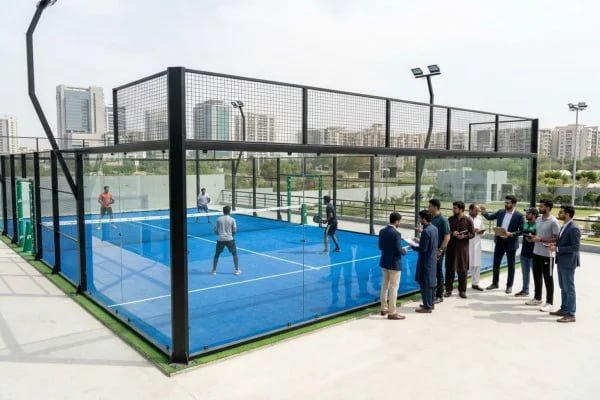
In my experience as a complete padel court supplier, Pakistani inquiries have progressed beyond simple price questions in some cases. Buyers have requested configuration comparisons, installation drawings, and shipping plans. Those actions suggest serious project evaluation, but they still do not establish national participation levels or guarantee club profitability.
How Popular Is Padel in Pakistan Today?
The main problem is that “popular” can mean several different things. A sport may receive social media attention without producing regular bookings.1 I therefore separate online visibility, investor interest, installed facilities, active players, and sustained paid utilization before I describe padel in Pakistan as commercially established.
Padel in Pakistan appears to be an emerging urban sports opportunity rather than a proven nationwide mainstream activity. Repeated supplier inquiries and interest in new courts are positive early signals. However, investors still need current city-level evidence, including active venues, booking frequency, repeat players, pricing acceptance, and peak versus off-peak court utilization.
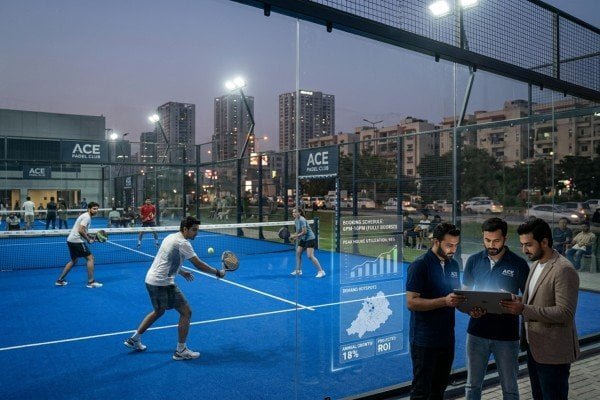
I Separate Attention From Participation
I often see three claims used to support a padel investment:
- Pakistan has a large population.
- Padel is growing quickly in other countries.
- Videos and club announcements receive social engagement.
These points can support a market hypothesis, but they do not prove paying demand. A large population does not show how many people live within a practical travel radius of a proposed club.2 Global growth does not guarantee that local consumers will accept the same booking price. Social engagement also does not show how often players return after their first session.
I use a stricter evidence ladder when evaluating a local padel market:
| Evidence level | Example | What I think it demonstrates |
|---|---|---|
| Weak | Likes, shares, or general inquiries | Awareness or curiosity |
| Moderate | Waiting lists, trial events, or player groups | Potential local interest |
| Strong | Repeat bookings and recurring coaching sessions | Sustained participation |
| Very strong | High utilization across several months | Possible commercial depth |
| Best available | Several viable venues with repeat customers | A developing local ecosystem |
A new market can still be attractive before it reaches the final level. However, an investor should price that uncertainty into the project.
I Treat Supplier Inquiries as an Early Signal
QHPADEL has received repeated Pakistani inquiries involving court types, quotations, foundation requirements, shipping, customs planning, and delivery arrangements. I view these inquiries as evidence that some buyers are moving from curiosity toward feasibility analysis.
However, I do not treat those conversations as proof of nationwide popularity. I also do not assume that every inquiry became an order. Buyers frequently compare suppliers, test budgets, approach potential partners, or pause a project while assessing land and financing.
I regard a detailed inquiry as evidence of project intent, not evidence of player demand.
Anyone researching the number of courts, clubs, or active players should verify current figures through dated local sources. Facility openings and closures can change the picture quickly. A current market check should include direct calls to venues, booking-platform reviews, site visits, and interviews with coaches or player communities.
What Signals Show Genuine Demand for Padel in Pakistan?
A basic equipment-price request tells me very little about the strength of a project. A detailed request provides more useful information, but it still measures buyer seriousness rather than customer demand. I look for both procurement maturity and local market evidence before I consider a proposed facility credible.
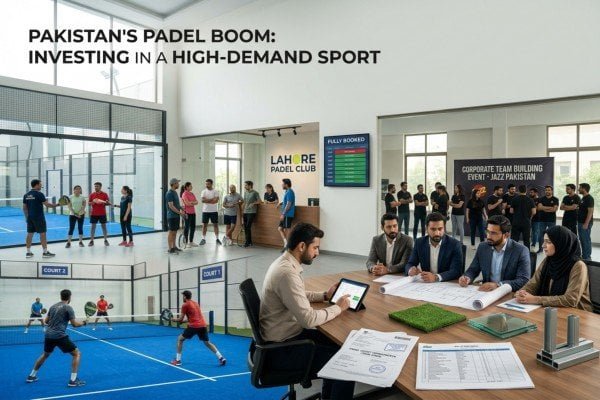
Strong demand signals for padel in Pakistan include repeat paid bookings, organized player groups, coaching demand, corporate events, waiting times during peak hours, and customers who accept realistic prices. Strong project-intent signals include requests for court comparisons, foundation drawings, installation plans, complete bills of materials, freight calculations, and customs documentation.
I Classify Inquiries by Purchase Intent
Prospective buyers usually move through several procurement stages. The exact journey varies, but I commonly see the following pattern:
- General curiosity: The buyer asks for a catalogue or a basic court price.
- Configuration comparison: The buyer compares panoramic, ultra-panoramic, classic, roofed, or custom designs.
- Site assessment: The buyer shares dimensions, site photographs, or a preliminary layout.
- Technical planning: The buyer requests foundation and installation drawings.
- Landed-cost analysis: The buyer asks about packing, container loading, freight, customs, and local delivery.
- Execution planning: The buyer discusses production time, payment, installation responsibility, and spare parts.
The later stages indicate stronger purchase intent because the buyer is investing time in the practical details. Even so, I would not use an advanced equipment inquiry as a substitute for customer research.
I Look for Evidence That Players Will Pay
An investor should ask local players more than whether they “like” padel. I recommend asking questions tied to actual behavior:
- How many times would the player book each month?
- What booking price would the player accept?
- Would the player travel 15, 30, or 45 minutes?
- Would the player book during weekday mornings or only after work?
- Does the player need racket rental, coaching, or organized matchmaking?
- Would a membership change the player’s booking frequency?
- Has the player already paid to use a comparable sports facility?
I prefer small paid trials over large free events. Free sessions can overstate demand because they remove the main purchase barrier.3
For example, an investor could rent a temporary venue, organize introductory sessions, and collect deposits for future bookings. The investor could then measure:
- Registration-to-attendance rate
- Trial-to-second-booking conversion
- Average accepted price
- Repeat booking frequency
- Preferred time slots
- Demand for coaching and equipment rental
I Build a Demand Scorecard
I use a simple scorecard to prevent enthusiasm from replacing evidence:
| Market factor | Weak signal | Stronger signal |
|---|---|---|
| Player interest | Survey responses | Paid advance bookings |
| Retention | One trial session | Several repeat sessions |
| Price acceptance | Hypothetical answer | Payment or deposit |
| Community | Social followers | Active weekly player group |
| Venue demand | General comments | Documented waiting periods |
| Corporate demand | Informal interest | Scheduled paid events |
This framework does not produce a guaranteed forecast. It helps an investor distinguish a promising concept from a project supported by measurable behavior.
Which Cities Offer the Best Potential for Padel in Pakistan?
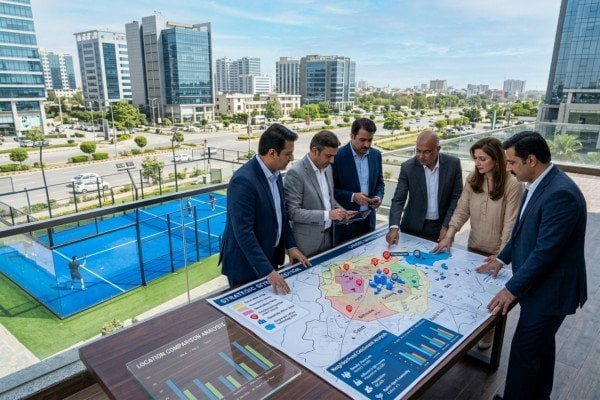
Pakistan’s population size can make a national market look attractive on paper. However, padel facilities depend on local catchment areas. I would not select a city based only on total population. I would compare neighborhoods, travel times, spending capacity, competing venues, land access, and the depth of suitable players.
The best potential for padel in Pakistan is likely to exist in urban catchments with sufficient spending power, accessible locations, active racket-sport communities, corporate customers, and limited but visible competition. Investors should compare specific districts rather than rank cities only by population, because a well-positioned local site can matter more than national market size.
I Start With a Practical Catchment Area
A city can contain millions of residents while a sports club serves only a small section of them. Traffic, parking, security, work schedules, and road access can reduce the practical catchment area.
I recommend mapping the proposed site using several travel-time zones:
- 0–15 minutes: Likely core customers
- 15–30 minutes: Potential regular customers
- 30–45 minutes: Occasional visitors or event players
- More than 45 minutes: Customers who may need a special reason to visit
The exact boundaries will depend on local traffic and customer habits. An investor should test them through interviews and actual journeys at peak hours.
I Compare Neighborhoods With a Weighted Model
I would score each site against consistent criteria instead of relying on instinct.
| Evaluation factor | Example weighting |
|---|---|
| Reachable target customers | 25% |
| Disposable income and price acceptance | 20% |
| Rent or land cost | 15% |
| Road access and parking | 10% |
| Existing sports community | 10% |
| Competition and market education | 10% |
| Expansion potential | 5% |
| Construction and utility constraints | 5% |
These percentages are only a starting point. A hotel may give more weight to guest experience. A standalone club may prioritize repeat local players. A school or university may focus more on safety, procurement compliance, and student access.
I Examine Competition Carefully
Competition can create both risk and validation. No existing club may indicate an open market, but it may also mean that consumers have not been educated about the sport. Several busy courts can demonstrate demand, but they can also raise customer-acquisition costs.
I recommend that investors visit competing venues where possible. They should record:
- Published and actual booking prices
- Available and occupied time slots
- Weekday versus weekend activity
- Coaching schedules
- Membership structures
- Court condition and maintenance
- Parking and supporting amenities
- Customer reviews and recurring complaints
A single busy evening does not prove full-week utilization. The investor should observe several periods and ask venue operators or players about seasonal changes.
I Test the Smallest Sensible Entry
If the evidence remains uncertain, a phased project can limit demand risk. However, the smallest project is not always the cheapest on a per-court basis. Shared costs such as shipping, site preparation, staffing, reception space, and utilities can make a very small facility inefficient.4
The investor should compare scenarios such as:
- A single demonstration court attached to an existing venue
- A two-court starter club
- A multi-court facility with coaching and events
- A court package inside a hotel, school, or residential project
Each model serves a different customer base. I recommend choosing the model only after testing booking demand and calculating all shared costs.
How Should Investors Forecast Padel Court Utilization in Pakistan?
New club forecasts often assume that courts will remain busy throughout the day. That assumption can create unrealistic revenue projections. I prefer to divide capacity into bookable hours, peak hours, off-peak hours, and unavailable time. I then test conservative, base, and optimistic utilization scenarios.
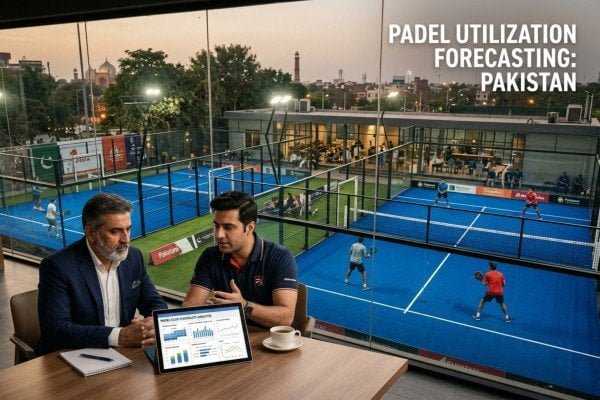
Investors should forecast padel court utilization by multiplying the number of courts by realistic bookable hours and expected occupancy for each time period. They should model peak and off-peak demand separately, include seasonal and operational downtime, and test whether revenue still covers costs under a conservative scenario.5
I Use Time-Slot Economics
A simple monthly capacity model is:
Monthly available court-hours = courts × bookable hours per day × operating days
A club with two courts and 12 bookable hours per day would have 24 available court-hours each day. However, the club should not assume that all 24 hours will sell. Morning, afternoon, and late-night demand can differ sharply from evening demand.6
I divide the schedule into bands:
| Time band | Typical planning issue |
|---|---|
| Early morning | Demand may depend on nearby residents or fitness groups |
| Working hours | Coaching, schools, and corporate bookings may be important |
| After work | Demand may be highest |
| Late evening | Noise, lighting, transport, or security can affect bookings |
| Weekends | Events and social groups may increase demand |
Investors should replace these assumptions with local research. Customer interviews, trial events, and competitor booking checks can reveal the most valuable periods.
I Run Three Scenarios
I normally recommend at least three operating cases:
- Conservative: Slow customer acquisition, weak off-peak demand, and occasional closures
- Base: Gradual repeat-player growth and reasonable peak-hour bookings
- Optimistic: Strong community development, coaching demand, and corporate events
The forecast should include more than court rental revenue. It can consider coaching, racket rental, tournaments, refreshments, sponsorships, and memberships. However, I would not use uncertain secondary income to rescue a weak core booking model.
The investor should also include recurring costs:
- Rent or land-related expenses
- Staff salaries
- Electricity and lighting
- Cleaning and turf maintenance
- Marketing
- Software and payment charges
- Insurance, where applicable
- Replacement parts
- Local taxes and professional fees
- Finance costs
I Test the Break-Even Utilization Rate
An investor can estimate the break-even number of sold court-hours:
Required sold court-hours = monthly fixed and variable costs ÷ average net revenue per sold court-hour
The average should use revenue after discounts, taxes, payment charges, and directly associated costs. The investor should also account for different prices across peak and off-peak periods.
I would be cautious if the project requires near-full peak utilization from the first month. New sports venues usually need time to educate customers, organize player groups, train staff, and build repeat usage. A cash reserve can be as important as the equipment budget.
What Does a Complete Padel Project in Pakistan Cost?
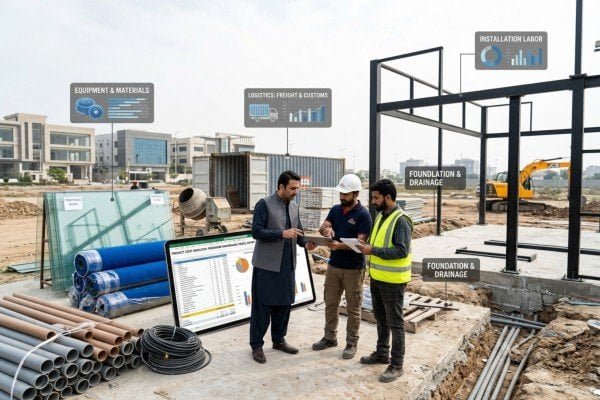
A low equipment quotation can look attractive while excluding major project expenses. Freight, customs, foundations, drainage, electrical work, installation, and local handling can materially change the budget. I therefore evaluate the total installed project rather than comparing only the factory price of a court package.
The complete cost of a padel project in Pakistan includes court equipment, export packaging, freight, insurance, customs-related charges, inland transport, foundations, drainage, electrical work, installation, professional review, and contingency. Buyers should obtain current quotations and confirm duties, taxes, import classification, and building requirements with qualified local professionals before approving a budget.
I Build a Total-Cost Checklist
I divide the budget into five groups.
1. Court Equipment
A complete equipment scope may include:
- Structural steel frames and posts
- Welded mesh panels
- Tempered glass
- Artificial turf
- LED lighting fixtures
- Court net and posts
- Fasteners and accessories
- Protective packaging
- Spare or wear-related parts
Buyers should confirm exactly what the supplier’s quotation includes. Similar-looking quotations may have different steel specifications, glass scopes, lighting quantities, turf characteristics, fastener packages, and commercial terms.
2. International Logistics
The logistics budget may include:
- Factory-to-port transport
- Export handling
- Ocean or other freight
- Cargo insurance
- Destination charges
- Container detention or storage risk
- Port-to-site transport
- Unloading equipment
Freight rates and destination charges change. I recommend obtaining dated estimates and checking the quotation’s Incoterm. Buyers should understand where the supplier’s responsibility ends.
3. Customs and Import Costs
A licensed customs broker should verify:
- Product classification
- Import documentation
- Duties and taxes
- Port procedures
- Inspection requirements
- Any applicable approvals or restrictions
I would not rely on an old shipment or an informal online estimate. Customs treatment can vary according to the goods, declared scope, origin, and current regulations.
4. Civil and Electrical Works
The equipment supplier does not control every site condition. The local project budget may need to cover:
- Survey and soil assessment
- Excavation and concrete
- Anchor or embedded-part preparation
- Surface tolerances
- Drainage
- Electrical cabling and distribution
- Lighting controls
- Access routes
- Fencing around the broader site
- Changing rooms or reception areas
A qualified local engineer should review the foundation design, structural loads, drainage, wind conditions, and applicable codes.
5. Installation and Contingency
The investor should define who handles unloading, assembly, glass installation, turf laying, electrical connections, testing, and final handover. The budget should also include contingency for site changes, delays, damage, or missing local materials.
When Pakistani prospects ask me for foundation drawings, packing lists, component details, and installation guidance, I see stronger planning discipline. These documents help the buyer identify costs that a simple court price cannot reveal.
How Should Buyers Select a Supplier for Padel in Pakistan?
The cheapest supplier does not always produce the lowest completed-project cost.7 Missing components, unclear drawings, poor packaging, inaccurate holes, or delayed replacements can interrupt installation. I advise buyers to evaluate the complete technical scope, documentation, quality-control process, production schedule, and after-sales responsibility before comparing final prices.
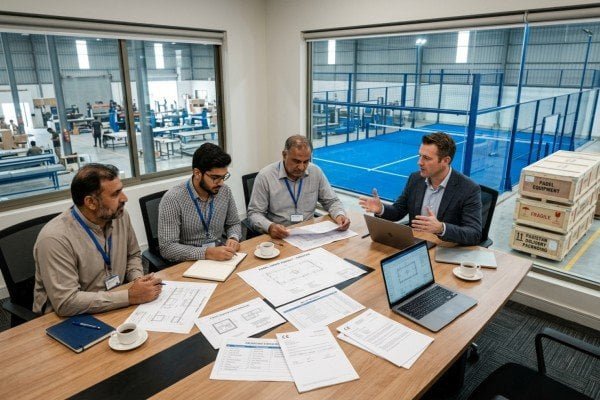
Buyers sourcing padel courts for Pakistan should compare suppliers by technical specifications, complete bills of materials, quality-control records, documentation, packaging, lead times, references, warranty terms, and replacement procedures. Buyers should verify all certificates and test reports, while local engineers should confirm whether the proposed structure and foundation suit the intended site.
I Request Comparable Quotations
I recommend sending each shortlisted supplier the same request for quotation. The request should define:
- Court model and quantity
- Indoor or outdoor application
- Proposed site dimensions
- Frame finish and color
- Turf color, Dtex, density, and other required characteristics
- Glass specifications
- Lighting quantity and specifications
- Wind or weather information
- Required documentation
- Spare-parts expectations
- Delivery location and preferred Incoterm
- Installation support requirements
A consistent specification makes price differences easier to interpret.
I Verify Documents Rather Than Accepting Logos
Certificates can support procurement, but a logo on a brochure is not enough. The buyer should ask for copies and verify:
- The named manufacturer or product
- The issuing body or laboratory
- Certificate number
- Standard and product scope
- Issue and expiry dates
- Relevant test values
- Whether the offered model matches the tested product
In QHPADEL’s supplied business context, the factory reports ISO 9001 certification. It also reports CE and other certificates or tests covering specified turf, steel, tempered glass, lighting, screws, and accessories. Buyers should request the current documents and confirm their relevance to the exact products being purchased. Local authorities or procurement consultants should decide whether the documents meet project requirements.
I Review Manufacturing and Delivery Capability
Production capacity matters, but buyers should connect capacity claims to a specific order schedule. QHPADEL reports ten production lines, monthly artificial-turf output above 1.5 million square metres, and capacity for 150 complete court systems per month. The company also reports annual exports above 600 containers.
For standard padel court orders, QHPADEL states that:
- Two courts can be produced in about 20 days.
- Four courts can be produced in about 20–25 days.
- Orders above four courts can generally be produced within 30 days.
- Custom designs can generally be produced within 35 days.
These are supplier-stated standard lead times, not unconditional delivery guarantees. Buyers should confirm the production slot, customization scope, inspection timing, shipping schedule, and contract terms for each order.
I Check Installation Readiness
A strong supply package should reduce uncertainty at the site. I look for:
- Foundation drawings
- Installation drawings
- Numbered components
- Clear fastener identification
- Packing lists
- Maintenance instructions
- Glass-handling guidance
- Turf installation details
- Online technical support
- A defined missing-part and replacement process
The local contractor should review these materials before production or shipment, not after the container arrives. That review can expose conflicts between the court design and the prepared foundation.
Frequently Asked Questions
Is padel already a mainstream sport in Pakistan?
I would describe padel in Pakistan as an emerging urban opportunity rather than a clearly established nationwide mainstream sport. Current court counts, participation figures, and booking data require dated local verification. Investors should study the specific city and neighborhood where they plan to operate.
Is Pakistan a good market for a padel club?
Pakistan may offer opportunities in suitable urban catchments, but population size alone does not make a club viable. I recommend testing paid demand, price acceptance, repeat-booking behavior, travel times, competition, and total project costs before signing a lease or ordering equipment.
How many courts should a new investor install?
The right number depends on validated demand, site capacity, operating costs, and the intended business model. I often suggest comparing one-, two-, and multi-court scenarios. A small project can reduce demand exposure, but shared staffing, shipping, and construction costs may raise its per-court cost.
How can an investor test demand before building?
I recommend running paid introductory sessions, interviewing racket-sport players, checking competitor bookings, collecting refundable deposits, and building a local player group. Paid behavior provides stronger evidence than likes or survey responses.8 The investor should measure repeat bookings, accepted prices, and preferred time slots.
Conclusion
Padel in Pakistan shows encouraging signs of commercial interest, but I would not confuse supplier inquiries or online attention with proven nationwide demand. Investors should validate each target city through paid trials, repeat-player research, utilization scenarios, and a complete landed project budget. They should also compare suppliers by specifications, documentation, quality control, and installation readiness rather than price alone.
-
"Setting the future of digital and social media marketing research", https://scholarscommons.fgcu.edu/view/action/uresolver.do?operation=resolveService&package_service_id=15506551030006570&institutionId=6570&customerId=6560. Studies of social-media engagement distinguish attention indicators, such as likes and shares, from actual purchasing behavior; this evidence supports treating online visibility as an awareness signal rather than proof of recurring bookings, although it is not specific to padel in Pakistan. Evidence role: mechanism; source type: paper. Supports: Research should distinguish low-cost online engagement from observable purchasing or repeat-use behavior.. Scope note: The supporting research is likely to concern consumer behavior generally rather than bookings for Pakistani sports facilities. ↩
-
"Detecting heterogeneity of spatial accessibility to sports facilities for …", https://ui.adsabs.harvard.edu/abs/2024OGeo…1620613C/abstract. Sports-facility planning research commonly evaluates demand within travel-time or accessibility catchments rather than relying on aggregate population alone; the appropriate catchment boundaries remain dependent on local transport conditions and user behavior. Evidence role: general_support; source type: research. Supports: Facility-planning research should show that accessibility and travel time define the effective user catchment more accurately than aggregate population.. Scope note: General facility-planning evidence does not establish the precise catchment size for a particular padel club in Pakistan. ↩
-
"[PDF] An Empirical Study of Pricing Strategies in an Online Market with …", https://economics.mit.edu/sites/default/files/publications/repeat27.pdf. Experimental research on the zero-price effect finds that consumers can respond disproportionately to offers priced at zero, supporting the view that attendance at a free session may not reveal willingness to purchase a paid booking; the evidence is behavioral rather than padel-specific. Evidence role: mechanism; source type: paper. Supports: Behavioral research should show that demand can increase disproportionately when a price falls to zero and therefore may not persist at a positive price.. Scope note: The magnitude of the zero-price effect may vary by market, customer segment, and service. ↩
-
"7.3 The Structure of Costs in the Long Run – Principles of Economics", https://pressbooks-dev.oer.hawaii.edu/principlesofeconomics/chapter/7-3-the-structure-of-costs-in-the-long-run/. Standard cost theory holds that average unit cost can decline when fixed or shared expenses are distributed across a larger output, supporting the possibility that a one-court project has higher per-court costs than a multi-court facility; actual savings depend on site design and operating scale. Evidence role: mechanism; source type: education. Supports: An economics source should explain that spreading fixed or shared costs across more units can reduce average cost.. Scope note: Economies of scale do not prove that a larger facility is preferable when local demand is uncertain. ↩
-
"Transport Note – Open Knowledge Repository – World Bank", https://openknowledge.worldbank.org/bitstreams/0964106b-3bb5-581a-8353-b7cb4f7510a6/download. Project-appraisal guidance recommends sensitivity and scenario analysis where demand, costs, or availability are uncertain, supporting separate peak, off-peak, downtime, and downside cases; such analysis tests resilience but does not make the underlying assumptions accurate. Evidence role: expert_consensus; source type: government. Supports: Public-sector appraisal guidance should endorse sensitivity or scenario analysis for uncertain demand, costs, and operating conditions.. Scope note: General appraisal guidance does not prescribe padel-specific occupancy rates or seasonal adjustments. ↩
-
"Comparative analysis of morning and evening training … – PMC", https://pmc.ncbi.nlm.nih.gov/articles/PMC12339409/. Studies of recreation and fitness-facility use report temporal variation in attendance, supporting separate peak- and off-peak utilization assumptions; the timing and size of peaks must nevertheless be measured for the specific city and customer segment. Evidence role: general_support; source type: paper. Supports: Empirical facility-use research should document variation in attendance or occupancy across daily time periods.. Scope note: Usage patterns from other sports or countries cannot determine the hourly demand profile of a Pakistani padel venue. ↩
-
"Life-cycle costing as a tool in mainstreaming green public procurement", https://www.oecd.org/en/publications/life-cycle-costing-in-public-procurement-in-hungary_8d90f627-en/full-report/component-5.html. Life-cycle costing guidance distinguishes initial purchase price from the broader costs of acquisition, installation, operation, maintenance, delay, and disposal, supporting comparison on completed-project cost rather than quotation price alone; the method does not establish which supplier will be cheapest in a particular procurement. Evidence role: general_support; source type: government. Supports: Procurement guidance should support evaluating life-cycle or total ownership costs rather than selecting solely on initial price.. Scope note: A total-cost framework requires project-specific estimates and does not independently verify any supplier’s performance. ↩
-
"[PDF] env/epoc/wpnep(2004)15/final | oecd", https://one.oecd.org/document/ENV/EPOC/WPNEP(2004)15/FINAL/en/pdf. The revealed-preference approach infers valuation from observed choices, while stated-preference methods rely on hypothetical responses and can be affected by hypothetical bias; actual deposits or purchases therefore provide more direct evidence of willingness to pay, though they still do not guarantee repeat demand. Evidence role: definition; source type: research. Supports: Economic research should explain why revealed choices involving real trade-offs are generally more probative of willingness to pay than hypothetical statements.. Scope note: A payment demonstrates behavior at a particular price and time but does not by itself establish long-term retention. ↩