Padel court frame protection options can look similar on a quotation, yet they may perform very differently after fabrication, shipping, and installation. A vague “galvanized and powder-coated” description can hide unprotected welds or cut edges. We recommend comparing the full treatment sequence, coverage, site exposure, and maintenance plan before choosing.
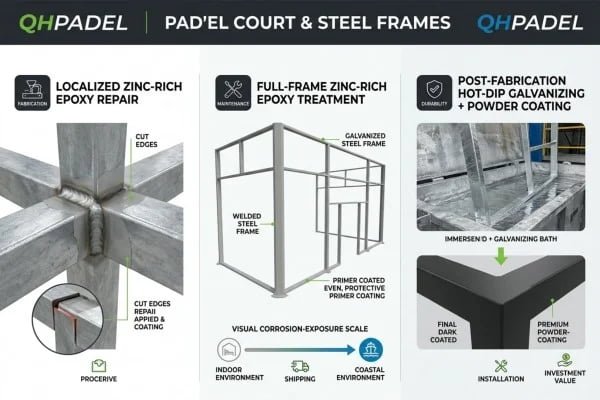
Padel court frame protection options generally include localized zinc-rich epoxy repair, full-frame zinc-rich epoxy treatment, and post-fabrication hot-dip galvanizing followed by powder coating. The right option depends on the project’s corrosion exposure, installation risks, maintenance capacity, and cost of downtime—not simply the coating name or the highest available specification.
We manufacture complete padel court systems and inspect frames before export. From that perspective, we have learned that coating thickness is only one part of the decision. Buyers also need to examine when protection is applied, which surfaces receive it, and what happens when installers damage the finish.
What Padel Court Frame Protection Options Are Available?
Buyers often receive quotations that use broad terms such as “painted,” “zinc coated,” or “galvanized.” These labels make comparison difficult because they do not explain the fabrication sequence. We reduce this uncertainty by separating the available systems according to treatment order, protected area, and expected project risk.
We offer three configurable protection levels: localized zinc-rich epoxy repair after welding and drilling, full-frame zinc-rich epoxy after fabrication, and post-fabrication hot-dip galvanizing above 100 μm followed by powder coating. Buyers should verify the complete process and coverage instead of relying on a generic coating description.
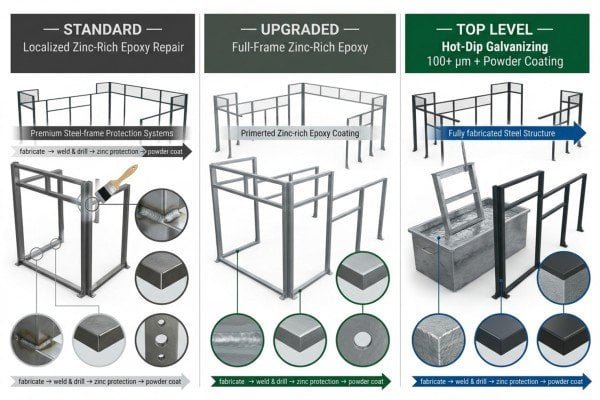
Level 1: Localized zinc-rich epoxy treatment
Our standard approach uses zinc-rich epoxy on locally affected areas after welding and drilling. The treatment focuses on points where fabrication has disturbed or exposed the steel surface.
These areas can include:
- Weld seams and heat-affected zones
- Drilled holes
- Cut edges
- Ground or polished surfaces
- Small areas damaged during fabrication
- Other visible points requiring repair before powder coating
This option can suit projects with moderate exposure, controlled installation, and a practical inspection and maintenance plan. However, buyers should not interpret localized repair as full-surface zinc protection. The protected scope is different.
A procurement specification should state:
- Which areas receive zinc-rich epoxy
- How the surface is prepared before application
- Whether powder coating follows the repair
- How repaired areas are inspected
- How coating damage is handled before packing
Level 2: Full-frame zinc-rich epoxy treatment
Our upgraded system applies zinc-rich epoxy across the full fabricated frame after welding and drilling, followed by the specified finish system.
The key difference is coverage. Localized repair targets fabrication points, while full-frame treatment creates a more consistent zinc-rich epoxy layer over the frame. This broader coverage may be appropriate when humidity, repeated condensation, maintenance limitations, or higher commercial consequences justify added protection.
The treatment sequence remains important:
We prefer buyers to evaluate “fabricate first, protect second” because later welding, cutting, or drilling can break an earlier protective layer.1
Full-frame zinc-rich epoxy does not eliminate every corrosion risk. Coating performance still depends on surface preparation, dry film thickness, curing, adhesion, handling, and installation quality.2 Buyers should request evidence for these production controls rather than assuming that the material name proves performance.
Level 3: Post-fabrication hot-dip galvanizing and powder coating
Our highest available protection configuration uses hot-dip galvanizing after fabrication, with a specified zinc layer above 100 μm, followed by powder coating. This sequence is often called a duplex system because it combines metallic zinc protection with an additional organic coating.3
For this configuration, our production sequence is generally:
- Steel components are cut, drilled, welded, and fabricated.
- Fabricated components undergo the specified preparation.
- Components receive hot-dip galvanizing.
- The galvanized surface is prepared for coating.
- Powder coating is applied in the required frame color.
- Finished parts undergo visual and dimensional checks.
Post-fabrication galvanizing helps avoid leaving ordinary fabrication welds and drilled holes untreated. However, the process needs planning. Galvanizing can affect venting requirements, drainage details, hole tolerances, surface appearance, and dimensional control.4 Powder coating over galvanized steel also needs suitable preparation and process compatibility.5
We present these three padel court frame protection options as configurable manufacturing solutions. We do not treat them as universal engineering prescriptions. Buyers should have the proposed system reviewed by a qualified coating specialist, structural engineer, or local authority when project conditions require professional evaluation.
| Protection level | Main treatment | General coverage | Typical evaluation context |
|---|---|---|---|
| Standard | Local zinc-rich epoxy after welding and drilling | Fabrication-affected areas | Moderate exposure and accessible maintenance |
| Upgraded | Full-frame zinc-rich epoxy after fabrication | Broad frame coverage | Humid sites or projects needing greater risk control |
| Top level | Post-fabrication hot-dip galvanizing above 100 μm, then powder coating | Fabricated steel surfaces, subject to design accessibility | Severe exposure or high consequences of repair and downtime |
How Should Buyers Select Padel Court Frame Protection Options?
A buyer can overspecify a dry inland project or underspecify a humid coastal one. Either mistake creates unnecessary cost. We recommend a risk-based selection process that connects environmental exposure with installation quality, inspection access, maintenance resources, and the financial consequences of premature corrosion.
Buyers should select padel court frame protection options by assessing moisture, salinity, humidity, UV exposure, airborne contaminants, drainage, installation damage, maintenance access, and downtime costs. Standard, upgraded, and top-level systems represent increasing levels of risk control, but no single environment automatically proves a fixed coating life.
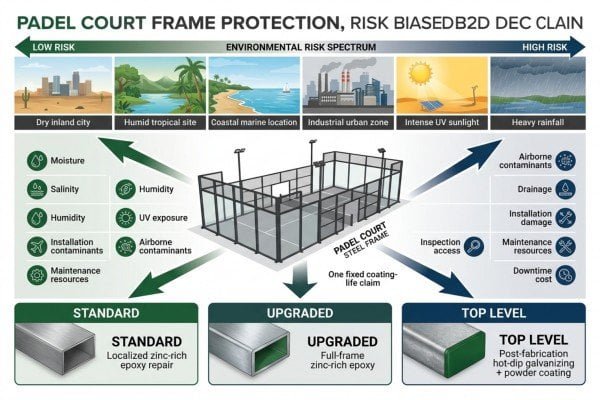
Start with the actual site rather than the country
A country name or city name rarely provides enough information.6 Two courts within the same region can experience different exposure because one sits near the coast while the other stands inland under a ventilated roof.
We ask buyers to consider:
- Distance from saline water: Sea spray and salt-bearing air can increase corrosion risk.7
- Relative humidity and condensation: Frequent wetting can matter more than occasional rainfall.8
- Drainage: Standing water around frame bases can create persistent exposure.
- Indoor or outdoor placement: Indoor courts can still experience high humidity or condensation.
- Airborne chemicals: Industrial pollution, pool chemicals, and cleaning agents may affect coatings.
- UV exposure: Strong sunlight can influence color and organic coating durability.
- Cleaning practices: Aggressive chemicals or pressure washing can damage finishes.
- Maintenance access: Some court layouts make inspection and repair difficult.
Buyers should avoid assigning a fixed corrosion-free lifespan from one environmental description. Service conditions vary, and coating durability depends on production quality, damage, installation, and maintenance.
Use a practical risk ladder
We use a three-level selection ladder during pre-sales discussions. The ladder does not replace project-specific engineering, but it gives procurement teams a consistent starting point.
| Project consideration | Standard system may be considered | Upgraded system may be considered | Top-level system may be considered |
|---|---|---|---|
| General exposure | Moderate and relatively controlled | Humid or repeatedly wet | Saline, aggressive, or difficult to maintain |
| Maintenance | Regular inspection is practical | Maintenance resources are limited | Repair access is costly or disruptive |
| Installation control | Experienced team with controlled handling | Multiple handling stages or greater damage risk | Complex logistics and high installation consequences |
| Downtime impact | Temporary closure has limited impact | Closure affects customer experience | Closure creates substantial revenue or contractual risk |
| Procurement priority | Lower initial cost with planned upkeep | Balanced cost and broader protection | Higher initial risk control |
We do not automatically recommend the highest level for every coastal project. A coastal location justifies closer assessment, but buyers still need to review distance from salt sources, wind exposure, shelter, drainage, cleaning, and maintenance.
Likewise, an inland project does not automatically have low exposure. An enclosed, poorly ventilated court with persistent condensation can require more protection than an open, dry site.
Match protection to consequences
Club operators often focus on lost booking revenue. Contractors may focus on handover defects and repair responsibility. Distributors may prioritize repeatable specifications, while public-sector buyers may need traceable documents for tender evaluation.
We therefore recommend scoring both probability and consequence:
- How likely is prolonged moisture or saline contamination?
- How easily can maintenance staff inspect the frame?
- Can damaged parts be touched up without closing the court?
- Who pays for access equipment and labor?
- Will visible rust affect customer confidence?
- Could a repair dispute delay project handover?
- Does the local specification require a particular treatment or verified test?
A qualified local professional should confirm application-specific requirements. Our manufacturing experience helps us discuss production feasibility, but it does not replace local corrosion classification, structural design, or regulatory review.
Which Frame Areas Need the Most Protection?
A coating system can appear complete while weak points remain at welds, holes, bases, and fastener interfaces. These areas face fabrication heat, exposed edges, trapped moisture, or mechanical damage. We inspect them closely because early corrosion often begins where continuity has been interrupted.
Buyers should pay special attention to welds, drilled holes, cut edges, frame bases, fastener interfaces, internal cavities, and handling damage. Purchase specifications should define factory inspection, packing protection, installation touch-up, acceptable repair materials, and responsibility for damage caused during unloading, assembly, or field modification.
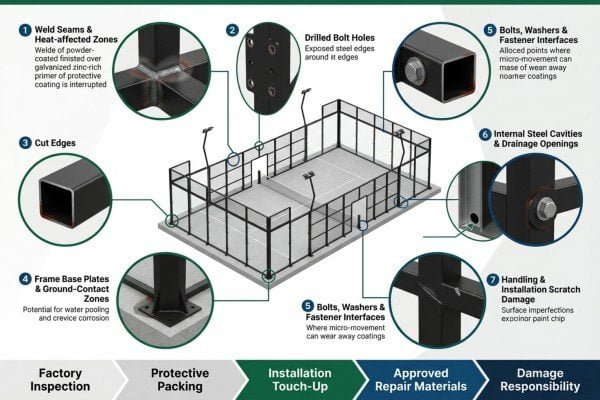
Welds and heat-affected areas
Welding changes the local surface condition. It can remove an existing coating and leave spatter, scale, sharp profiles, or difficult-to-cover edges. Surface preparation around the weld is therefore as important as the repair material.
During production inspection, we look for:
- Continuous and visually acceptable welds
- Removed welding spatter
- Cleaned surrounding surfaces
- Adequate access for coating
- Complete repair coverage
- No obvious bare steel before packing
A buyer should not accept “zinc-rich paint on welds” as a complete specification. The document should also describe preparation, application, inspection, and subsequent coating steps.
Drilled holes and cut edges
Holes and cut edges create exposed steel if they are added after a protective layer. Sharp edges can also receive less coating coverage because liquid or powder coatings tend to pull away from the edge profile.9
We recommend completing routine drilling and cutting before the principal protection process whenever the product design allows it. If installers drill additional holes on site, they should follow an approved repair procedure.
That procedure should define:
- How the damaged area is cleaned
- Whether rust or contamination must be removed
- Which compatible repair product is used
- The required application and curing conditions
- Who documents and accepts the repair
Frame bases and water traps
The lower frame area deserves careful review because rainwater, cleaning water, soil contamination, and debris can remain near the base. Poor foundation drainage can defeat an otherwise suitable coating system.10
Contractors should verify:
- Finished foundation levels
- Water drainage direction
- Sealant details, if specified
- Base plate contact conditions
- Anchor and fastener compatibility
- Accessibility for inspection
- Prevention of buried or constantly submerged steel unless designed for it
Foundation and installation drawings should show relevant levels and tolerances. Local engineers should confirm drainage and anchoring details because these conditions vary by site.
Fastener interfaces
Bolts, nuts, washers, and frame surfaces form a system. Incompatible materials or damaged contact areas may create localized corrosion risks.11 Installation tools can also scratch powder coating around bolt heads and access points.
Buyers should compare the specified fasteners with the frame treatment rather than treating accessories as an unrelated line item. QHPADEL can provide screws and accessories with supporting certificates, including AD 2000 W0 and PED 2014/68/EU quality-system documentation where applicable. However, buyers should verify document scope, validity, product matching, and local acceptance before relying on any certificate.
Shipping and installation damage
Factory protection does not remain untouched automatically. Frames can experience abrasion during:
- Bundling and packing
- Container loading
- Ocean transport
- Unloading
- Temporary site storage
- Lifting and positioning
- Glass and mesh installation
- Tool use during bolt tightening
Our export experience has made us cautious about responsibility boundaries. A frame may leave the factory in acceptable condition and still arrive at handover with scratches caused later in the chain.
The purchase contract should clarify:
- The required packing method
- Inspection timing before loading
- Procedures for reporting transport damage
- Site-storage requirements
- Approved touch-up materials
- The party responsible for installation damage
- Photo and batch-record requirements
- Replacement criteria for severely damaged parts
Clear responsibility does not prevent every problem, but it reduces after-sales disputes and speeds up corrective action.
How Should Buyers Compare Lifecycle Cost and Supplier Quality?
The lowest quotation can become expensive when rust repair requires labor, access equipment, replacement parts, or court closure. The highest specification can also waste money when project exposure is modest. We recommend comparing lifecycle risks and supplier controls instead of ranking offers by coating price alone.
Buyers should compare initial price with inspection requirements, maintenance frequency, repair access, replacement logistics, supplier responsibility, and expected downtime. Supplier evaluation should also cover fabrication sequence, surface preparation, coating records, packing, touch-up procedures, certificates, drawings, and the traceability of structural components and accessories.
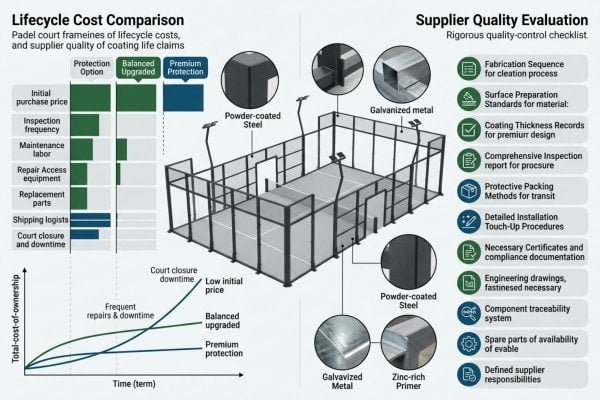
Build a total-risk comparison
A useful commercial comparison includes more than the ex-factory price.
| Cost or risk | Questions for the buyer |
|---|---|
| Initial treatment cost | What exact process, coverage, and thickness does the quotation include? |
| Inspection cost | Does the project require third-party checks or additional documentation? |
| Maintenance cost | Can staff inspect and repair the frame without specialist equipment? |
| Repair cost | Are compatible repair products available locally? |
| Access cost | Will lifts, scaffolding, or court dismantling be necessary? |
| Replacement logistics | How quickly can the supplier identify and reproduce a component? |
| Downtime | How much revenue or public access is lost during closure? |
| Dispute risk | Does the contract separate material defects from shipping or installation damage? |
For a small private facility, planned touch-up maintenance may be commercially acceptable. For a busy club chain, hotel, university, or municipal site, an unexpected closure can have broader financial and contractual consequences. The protection level should reflect those differences.
Ask suppliers process-specific questions
We recommend asking every potential supplier the same questions:
- Is zinc-rich material applied locally or over the full frame?
- Does protection occur before or after welding and drilling?
- If hot-dip galvanizing is specified, does it occur after fabrication?
- What zinc thickness is specified, and how is it verified?
- How is the galvanized surface prepared for powder coating?
- Which surfaces or cavities may have limited treatment access?
- How are welds, holes, edges, and frame bases inspected?
- What happens if installers cut or drill the frame?
- Which touch-up materials are approved?
- What records accompany the shipment?
The answers should appear in the quotation, technical agreement, inspection plan, or purchase contract. Verbal explanations are useful during negotiation, but they are harder to enforce after delivery.
Verify certificates and inspection evidence
QHPADEL operates an ISO 9001-certified factory, and our steel frame structure has CE documentation. Other package components have their own supporting documents, including CE documentation for artificial turf, tempered glass, and LED lighting, plus additional listed test or certification records for particular products.
We encourage buyers to verify:
- Certificate issuer
- Certificate number and validity
- Product model or scope
- Referenced standard
- Factory or legal entity name
- Relationship between the tested sample and ordered product
- Local tender or building-authority acceptance
A certificate does not automatically prove that every project requirement has been satisfied. Likewise, ISO 9001 concerns the quality-management system; buyers should not treat it as a guaranteed corrosion-performance result.
Evaluate the complete supplier package
Frame protection interacts with design, manufacturing, shipping, installation, and maintenance. A capable supplier should support the treatment with accurate documentation.
For complete padel court projects, we provide:
- Installation drawings
- Foundation drawings
- Packing lists
- Maintenance manuals
- Component identification
- Online installation guidance
- Configurable frame colors
- Turf and package customization
- Spare-part coordination
Our facility uses 10 production lines and has monthly capacity exceeding 150 complete padel court systems. Standard lead times depend on quantity: two courts can generally be produced in 20 days, four courts in 20–25 days, and larger standard orders in no more than 30 days. Custom styles can generally be produced within 35 days. Buyers should confirm the current schedule, specification, and inspection hold points before ordering.
Frequently Asked Questions
Is powder coating alone enough for a padel court frame?
Powder coating may be suitable for some controlled, moderate-exposure projects, but buyers should review surface preparation, coating continuity, fabrication order, installation damage, and maintenance. We recommend defining how welds, holes, and cut edges are treated rather than judging the system only by its visible colored finish.
Is hot-dip galvanizing always the best option?
No. Post-fabrication hot-dip galvanizing with powder coating offers a higher protection configuration, but it also adds cost and process requirements. We recommend it when site exposure or failure consequences justify the added control. A dry, accessible project with regular maintenance may not need the highest level.
Does a coating thickness guarantee a fixed service life?
No. Thickness is important, but it cannot guarantee a fixed corrosion-free lifespan. Surface preparation, adhesion, coverage, environmental exposure, shipping damage, installation quality, drainage, and maintenance also affect performance. Buyers should verify test methods and obtain qualified project-specific advice when service-life estimates are required.
Who should repair frame damage after installation?
The purchase contract should assign responsibility. Suppliers usually address verified manufacturing defects, while contractors or installers may be responsible for scratches, field drilling, improper storage, or tool damage. We recommend an agreed inspection record at delivery and an approved touch-up procedure before installation begins.
What documents should I request with a protected steel frame?
We recommend requesting the treatment specification, fabrication sequence, coating or galvanizing inspection records, product drawings, packing list, maintenance instructions, certificate copies, touch-up procedure, and warranty terms. Buyers should verify that each document matches the ordered product and local regulatory requirements.
Conclusion
The right padel court frame protection options depend on exposure, fabrication order, treatment coverage, installation control, maintenance access, and the consequences of premature corrosion. Buyers should compare localized zinc-rich repair, full-frame zinc-rich epoxy, and post-fabrication hot-dip galvanizing with powder coating as different risk-control levels—not as simple coating labels.
If you need a project-specific quotation and protection comparison, contact Alice Chen at QHPADEL via alice@grass-supplier.com, WhatsApp +86 185 7566 0746, or visit www.qhpadel.com. We can help you prepare a clear manufacturing specification for review by your contractor or local qualified professional.
-
"[PDF] Bridge Welding Reference Manual – Federal Highway Administration", https://www.fhwa.dot.gov/bridge/steel/pubs/hif19088.pdf. Steel-coating guidance treats welding, cutting, and drilling through a completed coating as operations that disrupt coating continuity and expose steel, requiring preparation and repair of the affected area; the extent of damage depends on the operation and coating system. Evidence role: mechanism; source type: government. Supports: Welding, thermal cutting, and drilling through coated steel remove or damage the protective layer and ordinarily require restoration of corrosion protection.. Scope note: The source supports the general mechanism but not a particular repair procedure for this manufacturer’s frames. ↩
-
"Coating Performance on Existing Steel Bridge Superstructures", https://www.fhwa.dot.gov/publications/research/infrastructure/structures/bridge/20065/. ISO 12944 and related protective-coating guidance identify surface preparation, film thickness, application and curing conditions, adhesion, and subsequent damage as factors affecting corrosion-protection performance; these sources address steel structures generally rather than padel court frames specifically. Evidence role: mechanism; source type: institution. Supports: Protective-coating standards identify surface preparation, application thickness, curing, adhesion, environmental exposure, and damage as material influences on coating performance.. Scope note: The evidence establishes general coating principles but does not predict the service life of a particular padel court. ↩
-
"Duplex Systems for Corrosion Protection", https://galvanizeit.org/corrosion/corrosion-protection/duplex-systems. Corrosion-protection literature defines a duplex system as a metallic zinc coating, commonly produced by galvanizing, used together with an organic paint or powder-coating layer. Evidence role: definition; source type: institution. Supports: Corrosion-protection literature defines a duplex system as zinc-coated or galvanized steel covered by an organic coating.. ↩
-
"The Influence of Hot-Dip Galvanizing on the Mechanical …", https://pmc.ncbi.nlm.nih.gov/articles/PMC8467660/. Hot-dip galvanizing standards and design guidance require adequate venting and drainage and recognize that zinc buildup, thermal effects, and process conditions can influence hole clearances, surface appearance, and dimensional stability; the magnitude of these effects varies with geometry and fabrication practice. Evidence role: general_support; source type: institution. Supports: Hot-dip galvanizing guidance requires venting and drainage and recognizes possible coating buildup, appearance variation, and dimensional distortion.. Scope note: The evidence identifies recognized process considerations but does not establish that every galvanized frame will experience material dimensional change. ↩
-
"Accelerated Corrosion Tests in Quality Labels for Powder …", https://pmc.ncbi.nlm.nih.gov/articles/PMC8585214/. Studies of organic coatings on galvanized steel show that cleaning, removal or control of zinc-surface contaminants, suitable pretreatment, and compatible curing conditions materially affect coating adhesion and defect formation; results vary by galvanizing condition and coating chemistry. Evidence role: mechanism; source type: paper. Supports: Surface contaminants, zinc corrosion products, and incompatible pretreatment can reduce adhesion between galvanized steel and an organic topcoat.. Scope note: The research supports the interface mechanism generally rather than validating a specific powder-coating process described in the article. ↩
-
"The Results of 45 Years of Atmospheric Corrosion Study in the …", https://pmc.ncbi.nlm.nih.gov/articles/PMC5506999/. ISO 9223 classifies atmospheric corrosivity using measured or estimated local factors such as time of wetness, airborne salinity, sulfur dioxide deposition, temperature, and relative humidity, indicating that a city or country label alone is not a complete exposure assessment. Evidence role: expert_consensus; source type: institution. Supports: Atmospheric-corrosivity classification uses site-specific factors such as time of wetness, airborne salinity, sulfur dioxide, temperature, and humidity.. Scope note: The standard characterizes atmospheric exposure generally and does not assign a corrosion class to any site discussed in the article. ↩
-
"[PDF] Corrosion-protective value of electrodeposited zinc and cadmium …", https://nvlpubs.nist.gov/nistpubs/jres/16/jresv16n2p185_A1b.pdf. Atmospheric-corrosion research shows that chloride-bearing marine aerosols can retain moisture and increase the conductivity of surface electrolyte films, thereby accelerating steel corrosion; actual rates depend on chloride deposition, wetness, shelter, temperature, and coating condition. Evidence role: mechanism; source type: paper. Supports: Deposited chloride salts promote electrolyte formation and accelerate electrochemical corrosion of steel in marine atmospheres.. Scope note: Marine proximity alone does not determine a specific corrosion rate or coating lifespan. ↩
-
"(PDF) Humidity and Dew Point: Their Effect on Corrosion …", https://www.academia.edu/17021842/Humidity_and_Dew_Point_Their_Effect_on_Corrosion_and_Coatings. Atmospheric-corrosion research and ISO classification methods use time of wetness as a major exposure variable because corrosion proceeds during periods when a conductive moisture film remains on the metal; rainfall frequency alone is therefore an incomplete measure of risk. Evidence role: mechanism; source type: research. Supports: Time of wetness is a recognized determinant of atmospheric corrosion because electrochemical corrosion proceeds when a sufficiently conductive moisture film is present.. Scope note: The relative importance of wetness and rainfall varies with temperature, pollutants, salts, shelter, and the drainage characteristics of the structure. ↩
-
"[PDF] HMEC Module C Participant Workbook", https://www.fhwa.dot.gov/pavement/materials/hmec/pubs/module_c/participant_workbook.pdf. Protective-coating guidance recognizes that surface tension and application geometry can produce reduced film thickness at sharp edges and recommends edge preparation or stripe coating to improve coverage; the severity of edge thinning depends on coating formulation and application method. Evidence role: mechanism; source type: government. Supports: Protective coatings often have reduced film build at sharp edges, which is why edge rounding and stripe coating are used in corrosion-control specifications.. Scope note: The general edge-retention phenomenon does not establish the actual thickness achieved on the frames described here. ↩
-
"Uncoated Weathering Steel in Structures – Bridges & Structures", https://www.fhwa.dot.gov/bridge/t514022.cfm. Durability guidance for steel structures identifies water traps, debris accumulation, and inadequate drainage as details that prolong wetness and promote localized coating breakdown and corrosion; the resulting deterioration rate depends on coating condition, contaminants, and exposure duration. Evidence role: mechanism; source type: government. Supports: Water traps and inadequate drainage prolong moisture exposure and can accelerate corrosion at coated steel details.. Scope note: The evidence supports drainage as a durability factor but does not show that drainage alone will cause failure of a particular coating system. ↩
-
"[PDF] Fastener Design Manual – NASA Technical Reports Server", https://ntrs.nasa.gov/api/citations/19900009424/downloads/19900009424.pdf. Corrosion engineering guidance explains that electrically connected dissimilar metals can form a galvanic cell when moisture supplies an electrolyte, increasing attack on the more anodic member; risk depends on material potential, exposed-area ratio, electrolyte conductivity, and isolation details. Evidence role: mechanism; source type: government. Supports: Electrically connected dissimilar metals exposed to an electrolyte can form a galvanic cell, increasing corrosion of the more anodic material.. Scope note: Material contact does not automatically produce significant damage, and project-specific risk depends on the exact fastener, coating, geometry, and environment. ↩