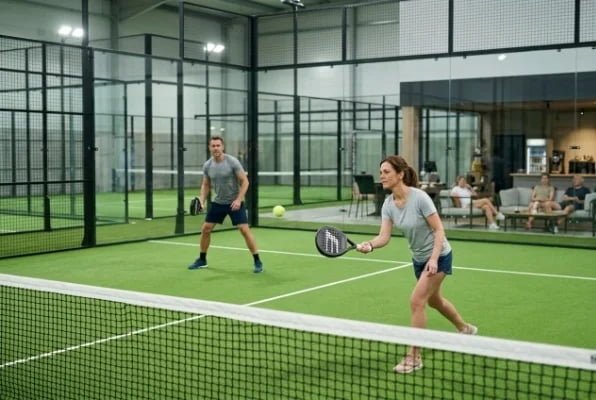
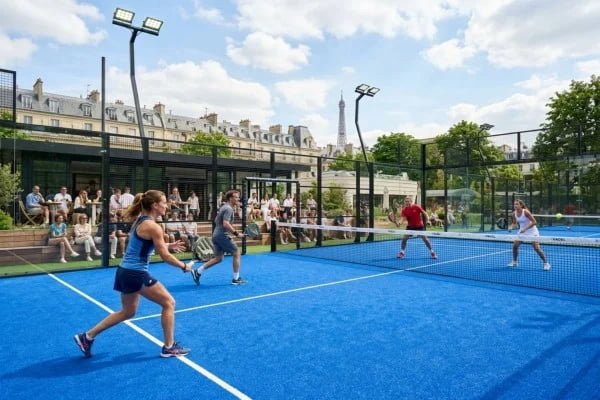
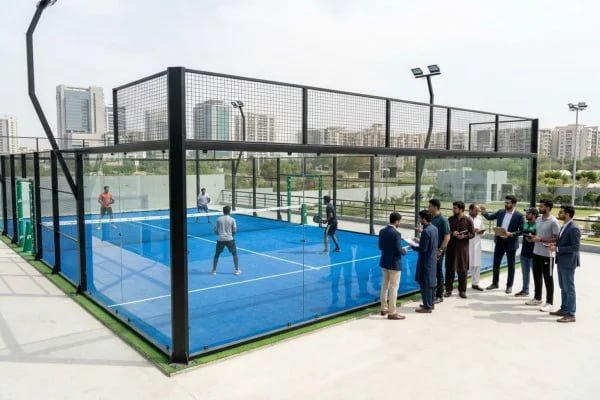
Padel in the UK can look surprisingly expensive when an investor compares booking fees with the apparent price of court equipment. That comparison hides the real problem: a venue must fund land, construction, professional services, operations, and commercial risk. I recommend evaluating the complete business system rather than focusing on one court quotation.
Padel is expensive in the UK because customers pay for more than time on a court. Booking revenue must support the site, groundworks, planning and professional services, installation, staffing, energy, maintenance, taxes, finance, and periods of low utilisation. Court equipment represents only one part of the total installed and operating cost.
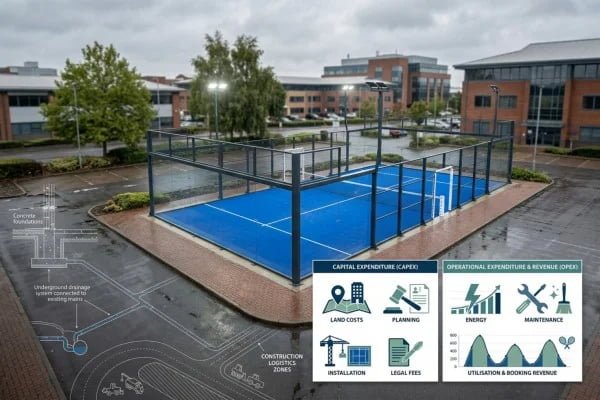
In my conversations with prospective buyers, I often see the same misconception: a low equipment price should lead directly to a low booking price. The missing link is the location-dependent cost structure. Once investors separate equipment, project delivery, and venue operations, the economics become much easier to assess.
Why Is Padel in the UK More Expensive Than the Court Equipment Suggests?
A court quotation creates a visible reference point, but it can also create a budgeting trap. An entrepreneur may secure an attractive equipment price and still discover substantial costs after ordering. If the original budget excludes civil works, professional approvals, or installation, the project can become underfunded before opening.
Padel in the UK costs more than its equipment because the investor must convert a site into a safe, compliant, operational venue. The full budget may include site acquisition, groundworks, drainage, foundations, freight, import charges, lifting equipment, installation, electrical work, local professional services, utilities, insurance, marketing, and contingency.
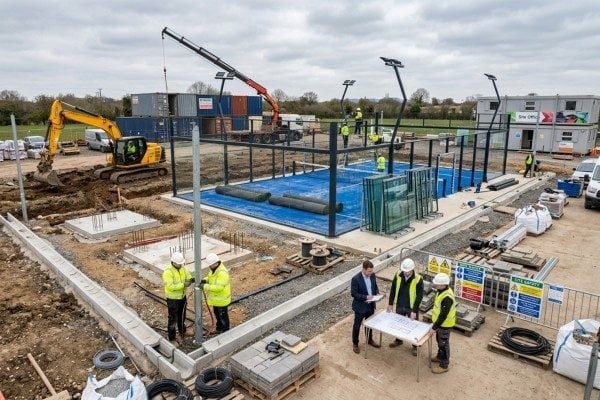
A Court Package Is Not a Finished Venue
A standard padel playing area measures 20 metres by 10 metres, but the project needs more space than the playing footprint. Investors may need circulation areas, access routes, reception space, changing facilities, storage, fire routes, parking, and room for construction equipment.
From a manufacturing perspective, I usually divide the investment into three layers:
- Equipment package
- Installed project
- Operating business
This distinction matters because suppliers do not always define “complete court” in the same way.
A court equipment package may include:
- Structural steel posts and frames
- Welded mesh or framed mesh panels
- Tempered glass
- Artificial turf
- LED lighting fixtures
- Court net and posts
- Fasteners and connection accessories
- Installation and foundation drawings
- Packing lists and component labels
However, it may exclude:
- Ground investigation
- Planning and building-related professional services
- Structural review for the specific site
- Excavation and concrete foundations
- Drainage
- Electrical distribution beyond the light fixtures
- Freight, unloading, cranes, and site storage
- Installation labour
- Perimeter buildings or roof structures
- Imported-goods taxes and local fees
- Spare glass and maintenance stock
A Practical Cost Framework
I recommend building a project budget with separate lines rather than one broad “court cost” figure.
| Cost layer | Typical items to investigate | Main risk |
|---|---|---|
| Site | Lease, purchase, deposits, access, surveys | A cheap site may be difficult to approve or develop |
| Professional services | Planning advice, structural engineering, legal work | Requirements vary by location and project |
| Civil works | Excavation, base, concrete, drainage, ducts | Ground conditions can change the budget |
| Equipment | Steel, glass, turf, lighting, net, hardware | Incomplete specifications can hide exclusions |
| Logistics | Freight, insurance, port charges, unloading | Access and timing can increase handling costs |
| Installation | Labour, lifting, alignment, electrical work | Poor installation can affect safety and play |
| Operations | Staff, utilities, insurance, cleaning, maintenance | These costs continue during quiet periods |
| Contingency | Delays, replacements, design changes | A zero-contingency budget is fragile |
UK planning, tax, labour, energy, and property costs are location- and time-sensitive.1 I would not apply an undated national estimate to a specific project. Investors should obtain current quotations and use qualified UK planning, legal, tax, structural, and construction professionals where appropriate.
I have seen buyers concentrate on saving a small amount on steel or turf while leaving major groundworks and site-access questions unanswered. In practice, those unanswered questions can be more important than the equipment discount.
Why Are Padel Booking Prices in the UK Often High?
High booking prices can frustrate customers, but reducing them is not as simple as sourcing a cheaper court. A venue must recover fixed and variable operating costs during a limited number of saleable hours.2 Low daytime demand, seasonal disruption, or expensive premises can place more pressure on peak-time sessions.
Padel booking prices in the UK reflect venue economics rather than equipment cost alone. Operators may need each occupied hour to contribute toward rent, financing, staff, energy, maintenance, insurance, software, marketing, taxes, and quieter periods. Indoor protection can improve availability, but the building itself may add significant cost.
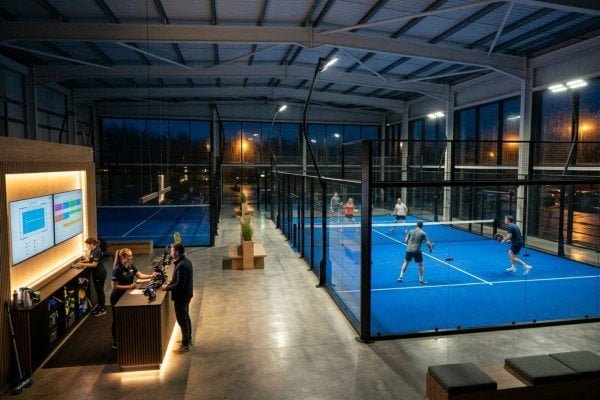
Utilisation Matters More Than Theoretical Capacity
A court may be available for many hours, but availability does not equal paid occupancy. Demand commonly clusters around evenings and weekends.3 An operator can therefore have strong peak demand and weak overall utilisation at the same time.
I suggest modelling three different figures:
- Available hours: All hours when bookings are technically possible
- Booked hours: Hours that customers actually reserve
- Collected hours: Booked hours after discounts, cancellations, refunds, and unpaid use
A simple revenue model is:
Monthly court revenue = collected booked hours × average collected price per hour
The average collected price should not be confused with the published peak tariff. Promotions, memberships, coaching allocations, complimentary sessions, and off-peak discounts can reduce the amount collected per hour.
For example, an investor could test three scenarios without claiming a guaranteed outcome:
| Scenario | Utilisation assumption | Pricing assumption | Purpose |
|---|---|---|---|
| Conservative | Low occupancy outside peak periods | Discounted blended rate | Tests downside resilience |
| Base | Gradual demand growth | Realistic blended rate | Supports normal planning |
| Upside | Strong peak and off-peak demand | Higher collected rate | Tests capacity requirements |
Each investor should insert verified local inputs rather than generic national figures. Nearby venue prices can provide context, but they do not prove achievable occupancy at a new site.
Indoor and Outdoor Padel Have Different Economics
Outdoor courts can avoid the cost of a full building, but weather can affect playable hours and customer confidence.4 Indoor venues can offer a more predictable experience, yet the structure, rent, lighting, ventilation, fire strategy, and utility requirements may increase capital and operating costs.
A roofed court is also not automatically equivalent to a fully enclosed indoor venue. Wind-driven rain, condensation, acoustic effects, clearance, drainage, and structural loads still require evaluation.5
Peak Pricing Supports Quiet Hours
Operators often use peak and off-peak prices because demand is uneven. Peak revenue may need to support:
- Underused weekday hours
- Staff coverage across long opening periods
- Cleaning and maintenance
- Booking and access-control systems
- Marketing and customer acquisition
- Repairs and replacement reserves
- Financing or investor returns
I advise entrepreneurs to model demand by hour and day, not as one monthly percentage. A 50% average utilisation assumption can hide an unrealistic expectation that weekday mornings will perform like Friday evenings.
Does More Expensive Padel Court Equipment Provide Better Value?
Investors can easily assume that a higher price or a more panoramic appearance means better quality. That assumption creates another risk. A visually premium design may support a venue’s positioning, but it does not automatically offer better durability, easier installation, or greater suitability for a particular site.
Expensive padel court equipment provides value only when its design, materials, documentation, and manufacturing controls match the operating scenario. Buyers should evaluate structural requirements, corrosion protection, glass, turf, lighting, component accuracy, maintenance, and local installation conditions instead of treating price or panoramic design as a quality grade.
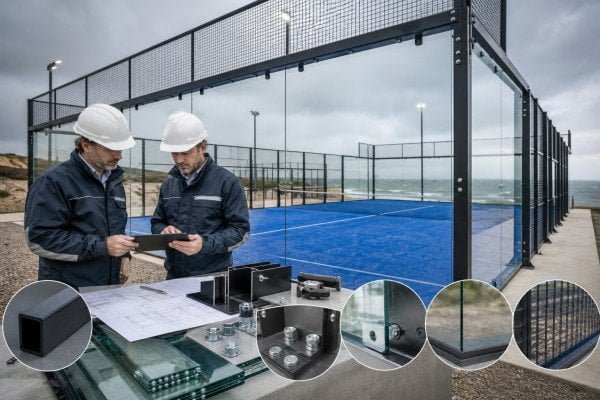
Match the Court to the Commercial Model
A panoramic court reduces some visible structural elements around the glass. This appearance may suit broadcast, spectator, or premium-club settings. However, buyers should not assume that fewer posts automatically mean a superior court.
Different designs distribute loads in different ways. Site-specific wind exposure, roof conditions, ground support, and local requirements can affect the appropriate structure.6 A qualified local engineer should evaluate the project where structural assessment is required.
I encourage buyers to start with operational questions:
- Will the court be indoors, outdoors, or under a canopy?
- Is the site exposed to strong wind or corrosive conditions?
- Will the venue host competitions, coaching, or casual play?
- Does the business depend on premium visual presentation?
- How quickly must damaged glass or lighting components be replaced?
- Can installers access every fixing point?
- What maintenance skills and spare parts are available locally?
Compare Specifications, Not Product Names
Terms such as “classic,” “panoramic,” and “ultra panoramic” are useful product categories, but suppliers may define them differently. Investors should request measurable specifications.
| Component | Details to request | Why the detail matters |
|---|---|---|
| Steel structure | Section sizes, thicknesses, grade, coating system | These affect fabrication, corrosion resistance, and structural review |
| Glass | Thickness, tempering standard, hole layout, edge treatment | Glass must match the frame and intended application |
| Mesh | Wire diameter, aperture, weld quality, frame design | Poor consistency can affect fit and finish |
| Turf | Fibre type, pile height, Dtex, density, backing, infill guidance | The system affects play, drainage, and maintenance |
| Lighting | Power, optics, layout, ingress protection, documentation | Fixture wattage alone does not prove lighting performance |
| Fasteners | Material, grade, coating, quantities | Missing or unsuitable hardware delays installation |
| Documentation | Drawings, numbering, manuals, test documents | Installers need controlled, consistent information |
At QHPADEL, we manufacture complete court packages and artificial turf. Our facility has more than 10 years of production experience and nine years of export experience. This background lets me discuss manufacturing and export workflows, but it does not make me a UK planning or structural authority.
Our factory reports ISO 9001 certification, and product categories have supporting documents for standards including CE and selected AS/NZS requirements. Buyers should still request the applicable certificate or test report, check the issuing body and scope, confirm the product identification, and ask whether the document applies to the exact supplied specification.
A certification logo on a brochure is not enough. Buyers should treat certifications as documents to verify, not as broad guarantees of site approval.
More Specification Is Not Always Better
An unnecessarily heavy or complex design can increase freight, handling, foundation demands, and installation time. In contrast, an underspecified product can create structural, maintenance, and replacement risks.
The right question is not, “Which court is most expensive?” I prefer this question:
“Which documented specification is suitable for this site, operating model, installation method, and local professional assessment?”
That question turns a style choice into a procurement decision.
How Do Incomplete Quotations Make Padel in the UK More Expensive?
A low quotation can protect the initial budget, but only when it covers the same scope as competing offers. When drawings, fasteners, packaging, replacement procedures, or delivery responsibilities are missing, the buyer may face delays and unplanned local purchases. The cheapest quote can then become the costliest project.
Incomplete quotations make padel in the UK more expensive by transferring cost and risk to the buyer. Omissions may cause port delays, installation stoppages, rework, emergency freight, or disputes. A useful quotation should define the bill of materials, specifications, documents, packaging, commercial terms, exclusions, and after-sales responsibilities.
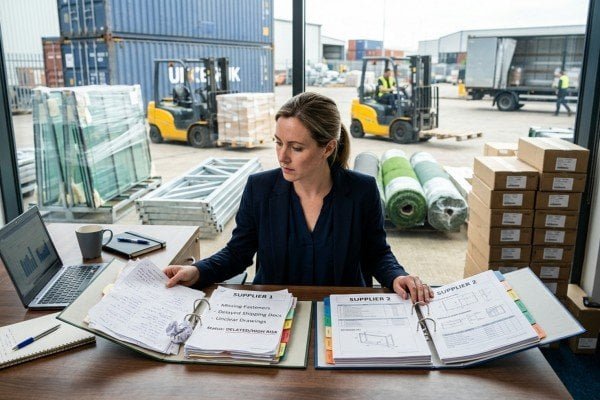
Ask for a Complete Bill of Materials
I often receive enquiries that ask for “one panoramic court” without defining what the package must include. That request makes quotations difficult to compare because one supplier may include turf and lighting while another may quote only the steel, glass, and mesh.
A buyer should request a bill of materials covering:
- Every structural post and frame
- Mesh panels
- Tempered glass panels
- Turf quantity and specification
- Net and net posts
- Lighting fixtures and mounting parts
- All bolts, screws, anchors, and connection plates
- Protective materials and packaging
- Spare or wear components, if included
- Installation tools, if included
- Drawings, manuals, and certificates
- Product labels and component numbering
The buyer should also confirm whether foundation anchors are supplied or sourced locally. The answer can depend on the foundation design and installation arrangement.
Define Freight and Delivery Responsibilities
An equipment price does not explain who handles export clearance, ocean freight, insurance, import clearance, port charges, inland delivery, unloading, or site storage.
The quotation should state the applicable Incoterms rule and named place, along with the version used. For example, a term without a named port or destination leaves too much room for misunderstanding.
Buyers should ask:
- Who books the freight?
- Who pays for cargo insurance?
- When does risk transfer?7
- Who completes import clearance?
- Are destination charges included?
- Who arranges unloading?
- What access does the delivery vehicle require?
- How long can packaged glass and steel remain safely stored?
Examine Packaging and Traceability
Good packaging does not merely make the shipment look tidy. It should help protect glass, coatings, lights, turf, and small accessories through several handling stages.
I look for:
- Clearly numbered packages
- Packing lists linked to court components
- Separate hardware boxes
- Protected painted surfaces
- Glass stillages suitable for the planned logistics
- Moisture protection where appropriate
- Labels that installers can match to drawings
- Photographic loading records
QHPADEL exports more than 600 containers annually and operates 10 production lines. Based on our business records, monthly output exceeds 1.5 million square metres of artificial turf and 150 complete court systems. Those capacity figures are useful for supplier evaluation, but buyers should still verify the schedule, production slot, and scope in their individual contract.
Clarify Defects and Installation Responsibility
A contract should distinguish among:
- Manufacturing defects
- Transit damage
- Storage damage
- Installation errors
- Foundation inaccuracies
- Improper use
- Normal wear
- Maintenance failures
This distinction matters because a misaligned structure may result from fabrication, foundations, installation, or a combination of factors. Photographs, dimensional checks, delivery records, and controlled drawings make diagnosis easier.
I also recommend agreeing on a replacement process before shipment. Buyers should know what evidence the supplier requires, who pays for urgent freight, and whether critical spare parts should travel with the original order.
How Should Investors Test Whether a UK Padel Venue Is Viable?
Enthusiasm can make a strong market look like a guaranteed investment. However, even growing sports can produce weak projects when rent, construction, demand, or finance assumptions are unrealistic. A viability model must therefore test adverse conditions rather than depend on full courts and peak prices.
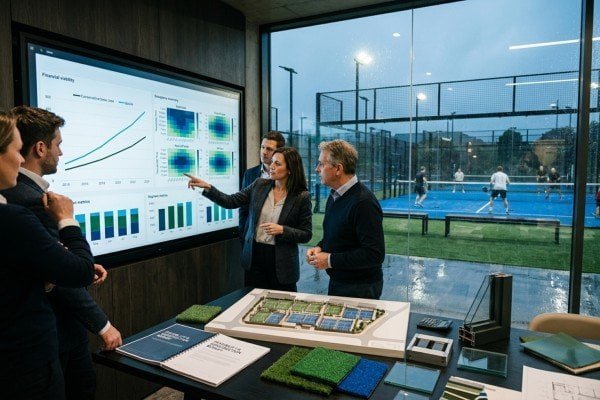
Investors should test a UK padel venue with location-specific capital costs, monthly operating costs, collected booking rates, hour-by-hour utilisation, and contingency assumptions. Conservative, base, and upside scenarios can show whether the project remains solvent when opening is delayed, demand grows slowly, or construction costs increase.
Build the Model From the Bottom Up
I would begin with the number of courts and realistic operating hours. I would then estimate bookings by time block rather than applying one optimistic occupancy percentage.
The core calculation can remain simple:
Revenue = court bookings + coaching + memberships + events + secondary sales
The cost side should include:
Operating costs = occupancy costs + payroll + utilities + maintenance + insurance + software + marketing + professional fees + finance costs + taxes
Investors should confirm the tax treatment with a qualified adviser. They should also avoid treating VAT, corporation tax, business rates, or import charges as interchangeable categories.
Stress-Test the Important Assumptions
A useful model asks what happens if:
- The opening is delayed by three or six months
- Groundworks exceed the initial allowance
- Only peak hours sell consistently
- The average collected price is below the advertised price
- Outdoor weather reduces playable hours
- Staffing costs increase
- A glass panel or light fixture requires urgent replacement
- A nearby competitor opens
- The venue needs more marketing than expected
- Financing costs change
A break-even utilisation calculation can help:
Break-even booked hours = monthly fixed costs ÷ contribution per booked hour
The contribution per booked hour should deduct variable costs associated with that booking. Investors should not use revenue per hour as if it were pure profit.
Use Gates Before Committing Capital
I recommend a staged decision process:
- Site gate: Is the location commercially attractive and physically practical?
- Professional gate: Do local advisers identify a credible approval path?
- Ground gate: Do surveys and civil estimates support the budget?
- Supplier gate: Is the equipment scope complete and technically documented?
- Demand gate: Do local research and pre-sales support the utilisation assumptions?
- Funding gate: Can the project survive delays and a slower ramp-up?
- Contract gate: Are responsibilities, payments, delivery, and remedies clear?
No supplier should promise a fixed payback period without controlling the site, price strategy, demand, and operating costs. I can provide equipment specifications, production details, packing information, drawings, and delivery inputs. A UK investor must combine those inputs with verified local property, planning, construction, labour, energy, and market information.
Frequently Asked Questions
Is the padel court itself the biggest project cost?
Not always. The equipment package can be a major cost, but site acquisition, groundworks, buildings, drainage, professional services, installation, freight, and utilities may materially change the total. I recommend comparing the court price with a total installed project budget, not treating it as the complete investment.
Is an indoor padel venue always more profitable in the UK?
No. Indoor operation can improve playing availability and customer confidence, but a building may increase rent, construction, energy, and compliance-related costs. Profitability depends on verified local costs, collected booking rates, utilisation, and finance terms. Investors should model indoor and outdoor scenarios separately.
Does a panoramic court justify higher booking prices?
A panoramic design may strengthen presentation, viewing, and premium positioning, but it does not guarantee higher customer demand. Booking prices depend on the whole venue experience, location, competition, service, and availability. Buyers should select the design for their business model and site rather than appearance alone.
What should I request from a padel court supplier?
I recommend requesting a detailed bill of materials, technical specifications, controlled drawings, packing list, installation manual, production schedule, commercial terms, warranty scope, certificate copies, and replacement procedure. Buyers should also confirm freight responsibilities, exclusions, component numbering, spare parts, and support for installation questions.
How many courts should a new UK venue install?
No single number suits every project. Investors should assess the site, local demand, peak-time capacity, coaching plans, funding, and operating costs. More courts can improve programming and events, but they also increase capital exposure. A staged project may reduce risk when the site design and approvals allow future expansion.
Conclusion
Padel in the UK is expensive because a booking supports an entire venue system, not just steel, glass, turf, and lights. Investors should separate equipment cost from installed project cost, model realistic utilisation, choose specifications for the operating environment, and reject incomplete quotations. Local planning, structural, tax, and compliance questions require qualified UK professionals. For a documented court package, drawings, production information, or an itemised export quotation, contact Alice Chen at QHPADEL via alice@grass-supplier.com or WhatsApp +86 185 7566 0746.
-
"Business rates in England", https://en.wikipedia.org/wiki/Business_rates_in_England. UK government guidance explains that business rates depend on a property’s rateable value and local circumstances, while energy and property costs are subject to changing market and contractual conditions. Evidence role: general_support; source type: government. Supports: That UK business costs, including rates and energy-related costs, can vary by property, location, tariff, and period.. Scope note: This supports the need for local, current estimates but does not quantify the cost of any particular padel project. ↩
-
"Managerial Costs | Ag Decision Maker – Iowa State Extension", https://www.extension.iastate.edu/agdm/wholefarm/html/c5-209.html. Managerial-economics texts distinguish fixed from variable costs and explain that firms must recover both through revenue generated from the portion of capacity that is actually sold. Evidence role: mechanism; source type: education. Supports: The relationship between fixed costs, variable costs, capacity utilisation, and the revenue required for a business to cover costs.. Scope note: The principle is general and does not establish the costs or optimal prices of a specific UK padel venue. ↩
-
"Difficulties Limiting Access to Sports and Recreational … – PMC", https://pmc.ncbi.nlm.nih.gov/articles/PMC7084857/. Research on recreation and sport participation commonly reports temporal variation in facility use, with work and school schedules contributing to higher demand outside standard daytime hours. Evidence role: general_support; source type: research. Supports: Observed temporal concentration of participation or facility use in evening and weekend periods.. Scope note: Patterns vary by sport, locality, demographic group, and operating model; this evidence would not prove demand at a proposed padel site. ↩
-
"The effects of climate change on outdoor recreation … – PMC", https://pmc.ncbi.nlm.nih.gov/articles/PMC10324584/. Studies of outdoor physical activity identify weather conditions, including rainfall and temperature, as factors associated with participation and facility use. Evidence role: mechanism; source type: research. Supports: That weather conditions can influence participation in outdoor physical activity and the usability of outdoor facilities.. Scope note: Such studies provide contextual support and do not measure the weather-related revenue effect for a particular padel court design or UK location. ↩
-
"Reproductions supplied by EDRS are the best that can … – ERIC", https://files.eric.ed.gov/fulltext/ED461981.pdf. Sports-facility and building-design guidance identifies moisture control, drainage, acoustics, safe clearances, and structural loading as matters requiring project-specific design assessment. Evidence role: general_support; source type: institution. Supports: That covered sports buildings require design consideration of moisture, drainage, acoustics, clearances, and structural actions.. Scope note: The guidance supports the need for evaluation but does not determine whether a particular canopy or court proposal complies with UK requirements. ↩
-
"UK National Annex to Eurocode 1 -Actions on structures …", https://www.academia.edu/50981936/UK_National_Annex_to_Eurocode_1_Actions_on_structures_Part_1_4_General_actions_Wind_actions. Eurocode-based structural design provisions require designers to determine relevant actions, including wind effects, and to verify the resistance of the structure and its supporting ground or foundations. Evidence role: mechanism; source type: institution. Supports: That structural design must account for site-dependent actions, including wind, and for foundation and support conditions.. Scope note: These provisions establish a design framework; a qualified engineer must apply them to the actual site, structure, and jurisdiction. ↩
-
"Know Your Incoterms", https://www.trade.gov/know-your-incoterms. Under Incoterms® rules, the transfer of risk is tied to the delivery obligation defined by the selected rule and may occur before, during, or after carriage depending on that rule. Evidence role: definition; source type: institution. Supports: That Incoterms® rules specify distinct points at which risk transfers from seller to buyer.. Scope note: The agreed contract wording, named location, insurance arrangements, and governing law remain important for any individual transaction. ↩