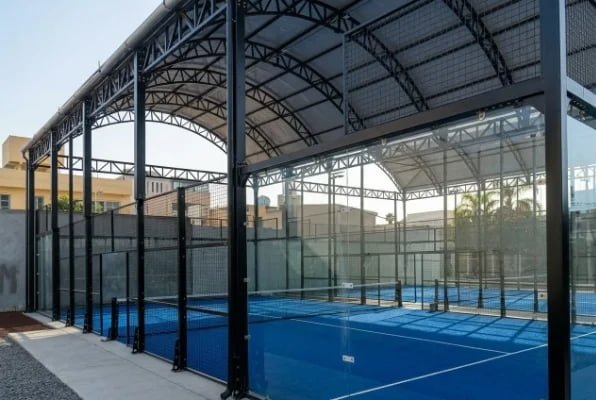
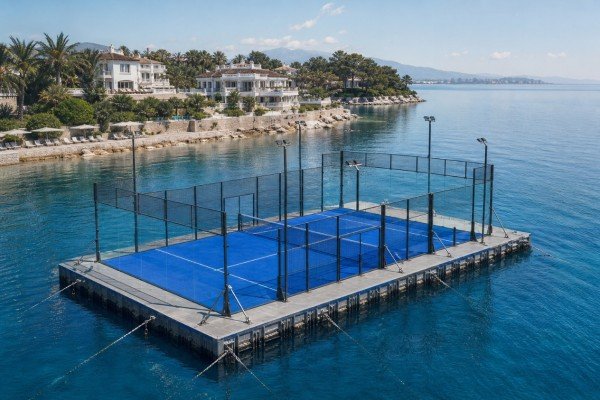
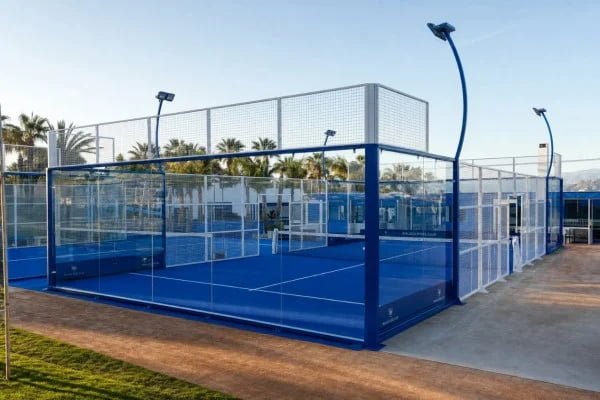
You found the perfect high-traffic location, but local municipalities refuse to approve deep concrete foundations for your project. Waiting months for zoning permits or walking away from prime real estate means you lose thousands in potential revenue. A mobile padel court solves this exact headache by bypassing permanent structural constraints while preserving your physical assets.
A mobile padel court is a highly engineered, self-standing sports enclosure that requires no permanent concrete anchors to the ground. It uses a specialized heavy-duty steel base and internal counterweights to maintain structural integrity. This design allows operators to assemble, dismantle, and relocate the entire court to new commercial locations.
As a B2B manufacturer exporting these systems for over a decade, I see many buyers misunderstand this product. Let us break down the strict engineering reality, the actual return on investment, and the installation requirements you must know before buying a mobile padel court.
Why invest in a mobile padel court instead of a fixed one?
Securing land for a profitable sports facility is stressful and expensive. When your commercial land lease expires in three to five years, leaving behind massive poured concrete foundations becomes a devastating sunk cost.
You should invest in a mobile padel court to bypass complex foundation permits, unlock restricted commercial locations, and protect your capital. Because the structure is completely freestanding, you retain the court as a movable physical asset even after your temporary land lease expires.
Bypassing the Permit Nightmare
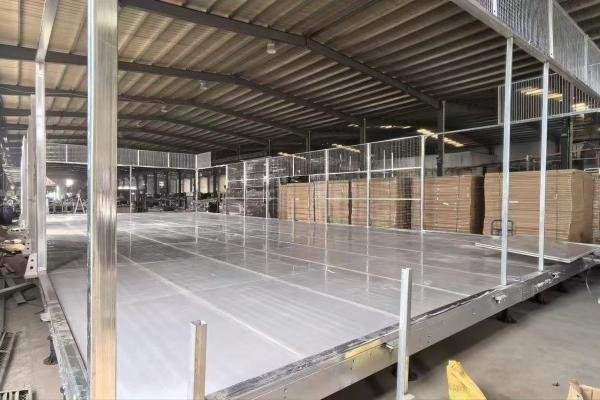
In many European, North American, and Middle Eastern municipalities, pouring a permanent concrete slab triggers a cascade of zoning laws, environmental impact studies, and building permits. This process can stall a commercial project for six to twelve months. Because a mobile padel court is often classified as temporary equipment rather than a permanent building structure, it frequently bypasses these strict civil engineering regulations.1 You can deploy your asset and start generating booking revenue months ahead of your competitors.
Preserving Your Capital Assets
In a standard fixed installation, the concrete foundation represents a significant portion of your capital expenditure (CAPEX). If you operate on a short-term land lease, you abandon that investment when you move. With a mobile padel court, the heavy-duty steel base replaces the concrete. When your lease ends, you unbolt the frame, pack the glass and turf, and take 100% of your sporting asset to your next location.
Unlocking Restricted Real Estate
The highest revenue potential for clubs often lies in high-foot-traffic areas. However, commercial landlords rarely allow structural drilling into mall atriums, public town squares, or commercial rooftops. A self-standing mobile system relies on wide base plates and counterweights, distributing the load safely without permanently altering the landlord’s property. This engineering approach makes you a highly attractive tenant to commercial real estate developers.
Are mobile padel courts cheaper to build?
Many club investors assume that skipping the concrete foundation will instantly slash their total project budget. The truth often catches commercial operators completely off guard.
No, mobile padel courts are not cheaper to manufacture. The initial hardware costs more because they require specialized, heavy-duty steel base plates and counterweight systems to remain secure. However, the true financial return comes from eliminating expensive concrete foundation work and achieving faster operational readiness.
Understanding the Total Cost of Ownership (TCO)
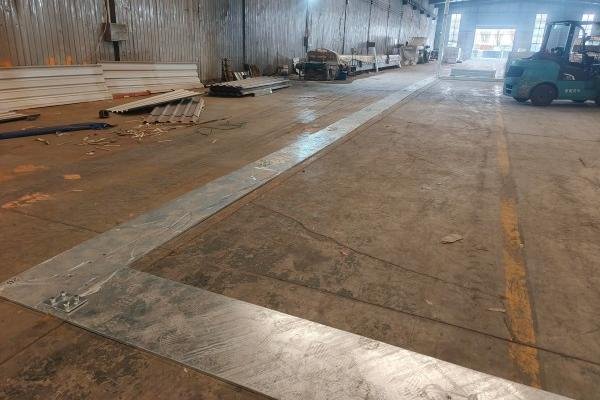
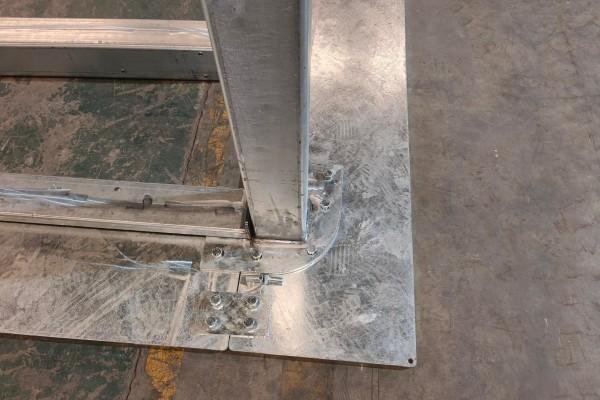
As an exporter producing over 150 complete padel court systems monthly, I always urge our B2B clients to look past the initial invoice. The hardware for a mobile padel court is inherently more expensive. We must manufacture a complex sub-frame out of structural steel (all CE certified in our ISO9001 factory) to replicate the stability of a poured concrete slab.
However, you must calculate the Total Cost of Ownership. Here is how the financial reality breaks down:
| Cost Category | Fixed Padel Court | Mobile Padel Court |
|---|---|---|
| Hardware Costs | Standard base price | Premium price (requires heavy steel sub-frame) |
| Civil Engineering | High (excavation, rebar, poured concrete) | Minimal (only requires an existing flat surface) |
| Permit Delays | 3 to 12 months (lost revenue) | 0 to 4 weeks (faster time-to-market) |
| End of Lease Value | Foundation is abandoned | 100% of the hardware can be relocated |
The ROI of Speed
The real savings of a mobile padel court come from operational speed. If concrete work and municipal permits delay your club’s opening by four months, you lose four months of peak booking revenue. By deploying a mobile system, you start selling court time immediately. The extra hardware cost pays for itself through rapid commercial deployment and zero civil engineering invoices.
Do you need perfectly level ground for a mobile padel court?
The term "mobile" tricks some buyers into thinking they can place these structures on any uneven grassy field, sloped parking lot, or sandy beach. This is a dangerous and costly assumption.
Yes, a mobile padel court requires an absolutely level surface. Failing to provide a perfectly flat base leads to severe engineering failures. Uneven ground causes asymmetric stress on the frame, which can easily shatter the heavy tempered glass, jam entry doors, and ruin the ball’s bounce trajectory.
The Engineering Danger of Uneven Ground
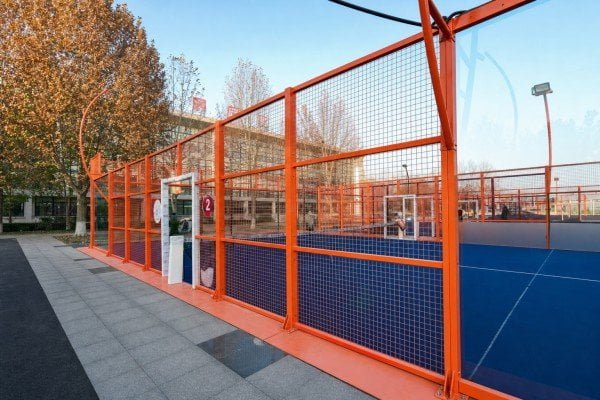
I need to be very clear: installing a mobile padel court is not like building Legos. You are dealing with tons of CE-certified structural steel and large panels of AS/NZS 2208:1996 certified tempered glass. While this glass is incredibly strong against blunt force impacts from players or balls, it is highly vulnerable to torsion and twisting.2
If you place the self-standing steel base on a surface with even a 2-degree slope, the structural posts will lean. When you bolt the rigid tempered glass to a leaning, misaligned frame, you create massive internal stress points. A slight temperature change or a player leaning on the wall will cause the glass to explode into thousands of pieces.3
Structural Integrity and Playability
Beyond the safety hazards of exploding glass, uneven ground destroys the commercial viability of the court. The frame welds will suffer extreme fatigue.4 The access doors will drag and jam. Most importantly, the artificial turf will sit on an undulating surface, causing the ball to bounce unpredictably.
At QHPADEL, we provide precise foundation drawings and installation manuals to engineering and civil contractors. We strictly mandate ground tolerance requirements. If you want to place a mobile padel court on a sloped parking lot, you must first build a perfectly level temporary deck or use specialized, heavy-duty adjustable shims engineered for the exact load of the court.
Can you relocate a mobile padel court without any damage?
You plan to host a pop-up tournament in a city square for a month and then move the court to your permanent indoor club. But relocation is rarely a flawless, frictionless process.
You cannot relocate a mobile padel court with 100% zero damage. Fasteners, screws, and artificial turf naturally suffer wear and tear during dismantling and transit. However, you can minimize this loss by using specialized high-density turf that requires no silica sand infill.
The Reality of Hardware Wear and Tear
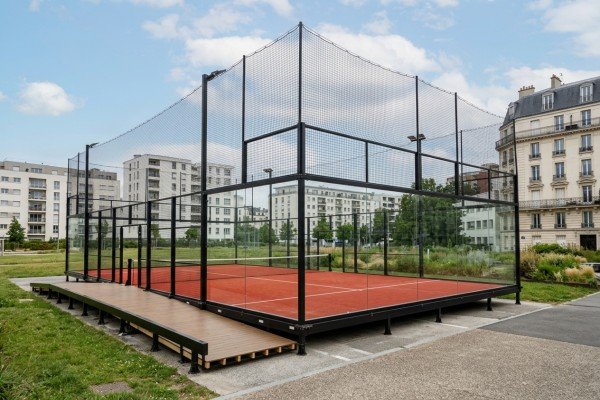
I believe in complete transparency with our equipment distributors and club operators. Every time you dismantle and reassemble a heavy steel structure, the hardware degrades slightly. Threads on screws can strip5, paint can scratch during forklift transit, and specialized brackets can warp.
To manage this, professional operators always maintain a spare parts package. We supply AD 2000 WO certified screws and accessories, and we actively advise buyers to order extra fasteners, a few spare glass panels, and touch-up paint when purchasing a court intended for frequent relocation.
The Sand Infill Problem
The biggest casualty during relocation is usually the artificial turf. Standard padel turf requires thousands of kilograms of silica sand brushed into the fibers to hold it down and provide ball bounce. If you try to roll up a sand-filled carpet to move it, the extreme weight will tear the backing, destroying the turf entirely. Vacuuming out the sand is practically impossible.
The Manufacturer’s Solution: High-Dtex Turf
If you plan to move your mobile padel court, you must order ultra-high-density and high-Dtex artificial turf. This specialized turf creates enough fiber density that it requires little to no silica sand infill to function properly.
Without the massive weight of the sand, your installation crew can easily roll up the turf, transport it safely, and unroll it at the next venue without tearing the base matrix. While QHPADEL’s general minimum order quantity (MOQ) for custom turf specs is 6 courts (1254 sqm), investing in sand-free, high-density turf is a mandatory strategy for event organizers and temporary commercial projects.
How do commercial projects use mobile padel courts?
Traditional sports clubs are often hidden away in industrial parks because of strict zoning laws and the need for massive concrete foundations. This isolation starves your business of high-visibility foot traffic.
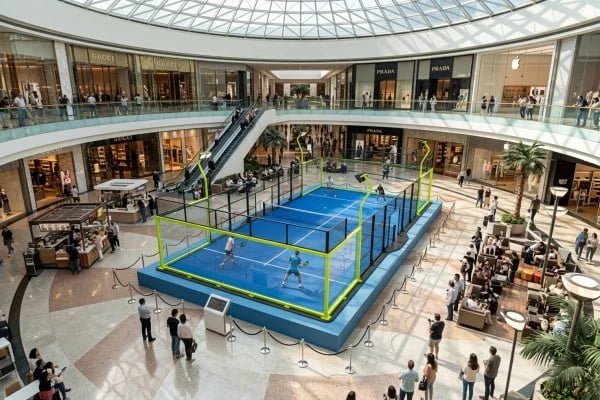
Commercial projects use mobile padel courts to deploy premium sports experiences in high-traffic, restricted real estate. Developers install them in shopping mall atriums, on commercial building rooftops, and at temporary beach resorts where drilling into the ground is strictly prohibited.
Dominating High-Foot-Traffic Areas
Equipment distributors, importers, and brand marketing agencies use mobile courts as powerful customer acquisition tools. Placing a fully functional court in the center of a luxury shopping mall or a busy public plaza immediately draws crowds. Because the self-standing base requires no ground penetration, mall management is much more willing to sign short-term leases for brand activation events.
Rooftop Club Installations
Real estate developers frequently want to monetize empty commercial rooftops. However, penetrating the waterproof membrane of a commercial roof to sink concrete anchors will void building warranties and cause massive water damage. A mobile padel court rests on top of the surface.
When installing on rooftops, engineering contractors must carefully evaluate the wind load and weight distribution. We provide the total weight metrics and AS 61347.2.13:2018 certified LED lighting specifications to ensure the building’s structural engineers can safely approve the rooftop installation.
Government and Public Sector Deployment
Municipal sports bureaus often rely on public procurement to bring sports to local communities. However, they may not want to permanently alter historic town squares or public parks. By deploying a mobile padel court, they can host summer sports camps6 and community tournaments, then dismantle the structures before the winter season, returning the public space to its original state. Comprehensive CE certifications and test reports are critical here to win these public bidding contracts.
Frequently Asked Questions
How long does it take to assemble a mobile padel court?
An experienced civil contractor crew of four to six people can usually assemble a mobile padel court in 4 to 7 days. You must use specialized glass-lifting machinery and strictly follow the factory’s structural numbering and foundation drawings to ensure safety.
Can a mobile padel court withstand high winds?
Yes, provided it is installed according to factory engineering guidelines. The self-standing base must be properly counterweighted. For extreme coastal environments, operators must verify wind-load ratings and may need to temporarily remove the artificial turf and nets during severe hurricane warnings.
What happens if a part goes missing during relocation?
Missing parts halt construction deadlines. B2B buyers should work with manufacturers that provide a complete Bill of Materials (BOM) with clear component numbering, reliable logistics packaging, and immediate spare parts packages to ensure rapid replacement of worn or lost items.
Conclusion
Choosing a mobile padel court is a strategic commercial decision, not a shortcut for cheap construction. While the specialized self-standing steel frames cost more upfront, they generate massive ROI by eliminating concrete costs, bypassing municipal permit delays, and unlocking restricted, high-traffic real estate. Remember to mandate perfectly level ground for installation to prevent structural failure, and always specify high-density, sand-free turf to protect your asset during relocation.
If you are a club operator, civil contractor, or event organizer looking for CE-certified structural accuracy and transparent B2B pricing, QHPADEL has over a decade of export experience to support your project. Contact me, Alice Chen, at alice@grass-supplier.com or via WhatsApp at +86 185 7566 0746 to discuss your complete court packages and technical requirements today.
-
"Do I Need a Permit? (Exemptions)", https://www.tucsonaz.gov/Departments/Planning-Development-Services/Permits/Tucson-Permit-Exemptions. The International Building Code (IBC) and similar regulatory frameworks often provide specific exemptions for temporary structures and equipment, allowing them to bypass the extensive civil engineering requirements mandated for permanent buildings. Evidence role: general_support; source type: institution. Supports: The exemption of temporary structures from permanent building codes.. Scope note: Temporary structure exemptions usually have strict time limits (e.g., 180 days) depending on local laws. ↩
-
"An Overview of Tempered Glass Load Bearing Capability …", https://www.academia.edu/91310809/An_Overview_of_Tempered_Glass_Load_Bearing_Capability_and_Mechanical_Behavior. While the tempering process induces compressive surface stresses that significantly enhance resistance to blunt impact, the material remains highly susceptible to failure when subjected to torsional forces or uneven out-of-plane bending. Evidence role: mechanism; source type: paper. Supports: The vulnerability of tempered glass to torsional stress compared to impact resistance.. ↩
-
"Tempered glass", https://en.wikipedia.org/wiki/Tempered_glass. Spontaneous breakage in tempered glass panels is frequently precipitated by improper installation or frame deflection, which creates localized stress concentrations that are exacerbated by thermal expansion or minor dynamic loads. Evidence role: mechanism; source type: research. Supports: The mechanisms of spontaneous breakage in tempered glass due to frame stress and thermal expansion.. Scope note: Nickel sulfide inclusions are also a primary cause of spontaneous breakage, independent of frame stress. ↩
-
"An Equivalent Structural Stress-Based Frequency-Domain …", https://pmc.ncbi.nlm.nih.gov/articles/PMC10707544/. Differential settlement or uneven foundation support in steel structures introduces unintended secondary stresses and bending moments, significantly accelerating fatigue degradation at welded joints. Evidence role: mechanism; source type: paper. Supports: The effect of uneven foundation settlement on steel frame weld fatigue.. ↩
-
"Component Influence-Driven Fastener Reduction for Robotic … – arXiv", https://arxiv.org/html/2605.21026v1. Repeated tightening and loosening of structural fasteners leads to progressive thread wear, galling, and a reduction in clamping force, limiting the safe reusability of bolts in structural steel applications. Evidence role: mechanism; source type: paper. Supports: The degradation of fasteners and threads during repeated assembly cycles.. ↩
-
"Parks and Recreation – City of Round Rock", https://www.roundrocktexas.gov/city-departments/parks-and-recreation/. Urban planners increasingly utilize temporary, pop-up architectural interventions to activate historic squares and public parks, allowing municipalities to host community events while strictly preserving the site’s permanent heritage fabric. Evidence role: case_reference; source type: paper. Supports: The use of temporary structures by municipalities to activate historic public spaces without permanent alteration.. ↩