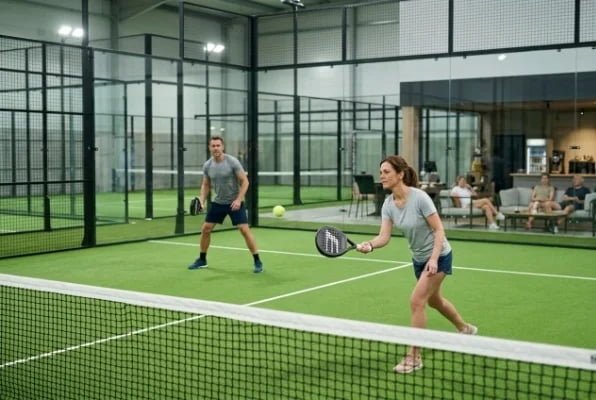
The correct padel grip often confuses beginners, especially players who arrive with strong tennis habits. A familiar forehand grip may initially feel powerful, but it can make backhands, volleys, and wall rebounds harder to manage. I usually suggest starting with the continental grip, then making small, task-specific adjustments with guidance from a qualified coach.
For most beginners, the correct grip for a padel racket is the continental grip, also called the hammer grip1. It provides a neutral racket position for forehands, backhands, volleys, serves, and wall rebounds.2 However, no single grip is universally correct. Players can use limited adjustments when a particular shot, playing level, or physical requirement justifies them.
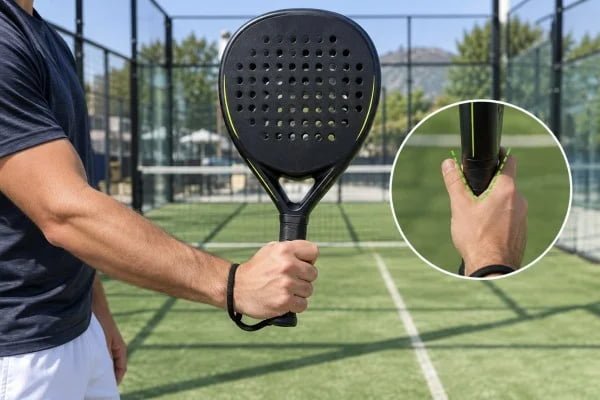
At QHPADEL, I have encountered recurring grip questions from customers and recreational players, although I am not a padel coach. The most useful answer is not simply a grip name. Players need a repeatable way to find the grip, test it, and recognize when an adjustment is becoming too large.
What Is the Correct Padel Grip for Beginners?
A beginner can easily choose a grip based on immediate comfort or forehand power. That choice may work during simple feeds, but padel demands quick reactions on both sides of the body. A grip that favors one stroke too heavily can slow every transition that follows.
The continental grip is the most practical starting grip for a beginner because it keeps the racket face relatively neutral and limits unnecessary hand movement between shots. It supports compact forehands, backhands, volleys, serves, and defensive contacts. Players should treat it as a dependable base position rather than an unbreakable rule for every ball.

Why does a neutral starting position matter?
Padel gives players less preparation time than many beginners expect.3 The court is enclosed, volley exchanges can be fast, and a ball may rebound from the glass before it is returned4. A player who makes a large grip change before every contact adds another decision to an already short sequence.
The continental padel grip helps reduce that problem. It does not optimize every possible stroke, but it keeps the hand close to a usable position for several common tasks. The player can focus on:
- Reading the incoming ball
- Moving into position
- Preparing the racket early
- Controlling the racket face
- Contacting the ball in front or beside the body
- Recovering for the next shot
This task-based approach changes the meaning of “correct.” I would not define the correct grip as the one that produces the hardest forehand during an isolated drill. I would define it as a grip that allows the player to manage the current shot and transition efficiently to the likely next shot.
How does it compare with stronger forehand grips?
Players who come from tennis sometimes keep an eastern or semi-western forehand position. Those grips can feel natural from the baseline, especially when the player wants topspin. However, the same hand position may require a noticeable change before a backhand or volley.
| Evaluation point | Continental grip | Forehand-oriented grip |
|---|---|---|
| Forehand power | Moderate and controllable | May feel more powerful |
| Backhand transition | Usually quick | Often requires a larger change |
| Volley preparation | Neutral starting position | Racket face may need adjustment |
| Wall rebound defense | Suitable for compact reactions | Can be harder during rushed contacts |
| Beginner learning | Simple common reference | Can reinforce one-sided habits |
| Spin potential | Supports slice and controlled variation | Often favors topspin forehands |
The comparison does not make a forehand-oriented grip automatically wrong. Advanced players may alter their grip for selected situations. The concern is that a beginner may copy an aggressive tennis grip without understanding its effect on the next ball.
Recognized coaching providers, including The Padel School and national associations such as the Lawn Tennis Association, commonly present the continental or hammer position as a core beginner reference. I recommend checking current coaching material and asking a qualified padel instructor to confirm the position in person.
How Do You Hold a Continental Padel Grip?
Grip terminology can make a simple action sound unnecessarily technical. A player may hear about bevel numbers, heel-pad placement, and knuckle positions before knowing how the racket should feel. That complexity can lead to overthinking and a tense first lesson.
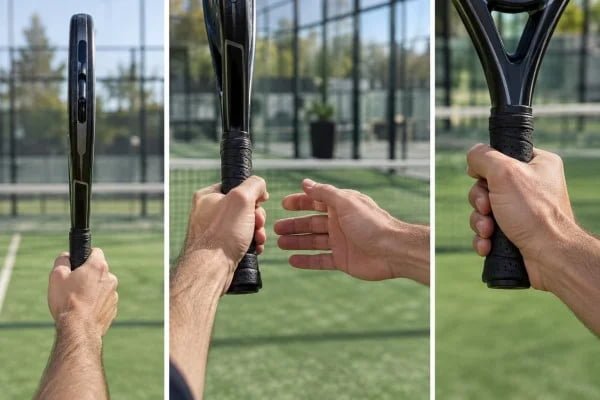
To find a continental padel grip, hold the racket in your non-playing hand with its edge facing upward. Place your playing hand on the handle as if you were shaking hands with it or holding a hammer. Wrap the fingers naturally, keep the wrist neutral, and apply only enough pressure to stop the racket from slipping.
A simple step-by-step method
I suggest using these cues before worrying about bevel numbers:
-
Stand the racket on its edge.
The racket face should point to each side rather than up and down. -
Offer your playing hand to the handle.
Approach it as if you were going to shake hands with another person. -
Wrap your fingers around the handle.
Avoid pressing the fingers flat against the grip. -
Leave a small trigger-finger gap.
The index finger can sit slightly apart from the middle finger instead of being tightly bunched. -
Check the racket face.
When the hand and forearm are in a comfortable neutral position, the face should not be dramatically open or closed. -
Relax the hand.
Hold the racket securely, but avoid constant maximum pressure.
The “hammer” cue is useful because most people recognize the hand position immediately. However, the analogy has limits. A padel swing is not a hammering action, and a player should not use the cue to justify a rigid wrist or forceful downward movement.
What about handle bevels?
Most padel handles have an octagonal shape. Coaches sometimes identify continental placement through numbered bevels, using the base knuckle of the index finger and the heel pad as reference points. However, bevel-number explanations can change according to viewing direction, handedness, and the diagram being used.
For that reason, I prefer the handshake and hammer cues for an initial self-check. A coach can then refine the hand position physically. This avoids a common situation in which two diagrams appear to contradict each other even though they use different numbering conventions.
How tightly should you hold the racket?
A tighter hold does not automatically create more control. Excessive pressure can make the arm feel rigid and may make small racket-face corrections more difficult.5 A very loose grip can also be unreliable because the handle may move during contact.
I use a practical middle-ground test:
- The racket should not twist easily during a gentle blocked contact.
- The fingers should not feel locked around the handle.
- The forearm should not remain rigid between shots.
- The player should be able to release unnecessary tension while waiting.
- The grip should become firmer briefly when stability is needed, rather than staying clenched throughout the rally.
Some coaches use a subjective pressure scale, such as holding the racket at three or four out of ten while waiting. That number is only a teaching cue. It is not a biomechanical standard and will vary with grip size, overgrip condition, hand strength, perspiration, and the shot being played.
Why Does the Correct Padel Grip Improve Transitions?
Beginners often evaluate a grip after hitting only forehands. That test hides an important problem. A position can feel excellent for one stroke but become awkward when the next ball arrives at the body, on the backhand side, near the net, or after the glass.
The correct padel grip should support the next action as well as the current contact. A continental base reduces the size of the grip changes needed between forehands, backhands, volleys, serves, and defensive shots. That efficiency can improve preparation and consistency, particularly during fast exchanges where players have little time to reorganize the hand.

Forehand-to-backhand transitions
A player who uses a strongly forehand-oriented grip may need to rotate the handle significantly for a backhand. That movement may be manageable during a slow baseline exchange. It becomes harder when the player is volleying or responding to a body shot.
The continental position gives both sides of the racket a practical role. The player may still make small changes, but the base position remains close to what the next shot requires.
Net play
Volley exchanges reward short preparation and a stable racket face. A neutral padel racket grip allows a player to prepare the racket in front of the body and move to either side without first rebuilding the hand position.
The grip alone will not create a reliable volley. Footwork, spacing, contact point, racket preparation, and tactical choice remain essential. Still, the grip can remove one unnecessary source of delay.
Wall rebounds
A wall rebound can change the ball’s speed, direction, and available contact point. Beginners sometimes make a large swing because they feel rushed. They may also rotate the grip while turning, which creates another variable before contact.
A continental base can support a compact defensive response. It lets the player concentrate on judging the rebound and creating space between the body and ball. A qualified coach should teach the exact technique because wall positioning cannot be learned from grip instructions alone.
Serves and overheads
Padel serves are underarm and must follow the applicable rules.6 The continental position can support controlled contact and variation without requiring a major change from the ready position. It is also widely used as a foundation for volleys and several overhead shots.
However, overhead technique varies by shot. A bandeja, víbora, controlled smash, and flat attacking smash do not share one identical movement pattern. Advanced players may use subtle adjustments based on their intended trajectory and spin.
I use this decision table as a simple learning framework:
| Situation | Starting recommendation | Main reason |
|---|---|---|
| Ready position | Continental | Fast access to both sides |
| Basic forehand | Continental or minor adjustment | Control and easy recovery |
| Basic backhand | Continental | Stable transition |
| Forehand volley | Continental | Compact preparation |
| Backhand volley | Continental | Minimal grip change |
| Serve | Continental base | Control and variation |
| Wall rebound defense | Continental base | Neutral, compact response |
| Specialized attacking shot | Coach-led adjustment | Technique and level matter |
The word minor matters. A small adjustment can help a specific task. A complete rotation for every shot can make the player late and inconsistent.
What Are the Most Common Padel Grip Mistakes?
Grip errors often survive because they produce occasional good shots. A player hits one powerful forehand and assumes the hand position must be correct. The same player may then mishit several volleys, arrive late on backhands, or squeeze the handle harder to compensate.
The most common mistakes are copying an aggressive tennis forehand grip, squeezing continuously, changing the grip too much between shots, and ignoring grip size or overgrip condition. Players should judge a padel grip by repeatable control and transition speed, not by one powerful contact. Persistent pain requires professional assessment rather than grip experimentation.7
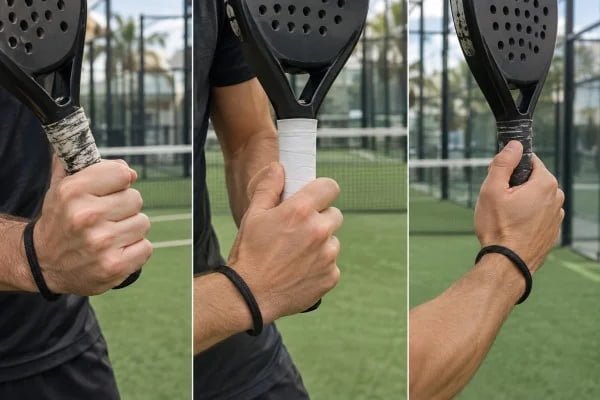
1. Copying a tennis forehand without adaptation
A tennis background can help with tracking, movement, and racket awareness. It can also create habits that do not transfer neatly to padel. A strong semi-western grip may encourage a player to treat every forehand as a topspin groundstroke8, even when the tactical situation calls for a compact block, a low controlled ball, or a quick volley.
The solution is not to forget tennis. The solution is to test whether the existing grip supports padel’s wider range of close-range tasks.
2. Squeezing harder after every mishit
Players often respond to uncertainty by tightening the hand. The racket then feels secure, but the extra tension does not correct late preparation, poor spacing, or an unsuitable racket-face angle.
I suggest diagnosing the mishit first:
- Did the player arrive late?
- Was the ball too close to the body?
- Was the racket face open or closed?
- Did the swing become too large?
- Did the player change the grip during preparation?
- Was the handle wet or the overgrip worn?
A fresh overgrip may improve security more effectively than squeezing harder. Players should also ensure that the handle circumference suits the hand. A qualified racket technician or coach can help evaluate grip size.
3. Making a large change for every shot
Some grip variation is normal. The problem begins when a beginner feels unable to hit any ball without searching for a new hand position. This habit divides attention and slows preparation.
A better progression is:
- Learn one clear continental reference.
- Return to it in the ready position.
- Practice forehand and backhand blocks.
- Add volleys from both sides.
- Introduce wall rebounds.
- Explore small adjustments only when the basic transition remains reliable.
4. Letting the hand slide to an extreme position
A worn, smooth, or damp overgrip can allow the racket to rotate. The player may start with the correct continental position and finish the rally holding an unintended bevel.
Players should inspect the overgrip for:
- A polished or slippery surface
- Tears near the butt cap
- Uneven overlap
- Loss of cushioning
- Movement between the grip layers
- Moisture that prevents secure handling
5. Playing through persistent pain
Temporary muscle fatigue and persistent pain are not the same issue. I am not a medical professional, so I would not diagnose wrist, hand, elbow, or forearm symptoms from a grip description.
A player should stop and seek appropriate advice if pain persists, becomes sharp, worsens, causes weakness or numbness, or affects normal daily use. A qualified coach can examine technique, while a licensed healthcare professional can assess injury concerns. General sports-injury guidance is also available through organizations such as the NHS.
How Can You Check Whether Your Padel Grip Is Working?
A grip may look correct in a photograph but fail during a rally. Static hand placement is only the first test. Players need to see whether the position remains usable under movement, changing ball heights, wall rebounds, and rapid transitions between forehand and backhand contacts.
I would assess a padel grip through four practical criteria: control, transition speed, consistency, and comfort. The player should be able to direct moderate-paced balls, switch sides without searching for the handle, repeat the racket-face position, and finish a session without avoidable hand tension or persistent pain.

Use a simple four-part test
Players can perform this test with a coach or a controlled practice partner.
1. Control test
Hit ten moderate forehands and ten moderate backhands. Avoid maximum speed. Choose a large target area and record how many balls land there.
The test should reveal whether the player can control direction without changing to an extreme grip. It can also show whether the racket face remains predictable.
2. Transition test
Alternate one forehand and one backhand. Start slowly, then increase the feeding pace. The player should note whether the hand remains calm or repeatedly searches for a new position.
A useful padel grip should make the transition feel compact. The shoulders and feet will still move, but the hand should not need a full reset after every ball.
3. Volley test
Block controlled volleys from both sides while keeping the racket in front. The player should avoid large backswing movements.
If one side feels stable and the other feels impossible, the grip may have drifted toward a forehand or backhand extreme. The problem may also involve preparation or contact point, which is why coach observation remains valuable.
4. Comfort test
After the drill, the player should check the hand and forearm. Normal effort is expected, but the player should not assume that pain proves the technique is effective.
| Self-check | Positive sign | Warning sign |
|---|---|---|
| Control | Predictable direction at moderate speed | Random face angle or frequent framing |
| Transition | Small, quick hand adjustment | Regripping before nearly every ball |
| Consistency | Similar setup across repetitions | Grip drifts during the drill |
| Tension | Secure hold with moments of relaxation | Constant clenching |
| Comfort | No persistent pain | Sharp pain, numbness, or worsening symptoms |
Record the grip rather than guessing
A short video can reveal whether the racket rotates during preparation. I would record from behind and from the side, provided the practice area is safe. The footage can help a coach see:
- The ready-position grip
- The size of each hand adjustment
- Racket-face changes
- Contact point
- Forearm tension cues
- Recovery after each shot
Video does not replace professional instruction, but it gives the coach clearer evidence than a verbal description such as “the racket feels strange.”
A grip passes the test when it helps the player solve several common shots reliably. One impressive forehand does not provide enough evidence.
Frequently Asked Questions
Is the continental grip correct for every padel shot?
No. The continental grip is a versatile starting position, not an absolute rule for every shot or player. Advanced players may make small changes for spin, contact height, or a specialized overhead. Beginners should first develop reliable transitions before adding larger grip variations.
Is a padel grip the same as a tennis grip?
The names and basic handle positions overlap, but the playing demands differ. Tennis players may arrive with a strong forehand grip that favors topspin groundstrokes. Padel often requires quicker movement between volleys, backhands, defensive contacts, and rebounds, so a continental base is usually more practical.
Should I change my grip for forehands and backhands?
A small adjustment may be appropriate, but beginners do not usually need an extreme change for every forehand and backhand. Start from the continental position and test whether you can control both sides. A qualified coach can recommend limited changes based on your technique and level.
How hard should I squeeze a padel racket?
You should hold it firmly enough that it does not slip or twist, but you should not clench continuously. Try to keep the hand relaxed in the ready position and add only the stability needed near contact. Replace a slippery overgrip instead of compensating with excessive pressure.
Can the wrong grip cause wrist or elbow pain?
Grip choice, grip size, technique, playing volume, and equipment may all be relevant, but pain cannot be diagnosed from a general article. Stop playing if pain is sharp, persistent, worsening, or associated with weakness or numbness. Consult a qualified healthcare professional and ask a certified coach to review your technique.
Conclusion
The correct padel grip for most beginners is the continental or hammer grip because it provides control and supports quick transitions between common shots. It should remain a flexible starting point rather than a universal rule. Players should test any grip through control, transition speed, consistency, and comfort while avoiding excessive pressure and unnecessary hand rotation. If you are building or operating a padel facility, contact QHPADEL at alice@grass-supplier.com to discuss complete court systems, technical documentation, and project requirements.
-
"Why Every Padel Player Should Use the Continental Grip", https://www.youtube.com/watch?v=nieLTQaeAtM. Coaching guidance describes the continental grip as a handle position commonly taught using a hammer or handshake analogy. Evidence role: definition; source type: education. Supports: That the continental grip is commonly described through a hammer-like or handshake hand position in racket-sport instruction.. Scope note: Terminology and hand-placement diagrams can vary by sport, handedness, and instructional convention. ↩
-
"LEARN THE PRO GRIP IN 60 SECONDS Your padel game …", https://www.instagram.com/reel/DOdTOrtEetJ/?hl=en. Padel coaching materials commonly present the continental grip as a versatile starting position for multiple shot types, including volleys and defensive contacts. Evidence role: general_support; source type: institution. Supports: That padel instruction commonly uses the continental grip as a versatile base position for forehands, backhands, volleys, serves, and defensive play.. Scope note: This supports a coaching convention rather than proving that one grip is optimal for every player or shot. ↩
-
"Padel Match Analysis: Notational and Time-Motion … – PMC", https://pmc.ncbi.nlm.nih.gov/articles/PMC9324445/. Match-analysis research characterizes padel as involving rapid, interactive exchanges in which players must make time-constrained positional and stroke decisions. Evidence role: general_support; source type: paper. Supports: That padel play includes rapid exchanges and time-constrained decision-making, particularly near the net.. Scope note: Such research describes match demands generally and does not directly measure preparation time for novice players. ↩
-
"RULES OF PADEL INTERNATIONAL PADEL FEDERATION", https://www.padelfip.com/wp-content/uploads/2025/12/FIP_Rules-of-Padel.pdf. The official Rules of Padel permit play to continue when a ball bounces on the court and then rebounds from an authorized wall before being returned. Evidence role: definition; source type: institution. Supports: That the official rules permit a player to return the ball after it has bounced and subsequently contacted a court wall on that player’s side.. Scope note: The applicable outcome depends on the sequence of contacts and the full conditions specified in the current rules. ↩
-
"Evaluating tennis player performance based on different types …", https://pmc.ncbi.nlm.nih.gov/articles/PMC13088397/. Biomechanical studies of racket-sport strokes associate higher grip force with increased forearm muscular loading and altered control of the implement. Evidence role: mechanism; source type: paper. Supports: That increased grip force is associated with greater forearm muscle activation or co-contraction and can affect fine motor control in racket-sport tasks.. Scope note: Evidence from tennis or laboratory tasks may not directly quantify the effect of grip pressure on padel racket-face corrections. ↩
-
"Documents", https://www.padelfip.com/documents/. The official Rules of Padel specify an underhand service procedure, including requirements governing the bounce and point of contact. Evidence role: definition; source type: institution. Supports: That padel service is governed by official requirements including an underhand strike after the ball is bounced.. Scope note: Readers should consult the current governing-body rules for the complete and potentially updated service provisions. ↩
-
"Elbow pain: a guide to assessment and management in … – PMC", https://pmc.ncbi.nlm.nih.gov/articles/PMC4617264/. Public-health guidance advises seeking medical assessment for pain that is persistent, severe, worsening, or accompanied by symptoms such as weakness or numbness. Evidence role: expert_consensus; source type: government. Supports: That persistent, severe, worsening, or neurologically associated musculoskeletal symptoms warrant clinical assessment.. Scope note: General guidance cannot diagnose the cause of an individual player’s wrist, hand, elbow, or forearm symptoms. ↩
-
"Effects of Grip Style and Contact Point on Force Production in …", https://pmc.ncbi.nlm.nih.gov/articles/PMC11658165/. Tennis stroke literature links forehand grip configuration, including semi-western positions, to racket orientations commonly used for topspin production. Evidence role: mechanism; source type: paper. Supports: That forehand grip configuration influences racket orientation and is commonly linked to topspin-oriented stroke production in tennis.. Scope note: This association does not show that a semi-western grip necessarily causes inappropriate tactical choices in padel. ↩