Padel growing in the US has attracted attention from sports-facility investors, contractors, and equipment distributors. However, national excitement can hide weak local demand, difficult permitting, or unrealistic cost assumptions. I believe buyers should examine both sides: why participation and court access reinforce each other, and whether that momentum can support a buildable local project.
Padel is growing in the US because its social doubles format encourages participation while new clubs, courts, tournaments, contractors, and distributors make the sport easier to discover and play.1 This creates a feedback loop between demand and access. However, rising participation alone does not prove that every proposed club or court will be commercially viable.
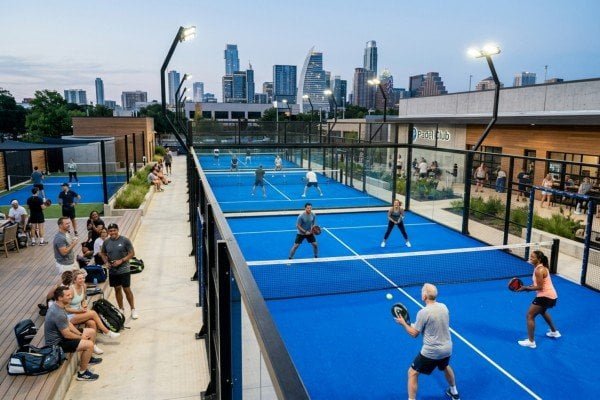
I see credible momentum, but I do not treat inquiries or announcements as proof of national profitability. Buyers need to separate player interest, facility growth, and project economics. That distinction explains both the opportunity and the risks behind padel’s U.S. expansion.
Why Is Padel Growing in the US Now?
Padel growing in the US is sometimes explained with one simple statement: the sport is easy to learn. That explanation is incomplete. A sport can attract first-time players and still struggle to retain them. Sustainable growth depends on repeat participation, accessible courts, social communities, organized competition, and reliable venue operations.
Padel is expanding because its doubles-based format supports social play, while increasing court availability gives more people an opportunity to try it. Clubs, coaches, tournaments, and online booking platforms then improve visibility and encourage repeat participation. The combination matters more than any single feature of the sport.
The Format Supports Social Participation
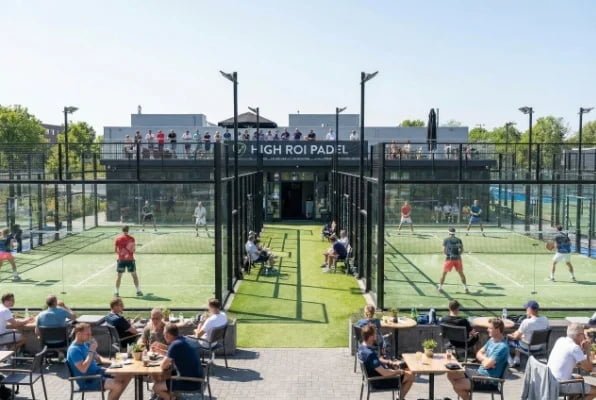
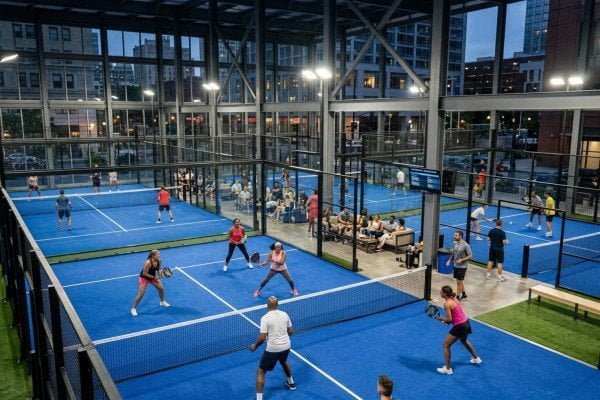
A standard padel court is designed for doubles play. Four participants therefore share each booking. This structure can help clubs form groups, leagues, social events, and corporate sessions. The enclosed court also produces a style of play that differs from tennis and pickleball.
I would not claim that every beginner finds padel easy. Players still need to understand positioning, rebounds, shot selection, and partner coordination. However, many newcomers can start a rally without first developing an advanced serve or powerful groundstroke. That can reduce the barrier to an enjoyable introductory session.
The commercial value comes from repeat participation rather than initial curiosity. A strong venue usually gives new players several reasons to return:
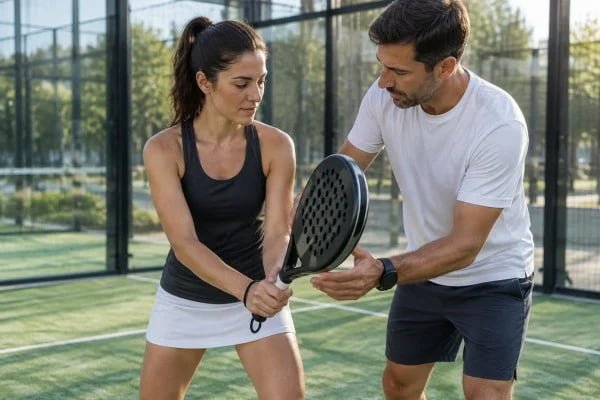
- Beginner clinics with qualified coaches
- Social matches arranged by level
- Leagues and ladders
- Corporate or private events
- Junior and family programs
- Local competitions
- Food, beverage, or social areas
- Simple booking and player-matching tools
Access and Awareness Reinforce Each Other
Padel can only grow where people can reach a court. Consumers may watch international matches online, but viewing activity does not automatically create a local playing habit. A suitable facility must open within a practical travel radius, offer convenient booking times, and introduce players to the game.
The growth cycle often looks like this:
- A developer or club installs the first courts in a local area.
- The venue markets trial sessions and beginner events.
- New players introduce friends, colleagues, and family members.
- Coaches and organizers create recurring programs.
- Booking activity makes the sport more visible.
- Other investors or existing clubs consider additional courts.
This feedback loop helps explain padel growing in the US, but buyers should verify its local strength. A full court in Miami, New York, or another established market does not prove that the same operating model will work in a smaller metropolitan area.
Buyers Should Use U.S.-Specific Evidence
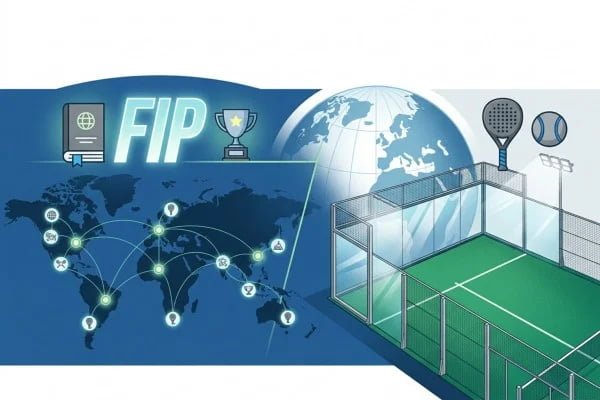
I recommend using multiple evidence sources rather than repeating one promotional market forecast. Useful sources include the United States Padel Association’s facility and competition information, the International Padel Federation’s country and tournament reporting, local planning records, and actual booking availability at nearby clubs.
| Evidence source | What it can show | What it cannot prove |
|---|---|---|
| USPA club or facility information | Named U.S. locations and organized activity | Audited national participation |
| FIP reports and tournament calendars | Internationally recognized competition and country-level development | Profitability of an individual club |
| Local permit records | Projects that have entered a formal approval process | Whether the venue will open on time |
| Club booking platforms | Prices, schedules, and visible availability | Complete utilization or financial performance |
| Google Trends | Relative search interest over time | Number of players or paid bookings |
| Distributor and supplier inquiries | Commercial interest in court procurement | Market-wide demand |
Published court and player totals can change quickly. Organizations may also count facilities, courts, players, or registered members differently.2 I always recommend checking the publication date, geographic definition, and methodology before using a figure in an investment presentation.
I treat customer inquiries as supplier-side signals. I do not treat them as a national participation survey.
How Does New Court Supply Support Padel Growing in the US?
Interest without courts creates frustrated potential players. Courts without sufficient demand create underused assets. The U.S. market therefore needs both sides to develop together. New clubs improve physical access, while contractors, importers, coaches, and distributors reduce some of the operational barriers associated with opening more venues.
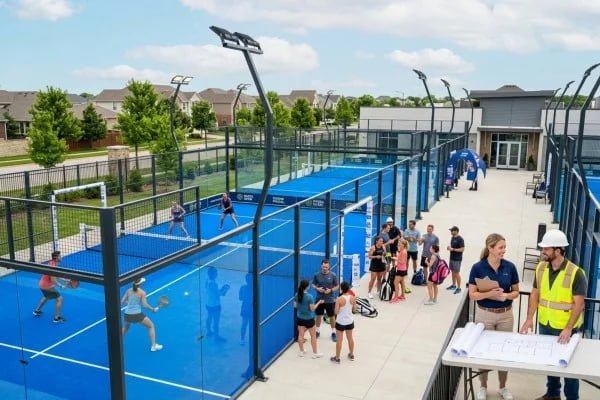
New court supply supports padel growing in the US by placing the sport closer to potential players and making trial sessions possible. Each operational venue can also create local coaches, leagues, tournaments, and social communities. These activities raise awareness and may give developers stronger evidence when evaluating additional locations.
Facilities Turn Awareness Into Participation
A potential player may be interested in padel but unwilling to travel an hour for a match. This issue makes geographic access critical.3 Buyers should not view a national court count as the only relevant measure. They should examine courts per local catchment area, travel time, operating hours, and peak-time availability.
For example, ten courts concentrated in one destination club may serve the market differently from ten courts distributed among several neighborhoods. The destination venue may support tournaments and premium hospitality. The distributed model may offer shorter travel times and more convenient weekly play.
I have seen U.S. inquiries become more detailed as buyers move from general interest to project planning. Early questions often concern court styles and indicative prices. Later questions usually address:
- Foundation and anchor requirements
- Installation drawings
- Structural documentation
- Tempered-glass specifications
- Lighting layouts
- Component numbering
- Container loading
- Replacement glass and spare parts
- Installation supervision
- Delivery scheduling
These questions do not prove that the whole U.S. market is expanding at a particular rate. However, they show what prospective importers, contractors, and distributors need before interest can become a physical facility.
A Stronger Supply Chain Reduces Development Friction
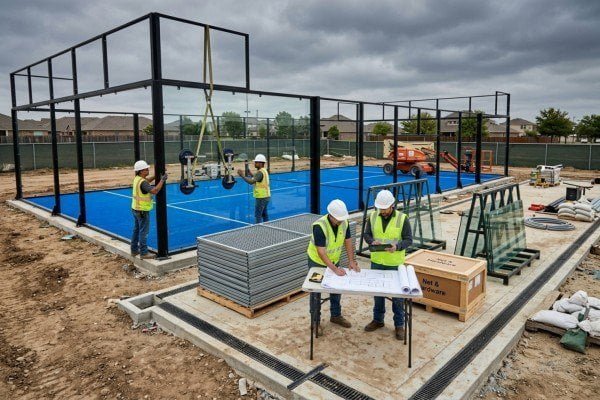
Padel facilities require more than turf and glass. A complete court package commonly involves a steel frame, welded mesh, structural posts, tempered glass, artificial turf, lighting, nets, fasteners, and installation accessories. The site itself needs foundations, drainage, access, power, and code-compliant construction.
As local contractors gain installation experience, they can estimate labor and project schedules more accurately. Importers can also stock common replacement items. Those capabilities may reduce the perceived risk for later projects.
Buyers should still evaluate every supplier independently. I suggest checking the following items before placing an order:
- Complete bill of materials: Buyers should confirm quantities, descriptions, and component references.
- Coordinated drawings: Foundation, pre-embedding, electrical, and installation documents should agree.
- Packing control: Packages should use clear labels that correspond with the drawings.
- Replacement process: The contract should explain how missing or damaged parts will be handled.
- Installation responsibility: The parties should define which issues belong to manufacturing and which belong to site installation.
- Document verification: Buyers should review certificate scope, issuing body, model reference, and validity.
- Local professional review: A licensed engineer and relevant authorities should confirm application-specific structural and code requirements.
At QHPADEL, I see buyers ask for complete packages because coordinating multiple unconnected vendors can increase missing-part and schedule risks. That observation reflects our procurement discussions. It does not mean one sourcing method is correct for every project.
What Could Stop Padel Growing in the US Locally?
Positive market headlines can encourage buyers to move too quickly. The difficult part often begins after a location has been identified. Zoning restrictions, foundation costs, drainage, structural review, installation coordination, freight delays, and incomplete packages can turn a promising idea into an expensive or delayed project.4
Padel growing in the US can slow at the local level when developers underestimate site preparation, permits, construction costs, weather conditions, or installation requirements. A viable project needs more than player interest. It needs a suitable site, approved design, complete procurement plan, qualified installers, realistic schedule, and dependable replacement support.
Site Suitability Comes Before Equipment Selection
The internal playing area of a standard padel court is generally 20 meters by 10 meters, but the actual project footprint must be larger. The site needs structural supports, circulation space, entrances, drainage, maintenance access, and any setbacks required by local authorities.
An indoor facility must also provide adequate clear height and account for lighting, roof structures, fire systems, ventilation, and other building services. An outdoor project must consider wind exposure, rainwater, corrosion conditions, snow where applicable, and neighboring properties.
A buyer should investigate at least these site questions:
- Does the proposed use comply with zoning rules?
- Will the facility require a conditional-use permit?
- Does the slab or foundation meet the required tolerances?
- Can the soil support the proposed foundation design?
- Where will stormwater go?
- Will lighting affect adjacent properties?
- Can trucks and lifting equipment reach the installation area?
- Does the site have sufficient electrical capacity?
- Will noise require assessment or mitigation?
- Can emergency exits and accessible routes remain unobstructed?
A court supplier should provide relevant loads, layouts, and technical documents. However, the supplier should not replace a licensed local engineer, geotechnical consultant, architect, electrician, or code official.
Freight and Packing Can Affect Installation
International procurement adds another layer of coordination. Buyers need to compare more than an ex-factory equipment price. They should consider inland transport, export handling, ocean freight, insurance, customs duties, port charges, brokerage, local delivery, unloading, storage, and installation labor.5
A low quotation can become expensive if the scope excludes critical items. Buyers should request a written inclusion and exclusion list covering:
| Procurement item | Question for the supplier |
|---|---|
| Steel structure | Are all posts, frames, mesh panels, and plates included? |
| Glass | What thickness, treatment, hole pattern, and edge finish apply? |
| Turf | What pile, Dtex, density, backing, roll plan, and infill assumptions apply? |
| Lighting | Are fixtures, mounting parts, cables, controls, and drivers included? |
| Fasteners | Does the package contain every bolt, screw, washer, and anchor? |
| Drawings | Are foundation and installation drawings included before shipment? |
| Packaging | Does each package have a component code and packing reference? |
| Spares | Are replacement glass, lights, turf, or fasteners available? |
| Support | What remote or on-site installation assistance is included? |
I once reviewed a project discussion in which the buyer initially focused almost entirely on the frame price. The conversation changed after the contractor asked who would supply the anchors, unloading plan, foundation information, and replacement glass. That experience reminded me that a court price and an installed project cost are not the same thing.
Documentation Requires Verification
Certificates can help a procurement team assess a product, but a certificate title alone is not sufficient. Buyers should check whether the document covers the exact manufacturer, factory, component, model, and standard quoted.
QHPADEL can provide documentation associated with its factory and components, including ISO 9001 and various CE, RoHS, AS/NZS, PED, and related records. I encourage buyers to verify those documents and confirm their relevance with qualified professionals. A certificate for one component does not establish compliance for an entire U.S. facility, and overseas documentation does not replace local approval.6
How Should Buyers Evaluate Whether Padel Growth in the US Supports a Project?
A growing sport can still produce an unsuccessful venue. Buyers sometimes connect national participation headlines directly to local revenue projections. That shortcut ignores travel behavior, competition, pricing, seasonal demand, operating expenses, and construction costs. A project needs evidence from the specific catchment area it intends to serve.
Buyers should evaluate padel growth in the US through a local feasibility study. The study should estimate reachable players, competing courts, achievable pricing, expected utilization, peak and off-peak demand, construction costs, landed equipment costs, staffing, maintenance, and financing. Conservative scenarios are more useful than a single optimistic forecast.

Start With the Local Catchment
I would begin by defining reasonable drive-time zones around the site. The analysis could use 10-, 20-, and 30-minute catchments, depending on traffic and the type of venue. A destination club may draw from farther away than a basic neighborhood facility.
The buyer should then examine:
- Population and household characteristics
- Existing racket-sport participation
- Nearby padel facilities
- Court pricing and membership plans
- Peak-time booking availability
- Corporate and university populations
- Indoor versus outdoor seasonality
- Local coaches and community organizers
- Competing leisure and fitness options
Surveys can provide useful information, but stated interest is weaker than paid behavior.7 A prospect who says “I would try padel” has not yet committed to a weekly booking. Buyers can collect stronger evidence through paid pop-up events, founding memberships, deposits, corporate commitments, or partnerships with existing sports clubs.
Model Court Utilization Carefully
A simple revenue model starts with available court hours:
Annual court revenue = number of courts × sellable hours × utilization × average realized court price
Every variable requires care. “Sellable hours” should exclude maintenance closures and hours when customer demand is unrealistic. Utilization should vary by day and time. The realized rate should account for discounts, memberships, promotions, and complimentary sessions.
For illustration only, consider one court with 14 sellable hours per day and an average realized booking value of $60 per hour:
| Utilization assumption | Booked hours per day | Illustrative annual court revenue |
|---|---|---|
| 25% | 3.5 | $76,650 |
| 40% | 5.6 | $122,640 |
| 55% | 7.7 | $168,630 |
These figures assume 365 operating days and do not include taxes, downtime, discounts beyond the realized rate, or any operating expenses. They are not a forecast or profitability claim.
The project must still pay for items such as:
- Rent or property costs
- Payroll and coaching
- Utilities and lighting
- Insurance
- Booking software
- Marketing
- Cleaning and maintenance
- Turf and component replacement
- Debt service
- Taxes and professional fees
A qualified financial adviser should review investment assumptions. A licensed engineer and local contractors should develop construction budgets.
Compare Scenarios Rather Than One Forecast
I recommend building at least three scenarios:
- Downside case: Opening delays, slow customer acquisition, lower utilization, and higher construction costs.
- Base case: Evidence-supported pricing and gradual demand development.
- Upside case: Strong leagues, corporate bookings, coaching, and efficient peak-time use.
The downside case matters because permit or construction delays may create expenses before the club earns revenue. Buyers should also test what happens if equipment freight rises, the opening date moves by six months, or the facility requires unexpected acoustic, drainage, or structural work.
Padel growing in the US provides a reason to investigate. It does not remove the need for disciplined underwriting.
What Should U.S. Buyers Check When Selecting a Padel Court Supplier?
Growing demand can attract experienced manufacturers as well as inexperienced trading companies. A buyer may receive quotations that look similar but contain different structural assumptions, component scopes, documentation, packaging methods, and service obligations. Those differences can become visible only after foundations have been poured or containers have arrived.
U.S. buyers should evaluate a padel court supplier through drawings, bills of materials, quality records, production controls, packaging plans, delivery history, and replacement procedures. Buyers should also ask qualified professionals to review structural, electrical, foundation, and code-related requirements for the actual project location.
Use a Document-Based Supplier Review
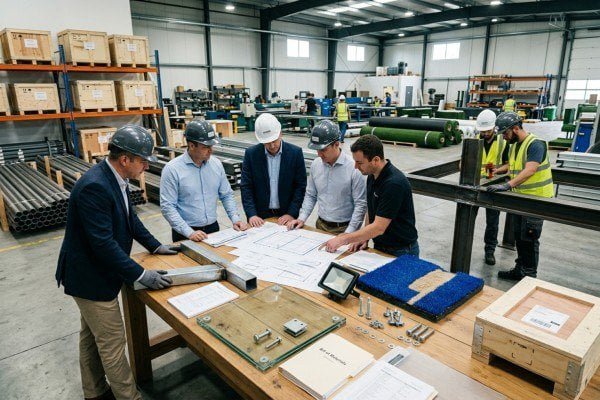
I recommend asking every shortlisted supplier for the same information. A standardized request makes comparisons more reliable.
A practical evaluation package should include:
- Company registration and factory details
- Manufacturing scope and subcontracted items
- Product drawings and component schedules
- Complete bill of materials
- Material and finish specifications
- Glass documentation
- Turf data sheet and test records
- Lighting information
- Installation manual
- Foundation or pre-embedding guidance
- Packaging and container-loading plan
- Quality inspection process
- Warranty terms and exclusions
- Missing-part and replacement procedure
- Production and delivery schedule
- References for comparable export projects
Buyers should confirm whether a quotation covers one complete operational court or only selected structural components. They should also clarify whether the supplier’s price includes freight, customs costs, unloading, installation, civil works, electrical connections, infill, or specialized lifting equipment.
Match the Court to the Project
Court selection should follow the business model and site conditions. A panoramic court may improve spectator views and visual presentation. An ultra-panoramic design may support a premium concept. A classic system may suit another budget or operational purpose. However, design labels are not standardized across every manufacturer.
I suggest comparing actual drawings rather than names. Buyers should review:
- Number and location of structural posts
- Steel sections and connection details
- Glass configuration
- Mesh layout
- Door positions
- Lighting-post arrangement
- Turf specification
- Corrosion-protection system
- Foundation interface
- Maintenance and replacement access
Site-specific wind, seismic, snow, and other loads require professional assessment. A supplier may offer a product described as reinforced or hurricane resistant, but a marketing name does not establish suitability for a particular jurisdiction. A local engineer should review the structure, foundations, connections, and applicable codes.
Evaluate Capacity Without Relying on Capacity Claims Alone
Production capacity matters when a distributor or chain plans multiple installations. However, buyers should verify whether stated capacity applies to the relevant product and delivery period.
At QHPADEL, our facility operates ten production lines and reports monthly output exceeding 1.5 million square meters of artificial turf and 150 complete court systems. Our standard planning guidance allows approximately 20 days for two courts, 20–25 days for four courts, and no more than 30 days for larger standard orders. Custom designs may require up to 35 days.
I present these figures as our stated factory capabilities, not guaranteed timelines for every order. Material availability, customization, inspection, holidays, shipping schedules, and contract terms can change the final delivery plan. Buyers should place milestones and responsibilities in the purchase agreement.
Frequently Asked Questions
Is padel the same as pickleball?
No. Padel and pickleball use different courts, rackets, balls, rules, and playing systems. Padel normally uses an enclosed 20-by-10-meter court where glass walls form part of play. Buyers should never use pickleball participation statistics or facility assumptions as evidence for a padel project.
How can I confirm whether my U.S. city has enough demand for padel?
I recommend reviewing drive-time demographics, nearby courts, booking availability, local racket-sport communities, and achievable prices. Buyers can test demand with paid introductory events, pre-opening memberships, corporate commitments, or deposits. A national growth statistic cannot replace evidence from the proposed venue’s catchment area.
How much space does a padel court project require?
The standard internal playing area is 20 meters by 10 meters, but a project needs additional space for the enclosure, entrances, circulation, maintenance, drainage, accessibility, and code-required clearances. Indoor projects also need suitable clear height. A local architect or engineer should confirm the total site requirement.
Which certificates should a U.S. buyer request?
The buyer should request certificates and test reports relevant to the steel, glass, turf, lighting, fasteners, and manufacturing system. The buyer should verify the issuing body, standard, model, scope, and validity. Local professionals must still determine whether the complete installation satisfies applicable U.S. codes and project requirements.
Conclusion
Padel growing in the US reflects a reinforcing cycle of player interest, better court access, new clubs, organized competition, and a developing supply chain. However, national momentum does not guarantee local profitability. Buyers should validate catchment demand, permits, site conditions, total project costs, utilization, supplier documentation, and installation responsibilities before investing.
-
"A gradual and steady growth, the Miami Premier, and the … – Padel FIP", https://www.padelfip.com/2025/03/a-gradual-and-steady-growth-the-miami-premier-and-the-boom-of-professionals-this-is-how-the-u-s-says-yes-to-padel/. International Padel Federation reporting and United States Padel Association facility and competition records document the expansion of organized padel activity in the United States; these administrative sources indicate market development but do not establish that the listed factors caused participation growth or that individual venues are profitable. Evidence role: general_support; source type: institution. Supports: FIP and USPA records should document the expansion of organized padel activity, competitions, and court access in the United States.. Scope note: Federation directories and calendars measure organized activity rather than audited participation, causation, or commercial performance. ↩
-
"FIP PROMISES SAN FRANCISCO, CA 2026 | Padel FIP", https://www.padelfip.com/events/fip-promises-san-francisco-ca-2026/. Federation reports distinguish among clubs, courts, registered competitors, and estimated participants, demonstrating that these figures represent different units of analysis; the distinction does not by itself show that every published market estimate is methodologically incompatible. Evidence role: general_support; source type: institution. Supports: Federation reports and directories should show that courts, clubs, registered competitors, and estimated players are distinct measures.. Scope note: Direct comparison still requires reviewing the definitions, dates, and geographic coverage of each individual source. ↩
-
"Development of a Nationally Representative Built …", https://www.cdc.gov/pcd/issues/2015/14_0378.htm. Studies of the built environment generally associate closer or more convenient access to recreational facilities with greater physical-activity participation; this supports treating travel time as a relevant demand variable, although it does not establish a universal travel threshold for padel players. Evidence role: mechanism; source type: paper. Supports: Research should establish an association between access to recreational facilities and participation in physical activity or organized sport.. Scope note: Most accessibility studies concern physical activity or sports facilities generally rather than U.S. padel specifically. ↩
-
"ARTICLE II. ZONING DISTRICT REGULATIONS", https://www.hendersoncountync.gov/code-document/article-ii-zoning-district-regulations. Construction-delay research and public permitting guidance identify regulatory approvals, unforeseen site conditions, design coordination, and material procurement as recurring sources of schedule disruption and cost escalation; the relative importance of each factor depends on the project and jurisdiction. Evidence role: mechanism; source type: research. Supports: Construction research and public permitting guidance should identify approvals, unforeseen site conditions, design coordination, and procurement delays as sources of schedule and cost risk.. Scope note: General construction evidence does not quantify the likelihood or financial effect of these risks for a particular padel facility. ↩
-
"Determine Total Export Price – International Trade Administration", https://www.trade.gov/determine-total-export-price. U.S. import guidance treats customs duties, transportation, insurance, brokerage, and handling as costs that may arise in addition to the supplier’s sale price; installation and domestic site work are further project costs rather than customs components of landed value. Evidence role: definition; source type: government. Supports: Government import guidance should explain that the purchase price is only one component of the total cost of bringing imported goods to their destination.. Scope note: The exact allocation of charges depends on the contract, Incoterm, tariff classification, shipment route, and service scope. ↩
-
"[PDF] THE ABC’s OF THE U.S. CONFORMITY ASSESSMENT SYSTEM", https://nvlpubs.nist.gov/nistpubs/Legacy/IR/nistir6014.pdf. U.S. conformity-assessment guidance emphasizes that a certificate applies only to its stated product, standard, and scope, while code acceptance of the assembled facility remains subject to the applicable regulatory authority; guidance concerning electrical listings or other specific components should not be generalized beyond its formal scope. Evidence role: general_support; source type: government. Supports: U.S. conformity-assessment and safety guidance should show that certification has a defined scope and that local authorities determine acceptance under applicable codes.. Scope note: Approval procedures differ by jurisdiction and by whether the document concerns structural, electrical, fire-safety, or other requirements. ↩
-
"Why We Don’t “Just Do It”: Understanding the Intention … – PMC", https://pmc.ncbi.nlm.nih.gov/articles/PMC6125069/. Meta-analytic research documents a persistent intention–behavior gap, under which stated plans or willingness do not consistently translate into subsequent action; this supports assigning greater evidentiary weight to deposits, purchases, or other observed commitments, although such behavior may still be affected by price and availability. Evidence role: expert_consensus; source type: paper. Supports: Behavioral and consumer research should document the intention–behavior gap and the limitations of treating stated willingness as equivalent to actual purchasing behavior.. Scope note: General intention–behavior findings do not specify the conversion rate from interest to paid participation in padel. ↩