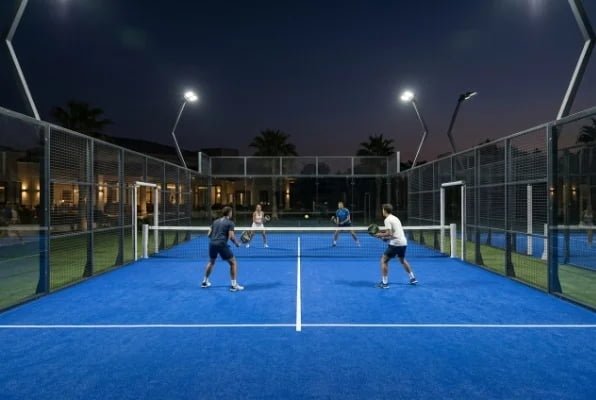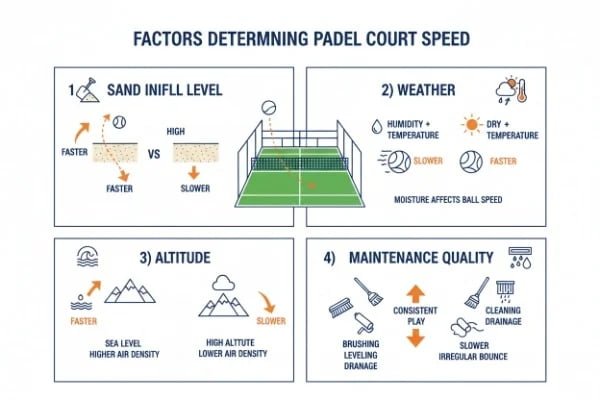

Many new club investors ask me what the sand used for on a padel court actually does, often viewing it as a messy nuisance. They want to skip the sand to keep their vibrant blue courts looking pristine, but this aesthetic choice creates a massive structural problem. Without sand, your expensive padel turf will rapidly degrade.
The sand used for on a padel court acts as the structural anchor and protective armor for the artificial turf. It weighs the grass down to prevent wrinkling, protects the fiber base from being crushed by player foot traffic, provides necessary sliding friction, and ensures a consistent, predictable ball bounce1.
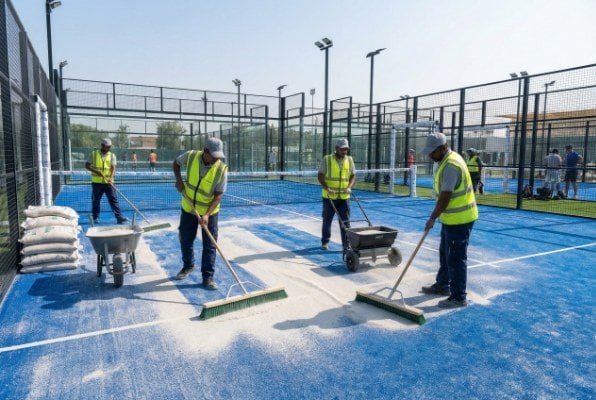
Understanding this infill material goes far beyond gameplay preferences. As an exporter of complete padel court systems, I want to break down exactly how sand protects your capital investment, why the wrong sand will destroy your turf, and how to source the right material locally.
Why is the sand used for on a padel court structurally necessary?
Padel is an intense sport with aggressive starts, stops, and slides. If your turf lacks proper ballasting, the physical shear force from players will stretch and tear the artificial grass joints2. This leads to costly early replacements and facility downtime.
The sand used for on a padel court is structurally necessary because it acts as ballasting weight. It holds the turf flat against the concrete foundation, prevents joint shifting, absorbs the impact of heavy foot traffic, and keeps the artificial grass fibers standing upright for optimal ball performance.
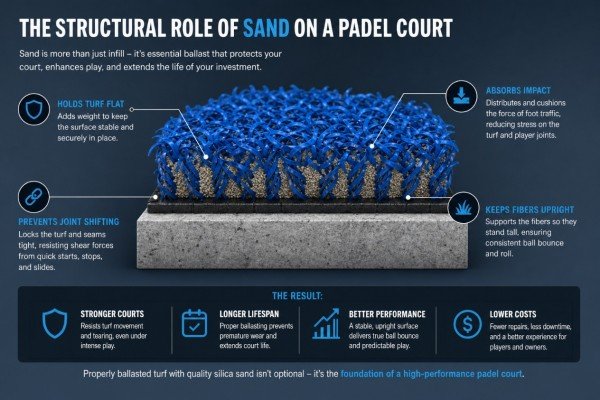
To truly grasp the importance of this infill, club operators must view it as a core component of the court’s engineering rather than a mere accessory. I always explain to buyers that sand provides two critical mechanical functions: acting as the anchor and the armor.
The Anchor Effect
Padel artificial turf is manufactured and shipped in massive, heavy rolls. During installation, these rolls are laid out and the seams are glued together over a concrete or porous asphalt base. However, the turf is rarely glued directly to the hardscape across the entire surface. When a player sprints and stops abruptly, they generate immense lateral shear force. Without enough weight, the turf will wrinkle, bunch up, and eventually rip at the glued seams. The sand adds tons of evenly distributed weight across the 200 square meters of the court, firmly locking the carpet to the foundation.
The Armor Effect
Even high-quality polyethylene (PE) grass fibers are vulnerable to crushing under constant human weight. The sand fills the microscopic voids between the individual grass yarns. When a player steps heavily, the impact is absorbed by the dense sand bed rather than the fragile base of the plastic fibers. Without this armor, the grass will flatten permanently—a condition known as "fibrillation failure."3
Furthermore, the sand is entirely responsible for the mechanics of the game. A consistent ball bounce requires a firm, dense surface. Too little sand results in a "dead bounce" where the ball’s kinetic energy is absorbed by the empty plastic fibers. By strictly maintaining your sand levels, you are actively protecting your club’s capital investment and ensuring compliance with professional playability standards.
What type of sand is used for on a padel court?
Sourcing the wrong sand is a fatal material mistake I see civil contractors make frequently to save a few dollars. Using standard construction sand will literally destroy your turf from the inside out. You need highly specific infill to protect the court.
The correct sand used for on a padel court is strictly washed, round or spherical silica sand with a grain size of 0.4mm to 0.8mm. Round silica sand prevents fiber damage, whereas sharp, angular construction sand acts like microscopic razor blades that slice the artificial grass.
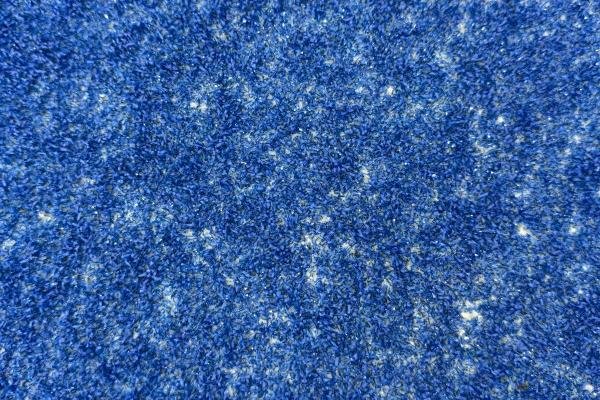
When local engineering and civil contractors are responsible for site preparation, they often attempt to use leftover sand from foundation work. This is a catastrophic error. As a factory supplier, I frequently review warranty claims for prematurely failing turf, and the culprit is often improper sand procurement.
The Danger of Angular Sand
Standard river sand or construction sand is highly angular. Under a microscope, these sand particles feature sharp, jagged edges. When a 180-pound player steps on this sand, those jagged edges grind against the artificial grass yarns. Over a few months, this acts like microscopic razor blades, permanently severing the fibers and leaving your court bald.
Procurement Specifications for Padel Sand
When you go to a local supplier to buy sand for your new installation, you must demand documentation proving the sand meets specific criteria:
- Shape: It must be naturally round or mechanically rounded spherical silica sand.
- Cleanliness: It must be washed and kiln-dried. Unwashed sand contains clay and dust, which will turn into an impermeable mud layer when it rains, ruining the court’s drainage system4. The sand must also be completely dry to flow evenly into the turf during installation.
- Grain Size: The required specification is between 0.4mm and 0.8mm. If the sand is too fine (like powder), it will compact into a concrete-like block. If it is too coarse, it will sit on top of the grass, creating a dangerous slip hazard for players.
| Sand Specification | Round Silica Sand (Recommended) | Construction/River Sand (Avoid) |
|---|---|---|
| Grain Shape | Spherical, smooth edges | Angular, jagged edges |
| Friction Effect | Allows safe sliding | Slices and destroys turf fibers |
| Dust Content | Washed, zero dust | High dust/clay content |
| Drainage Impact | Maintains excellent water flow | Clogs drainage, creates surface mud |
Does the sand used for on a padel court ruin the visual aesthetics?
High-end club operators hate the "sandy look" that dulls the bright colors of a new court. They frequently pressure installers to use less sand to keep the court looking vibrant. Unfortunately, this compromises durability.
The sand used for on a padel court does not ruin visual aesthetics if you use texturized artificial grass and proper machine brushing. Texturized curly fibers trap the sand deep at the root level, making the infill practically invisible while maintaining full structural protection.
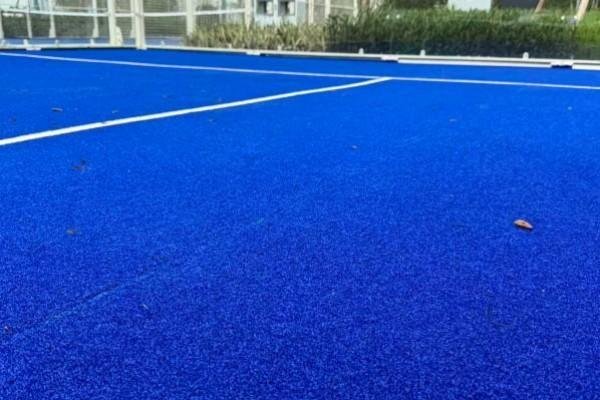
The conflict between visual appeal and structural integrity is one of the most common discussions I have with commercial property developers. They invest heavily in a panoramic court with premium LED lighting, only to feel disappointed when standard installation leaves a dusty, white layer of sand obscuring the vibrant blue turf.
The Manufacturer’s Fix: Texturized Grass
The "ugly sand" problem is completely solved through correct material selection, specifically by upgrading to texturized artificial grass. Historically, padel courts used fibrillated or monofilament straight yarn. On straight grass, the sand tends to sit loosely near the surface, shifting constantly and looking messy.
At QHPADEL, we strongly advocate for texturized grass for our club and chain brand clients. Texturized grass undergoes a high-heat curling process during manufacturing. This curly structure creates a dense canopy at the top of the turf. When sand is applied, it falls through the curly top layer and locks firmly at the base. The top 2mm to 3mm of the grass remains completely exposed, delivering the pure, brilliant color the club owner desires, while the heavy sand remains hidden below, doing its structural job.
The Role of Machine Brushing
Even with premium texturized grass, aesthetics rely heavily on the installation technique. If a local contractor simply dumps the sand and uses a manual push broom, the sand will remain visible. Installers must use a heavy, motorized rotary brush machine. The mechanical rotation forces the silica sand deep into the base of the curly fibers, ensuring an even distribution and an immaculate visual finish. A visually clean court is simply a properly installed court.
Where and how much sand is used for on a padel court?
Buyers constantly ask me to ship standard sand in their court containers. Additionally, they demand exact sand volume figures before knowing their turf specs. Both of these approaches lead to massive logistical and financial inefficiencies.
The volume of sand used for on a padel court depends entirely on the turf’s Dtex, pile height, and density. Furthermore, because shipping standard heavy sand overseas is cost-prohibitive, 99% of club owners should procure standard silica sand locally to maximize their return on investment.
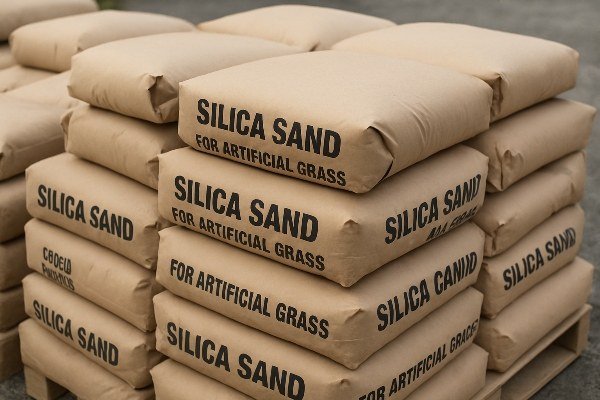
When managing B2B procurement for multi-court facilities, understanding freight logistics and volume calculations is essential for staying under budget. I regularly advise equipment distributors and importers on the realities of sand acquisition.
The Cross-Border Procurement Reality
Do not import standard silica sand from overseas. A standard padel court requires multiple tons of sand. Loading 4 to 8 tons of cheap sand into a shipping container drastically reduces the space and weight capacity available for high-value items like tempered glass, steel structural posts, and LED lighting fixtures. You will end up paying premium international sea freight rates for a material you can buy inexpensively in your own country. Local sourcing is the only financially sound strategy for standard silica sand.
The only exception to this rule involves highly customized aesthetic requests. For instance, if a club wants a specialty red, green, or black court, QHPADEL can source color-matched silica sand in China and load it into the main container as a custom add-on to ensure absolute color uniformity.
Calculating Sand Volume
You should never trust a rigid, one-size-fits-all metric for sand volume. The exact tonnage required varies based on the manufacturing specifications of the turf you select:
- Pile Height: A turf with a 12mm pile height inherently requires more sand to stabilize the fibers than a turf with a 10mm pile height.
- Stitch Density: High-density turf (e.g., 52,500 stitches per square meter) has less empty space between the yarns, thus requiring slightly less sand than a lower-density alternative.
- Dtex: Thicker, heavier yarns occupy more volume per square meter, altering the required infill capacity.
Upon ordering, your manufacturer should provide a precise Bill of Materials (BOM) and installation manual tailored to your specific SKUs. For example, a standard 12mm texturized grass may require roughly 5 to 8 kilograms of silica sand per square meter, translating to roughly 1 to 1.6 tons for a standard 200 sqm court. Always rely on the factory’s engineering data rather than generic estimates to guarantee warranty compliance.
Frequently Asked Questions
Can a padel court be used without sand?
No. Playing without the required sand infill will ruin the artificial grass within weeks. The lack of weight will cause the turf to shift and wrinkle, while player impact will permanently crush and snap the unprotected plastic fibers, voiding your manufacturer warranty.
How often should the sand be replenished on a padel court?
Sand levels should be inspected weekly, particularly in high-wear zones like the baseline and net areas. Minor redistribution via brushing is required per month, while a professional top-up of fresh silica sand is typically required every 6 to 12 months depending on court utilization.
Does heavy rain wash the sand away?
If the court has proper foundation drainage and utilizes washed silica sand, rain will pass directly through the drainage holes without washing the sand away. However, heavy storms can cause minor sand displacement, requiring a quick machine brushing once the court dries to level the infill.
Conclusion
Understanding what the sand used for on a padel court accomplishes is essential for any investor or club operator looking to protect their facility. It is not just a gameplay accessory; it is the vital anchor and armor that ensures a consistent ball bounce, prevents seam tearing, and prolongs the lifespan of your artificial turf. By choosing high-quality texturized grass and sourcing the correct 0.4-0.8mm round silica sand locally, you can achieve both incredible aesthetics and outstanding structural durability.
-
"Ball COR | Sports Science Laboratory", https://ssl.wsu.edu/glossary/cor/. Biomechanical and sports engineering studies demonstrate that the depth and compaction of sand infill directly dictate the coefficient of friction for player sliding and the kinetic energy restitution for ball bounce. Evidence role: mechanism; source type: paper. Supports: the correlation between infill density, surface friction, and ball restitution. ↩
-
"Comparison of lower limb segment forces during running on …", https://pmc.ncbi.nlm.nih.gov/articles/PMC6582296/. Engineering analyses of sports surfaces indicate that abrupt deceleration by athletes generates significant lateral shear stress, which can cause seam rupture in synthetic turf systems lacking adequate infill ballast. Evidence role: mechanism; source type: research. Supports: the impact of lateral shear forces on synthetic turf seams. ↩
-
"Synthetic Turf: History, Design, Maintenance, and Athlete Safety", https://pmc.ncbi.nlm.nih.gov/articles/PMC6299344/. Material science evaluations of polyethylene turf fibers define fibrillation as the longitudinal splitting and permanent flattening of yarns, a degradation process significantly accelerated by inadequate infill support. Evidence role: definition; source type: paper. Supports: the definition and cause of fibrillation in synthetic turf fibers. ↩
-
"Drainage management", https://safesportsfields.cals.cornell.edu/soils/drainage-management/. Hydrological assessments of artificial turf systems indicate that the presence of silt and clay fines in infill materials drastically reduces hydraulic conductivity, leading to pore clogging and surface water retention. Evidence role: mechanism; source type: research. Supports: the impact of fine particulates on the permeability of synthetic turf systems. ↩