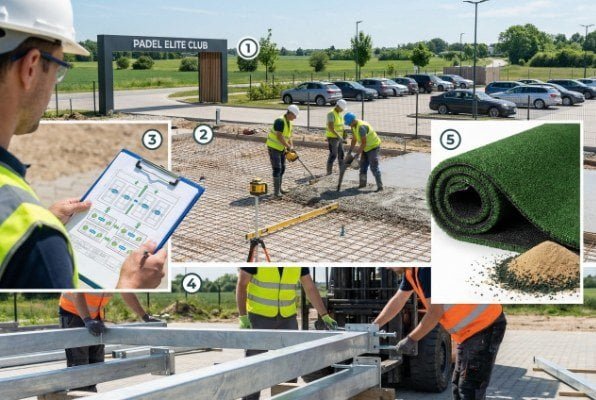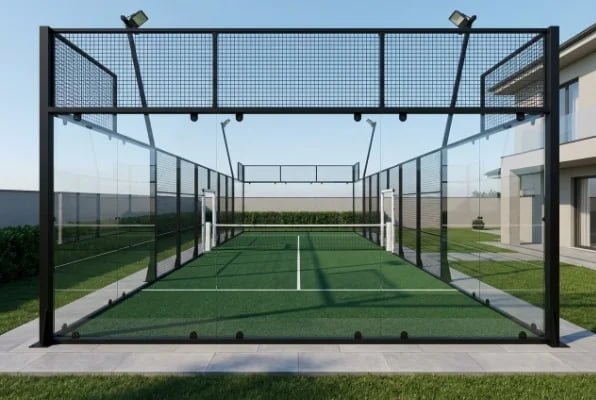

Have you ever stepped onto the artificial grass, only to slip dangerously when trying to return a fast ball? Finding the best shoes for padel court is a common struggle for players, especially when the wrong choice leads to rolled ankles. The solution actually starts with understanding the ground beneath your feet.
The best shoes for a padel court feature a herringbone (clay court) or omni (dot) outsole pattern. These specific tread designs bite through the silica sand layer to grip the artificial turf securely.1 They also provide rigid lateral support to prevent ankle sprains during quick, multidirectional changes in movement.2
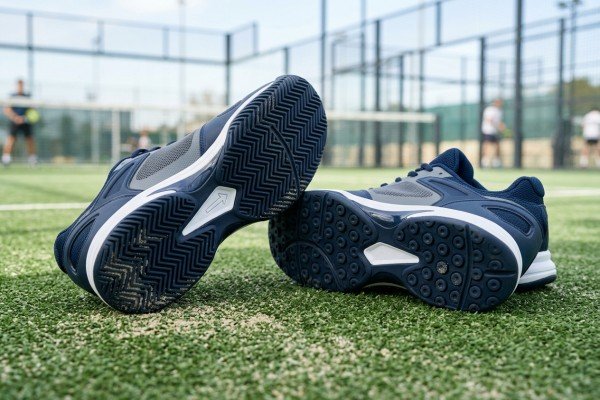
Choosing padel footwear is not about flashy brands or sneaker technology. As someone who builds these courts for a living, I can tell you it is fundamentally a physics problem. Let us look at how different shoes interact with the turf.
Why can’t you wear running shoes on a padel court?
Many beginners show up for their first match wearing standard running shoes. They quickly realize they cannot stop or turn properly. Worse, these shoes actively put both the player’s joints and the club’s expensive artificial turf at great risk.
Running shoes are built for forward motion on hard surfaces, lacking the lateral support needed for side-to-side padel movements.3 Their deep, chunky treads fail to grip sand-filled artificial turf, causing dangerous slips. Additionally, aggressive running treads act like blades, ripping out turf fibers and permanently damaging the court.4
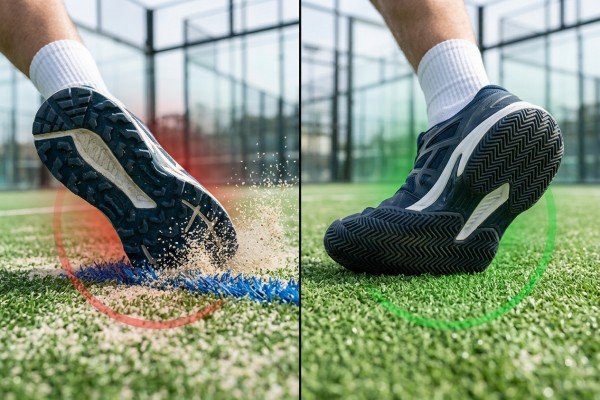
I have spent over a decade manufacturing and inspecting padel courts at QHPADEL. Over the years, I have seen exactly what happens when players ignore the physical reality of the court surface.
The Biomechanics Mismatch
Running shoes are engineered for one specific task: moving straight ahead. They have thick, elevated heels designed to absorb the heavy impact of a heel strike on solid asphalt. This creates a high center of gravity.5 However, padel requires explosive lateral (side-to-side) movements, sudden stops, and rapid pivots. If you wear running shoes on the court, that elevated heel and lack of side reinforcement will almost certainly lead to a rolled ankle when you lunge for a wide ball.
Similarly, if you wear standard hard-court tennis shoes, you face a completely different problem. Hard-court shoes have very flat, shallow outsoles. When you step onto a padel court with them, the loose silica sand acts exactly like ball bearings.6 You will slide around like you are playing on an ice rink, severely limiting your ability to accelerate.
The "Double Warning": Player Safety and Court Damage
Wearing the wrong footwear is a dual threat. It is bad for you, and it is terrible for the club.
- Threat to the player: Slipping due to flat soles causes severe muscle strains. Collapsing over the edge of a running shoe causes painful ligament sprains.
- Threat to the court: Running shoes, cross-trainers, and field cleats feature aggressive, deep rubber grooves. When you drag your foot in these shoes, the chunky rubber catches the artificial grass yarns. Instead of gliding smoothly over the sand, the shoe rips the plastic fibers right out of the primary backing.
Club owners despise this. A high-quality padel court requires a massive financial investment. Destroying the meticulously installed turf with the wrong shoes is a quick way to get banned from your local sports club.
How does the court surface dictate your padel court shoes?
You might wonder why padel courts feel so slippery when dry. Players who ignore the physical makeup of the court often struggle to generate power or change direction. The secret to your grip lies entirely in the sand.
A standard padel court consists of fibrillated or monofilament artificial grass filled with fine silica sand. This sand layer controls ball bounce and allows players to slide safely. Padel court shoes must have a specific tread depth to penetrate this sand and grip the turf backing without getting stuck.
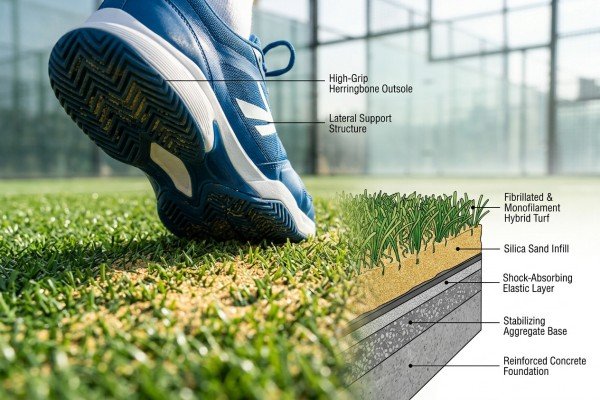
As a turf manufacturer, I look at padel court shoes entirely through the lens of friction and surface interaction. I am not a sneakerhead. I do not follow the latest cushioning foams or upper fabric marketing trends. But I know exactly how a rubber outsole interacts with a sand-filled artificial turf system.
The Role of Silica Sand
If you look closely at a padel court, you are not just playing on a carpet of plastic grass. You are playing on a specialized, engineered system. At our factory, we produce artificial grass with specific Dtex and density ratings. But once the grass is laid down on the foundation, installers must brush layers of fine silica sand into it.
The sand serves two critical purposes:
- Friction control: The sand prevents the turf from being too grippy. If your shoe locked perfectly into the plastic grass with zero slide, the abrupt stops would shatter your knees. The sand provides a controlled, safe slide.
- Fiber protection: The sand holds the grass fibers upright, taking the brunt of the foot traffic and extending the lifespan of the court.
The Physics of the Grip
When your foot hits the ground, your shoe does not just touch the grass. It hits the sand first. To get traction, the outsole of your padel court shoes must be able to displace that sand momentarily and catch the grass fibers underneath.
If the tread is too shallow (like a hard-court shoe), you float on top of the sand and experience zero traction. If the tread is too deep and sharp (like a trail running shoe), you lock into the turf too aggressively, which leads to joint injuries and damaged grass. The perfect shoe finds the exact middle ground of this physics equation.
Which outsole patterns are best for padel court shoes?
Buying shoes based on color or brand often leads to buyer’s remorse on the court. If you do not flip the shoe over and inspect the bottom, you are merely guessing. The sole is the only thing that matters.
The two most effective outsole patterns for padel court shoes are the herringbone (zig-zag) pattern and the omni (dot) pattern. Herringbone provides deep, consistent grip for sandy courts, while omni soles offer easier pivoting and rotational movement, making both ideal for artificial turf.
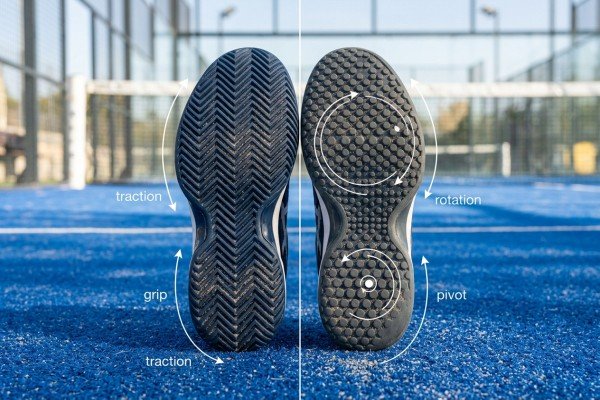
When evaluating the best shoes for padel court use, turn the shoe over immediately. The tread pattern dictates everything about your performance. In the court construction and equipment industry, we recognize two distinct outsole designs that work flawlessly with sand-filled artificial grass.
1. The Herringbone Pattern (Clay Court Soles)
This is the classic zig-zag pattern borrowed directly from clay-court tennis shoes. It features continuous, wavy grooves running across the entire sole.
- How it works on turf: The deep zig-zag channels easily displace the loose silica sand, allowing the sharp rubber edges to bite into the artificial grass fibers.
- The benefit: It offers the highest level of raw traction. You can stop on a dime. Furthermore, the sand easily escapes through the open channels of the tread as you run, preventing dangerous build-up under your foot.
2. The Omni Pattern (Dot Soles)
This pattern consists of multiple small rubber dots or dimples covering the bottom of the shoe. It is specifically designed from the ground up for artificial grass sports.
- How it works on turf: The small dots dig perfectly into the sand layer without aggressively hooking the turf yarns.
- The benefit: It allows for much easier rotational movement. Padel forces you to pivot constantly—especially when defending off the glass. The omni sole reduces the rotational strain on your knees and ankles while still providing excellent baseline grip.
Pattern Comparison Table
| Feature | Herringbone (Zig-Zag) | Omni (Dots) | Mixed / Hybrid Soles |
|---|---|---|---|
| Best Court Type | Sand-heavy classic courts | Less sandy modern courts | Standard panoramic courts |
| Traction Level | Very High | Medium-High | High |
| Pivot Ease | Moderate | Excellent | Good |
| Durability | Exceptional | Good | Varies by brand |
Many modern padel shoes now use a hybrid sole. These designs combine herringbone sections on the edges for maximum stopping power with omni dot sections under the ball of the foot to allow for easier, safer pivoting.
What else matters for your padel court shoes?
Finding the right outsole solves the grip problem, but playing a grueling two-hour match in uncomfortable shoes will leave your feet blistered and exhausted. You must also consider how the shoe supports your body weight.
Beyond the outsole, the best shoes for a padel court must feature rigid lateral support to handle sideways movements without rolling. Adequate shock-absorbing cushioning in the midsole protects your knees from impact, while a breathable mesh upper keeps your feet cool and dry during intense matches.
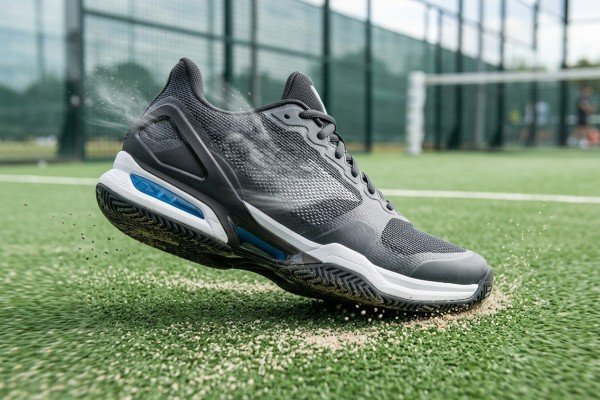
While my primary focus as a court manufacturer is the interaction between the outsole and the turf, player comfort is still a physical reality. I may not design shoe foams, but I understand the physical toll that padel takes on the human body. Once you have secured the correct herringbone or omni sole, you should evaluate three secondary factors.
Rigid Lateral Stability
Padel requires constant side-stepping. Look at the outer edges of a proper padel shoe. You will usually notice a hard piece of plastic or reinforced rubber wrapping around the outside of the midfoot. This stability shank prevents the shoe from collapsing outward when you lunge for a ball. A soft, unreinforced shoe will fold under your weight, taking your ankle with it. You want a shoe that keeps your foot locked securely over the footbed.
Midsole Cushioning
Even though artificial turf installed over a proper foundation is softer than a concrete tennis court, the repeated jumping and hard landings will eventually wear down your joints. You need a shoe with substantial midsole cushioning, particularly in the heel area. Good cushioning absorbs the kinetic energy of heavy footfalls, protecting your lower back and knees over years of play.
Upper Breathability and Durability
Padel involves a tremendous amount of toe-dragging. When you lunge for a low volley, the top of your trailing foot often scrapes aggressively against the sand-filled turf.
- Durability: The best padel court shoes feature reinforced rubber or synthetic guards around the toe box and the medial (inner) sides. This prevents the highly abrasive silica sand from chewing through the fabric in just a few short weeks.
- Breathability: The rest of the upper should be made of a breathable mesh to vent heat. Artificial turf can get quite warm under the direct summer sun. Keeping your feet dry helps prevent severe blistering and improves your overall comfort.
Frequently Asked Questions
Can I use tennis shoes on a padel court?
Yes, but only if they are clay-court tennis shoes. Clay-court shoes feature the exact same herringbone outsole pattern needed to grip the sand on a padel court. Hard-court tennis shoes have flat soles and will cause you to slide dangerously on the artificial turf.
How long do padel court shoes last?
For a player who plays two to three times a week, a good pair of padel court shoes will typically last six to eight months. You should replace them once the outsole tread pattern wears flat, as you will lose essential traction on the sand.
Are indoor and outdoor padel shoes different?
Generally, no. Both indoor and outdoor padel courts use sand-filled artificial grass systems. The fundamental requirement for a herringbone or omni outsole remains exactly the same regardless of whether a roof covers the sports facility.
Why do my feet hurt after playing padel?
Foot pain usually stems from wearing running shoes or lifestyle sneakers that lack proper lateral support and shock absorption. Upgrading to purpose-built padel footwear ensures your feet are braced correctly for side-to-side movements and cushioned against heavy, repetitive landings.
Conclusion
Choosing the best shoes for padel court play ultimately comes down to understanding the physical ground you are standing on. Because you are navigating a unique system of sand-filled artificial grass, you must select footwear with a herringbone or omni outsole to ensure proper friction and grip. Avoid running shoes entirely—they will only lead to rolled ankles and ruined turf. By prioritizing the correct tread pattern and strong lateral support, you protect your body from injury and help preserve the lifespan of the court. Next time you pack your padel bag, take a moment to flip your shoes over and check your tread before hitting the grass.
-
"Influence of Cleats-Surface Interaction on the Performance …", https://pmc.ncbi.nlm.nih.gov/articles/PMC5480019/. Studies on sports surface tribology indicate that deep, open-channel tread patterns allow particulate infill to displace, enabling the rubber edges to engage directly with the underlying synthetic fibers for optimal traction. Evidence role: mechanism; source type: research. Supports: The mechanical interaction between deep-grooved outsoles and sand-infilled artificial turf.. Scope note: Most research focuses on field sports (like football) or clay tennis courts; direct studies specifically on padel footwear are limited but rely on the same physical principles. ↩
-
"The Role of Shoe Design in Ankle Sprain Rates Among … – PMC", https://pmc.ncbi.nlm.nih.gov/articles/PMC2386428/. Biomechanical analyses of court sports demonstrate that footwear with increased lateral stiffness significantly reduces the degree of ankle inversion during sudden lateral cuts, thereby lowering the risk of ligamentous sprains. Evidence role: general_support; source type: paper. Supports: The role of lateral shoe stiffness in reducing the risk of ankle inversion sprains.. ↩
-
"Differences in running biomechanics between a maximal, …", https://pubmed.ncbi.nlm.nih.gov/31501022/. Footwear engineering literature confirms that running shoes are optimized for sagittal plane biomechanics, utilizing flexible uppers and decoupled midsoles that offer minimal resistance to frontal plane (lateral) forces. Evidence role: mechanism; source type: paper. Supports: The structural design of running shoes prioritizing forward motion over lateral stability.. ↩
-
"Effect of Soccer Boot Outsole Configuration on Translational …", https://pmc.ncbi.nlm.nih.gov/articles/PMC11311168/. Research on synthetic turf durability indicates that footwear with deep, sharp, or widely spaced lugs can hook into the primary backing of the turf, leading to premature fiber fibrillation and pull-out during high-shear movements. Evidence role: mechanism; source type: research. Supports: The mechanism by which inappropriate footwear treads accelerate the degradation of synthetic turf fibers.. ↩
-
"Systematic Review of the Role of Footwear Constructions in Running …", https://pmc.ncbi.nlm.nih.gov/articles/PMC7039038/. Biomechanical studies show that footwear with a high heel stack height elevates the foot’s center of mass relative to the ground, increasing the lever arm and subsequent torque on the ankle joint during lateral movements. Evidence role: mechanism; source type: paper. Supports: The relationship between high midsole stack heights (elevated heels) and reduced lateral stability.. ↩
-
"Tribological Behavior of Bioinspired Surfaces – PMC", https://pmc.ncbi.nlm.nih.gov/articles/PMC9944884/. In tribological terms, loose granular materials like silica sand act as a ‘third body’ between a flat shoe outsole and the ground, transitioning the contact mechanics from sliding friction to rolling friction, which drastically reduces traction. Evidence role: mechanism; source type: research. Supports: The tribological effect of loose sand acting as a rolling third body to reduce friction.. ↩