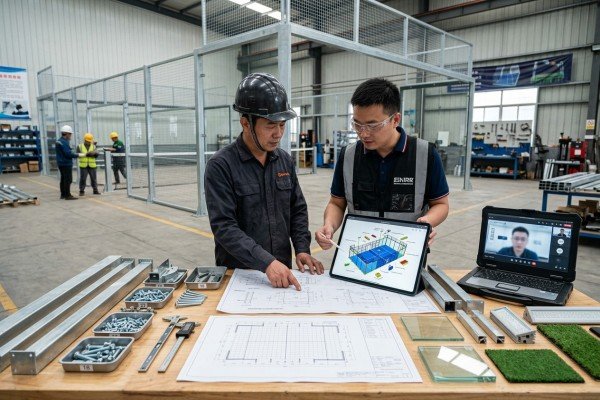
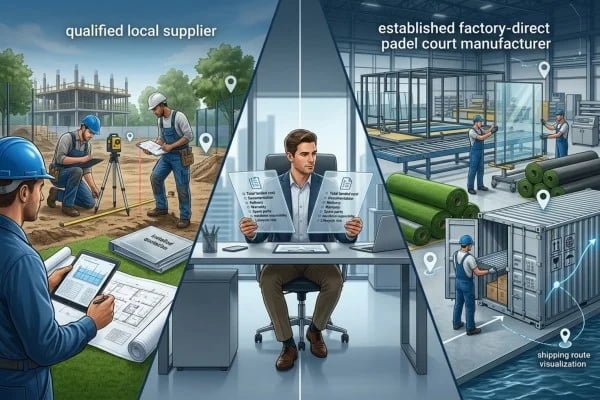
The Playtomic Global Padel Report can help investors identify markets worth investigating, but market momentum can easily be mistaken for project viability. A country may show rising interest while a specific club still faces weak utilization, expensive land, or permit delays. I use the report as a screening tool, followed by local feasibility and cost validation.
The Playtomic Global Padel Report should help investors shortlist countries and cities for deeper research, not predict club profitability. I recommend using its market indicators to locate possible demand, then verifying local paying players, competition, site conditions, permits, construction requirements, and the complete landed and installed cost before making an investment decision.

The important question is not simply, “Which market is growing fastest?” I believe investors should ask, “Can this specific location support a compliant, fully installed club at a cost and utilization level that make commercial sense?” The following framework turns high-level market information into practical due diligence.
What Can the Playtomic Global Padel Report Tell Investors?
A global report can reveal broad direction, but it cannot examine every neighborhood, property, or construction constraint. The problem begins when investors treat a market ranking as a location decision. That shortcut can hide weak local demand, unsuitable sites, and costs that only appear after procurement begins.
The Playtomic Global Padel Report can indicate where padel participation, court supply, booking activity, or market development may deserve attention, depending on the edition’s methodology. I use those signals to form research questions. I do not treat them as proof that a particular city, site, or club format will generate an acceptable return.

I Separate a Market Signal From an Investment Conclusion
A report operates at the level defined by its data. That level may be global, regional, national, or city-based. A club project operates at a much smaller level: a specific plot, catchment area, lease structure, customer group, and operating model.
I therefore separate two questions:
- Does the market show signs that justify investigation?
- Can the proposed project work at its actual location?
A positive answer to the first question does not guarantee a positive answer to the second.
For example, rapid percentage growth may start from a small base1. A market that moves from limited supply to slightly less limited supply can produce an impressive growth rate without yet having a large, stable player community. In contrast, a more mature market may grow slowly while offering better player awareness, experienced coaches, established leagues, and more predictable demand.
I Verify the Report Before Using Its Claims
Playtomic has published different market materials over time. I recommend checking the original document rather than relying on third-party summaries, social posts, or charts without context. Before I use any reported figure, I record:
- The report title and publication year
- The period covered by the data
- The geographic scope
- The definition of a player, club, or court
- Whether booking activity reflects the entire market or a platform sample2
- Whether forecasts are observations, estimates, or modeled projections
- Whether rankings use absolute totals, percentages, or another measure
- Whether the latest edition has revised earlier figures
Any exact ranking, forecast, or growth figure should remain pending verification until it has been checked against the original Playtomic report.
I treat a market report as a map of where to look. I do not treat it as a feasibility study for a particular property.
In our work at QHPADEL, we have handled inquiries from investors in multiple countries and observed changes in regional quotation activity. These are useful commercial observations, but they are not proof of global market size or future demand. Inquiry volume can change because of advertising, distributor activity, exchange rates, or individual projects. I keep those observations separate from Playtomic’s published data.
How Should I Use the Playtomic Global Padel Report to Screen Markets?
Investors often face a long list of possible countries and cities. Researching every option at the same depth wastes time and money. However, choosing only the market with the most exciting headline creates a different risk. I prefer a staged screening method that removes weak options before expensive due diligence begins.
I use the Playtomic Global Padel Report to create a preliminary shortlist, then apply four gates: market demand, local paying demand, site and regulatory viability, and complete project economics. A market advances only when evidence supports each gate. Fast growth triggers more investigation; it does not provide an automatic green light.

Gate 1: Identify Broad Market Momentum
I first look for signals that a country or region may support further investigation. Depending on the verified report methodology, those signals might include:
- Growth in courts or clubs
- Changes in booking or player activity
- Development outside established padel markets
- Supply gaps between player interest and available courts
- Increasing geographic spread within a country
At this stage, I avoid assigning revenue forecasts. The purpose is only to reduce a large list of markets to a manageable shortlist.
Gate 2: Test Local Paying Demand
National enthusiasm does not tell me how many people near a proposed site will pay the intended court fee. I therefore move from country-level data to the local catchment area.
I would investigate search behavior, local clubs, racket-sport participation, coaching activity, corporate demand, residential density, and travel time. I would also speak with local operators, coaches, sports associations, property professionals, and potential customers.
Gate 3: Confirm Delivery Feasibility
A market can have strong demand and still present an unworkable project. Land may be unavailable, ceiling height may be inadequate, planning permission may prohibit the intended use, or foundations may require costly engineering.
I therefore ask a local architect, structural engineer, contractor, and permitting professional to assess the proposed site. A court supplier can provide product drawings and technical inputs, but local qualified professionals must determine whether the design complies with applicable building, wind, fire, electrical, accessibility, and planning requirements.
Gate 4: Build the Full Economic Model
Only after the first three gates do I compare the expected opening cost with the project’s conservative operating assumptions. The equipment quotation is one input, not the whole capital budget.
| Screening gate | Main question | Evidence I would request | Stop signal |
|---|---|---|---|
| Market momentum | Is this market worth studying? | Verified report data and methodology | Weak or unclear underlying demand |
| Local demand | Will people near the site pay? | Competitor review, interviews, pricing tests | Demand depends only on broad national growth |
| Site viability | Can the club be permitted and built? | Local engineering and regulatory review | Unresolved planning or structural constraints |
| Project economics | Can the complete project meet the investor’s criteria? | Full CAPEX, schedule, and operating model | Budget omits major landed or installation costs |
This gate system prevents a common mistake: spending heavily on design or equipment before confirming that a legal, buildable, commercially plausible site exists.
How Can I Validate Local Padel Demand?
A rising sport creates excitement, and excitement can encourage optimistic assumptions. However, online interest does not always become recurring paid bookings. I try to distinguish curiosity from customer behavior by testing who will play, how often they may play, what they can afford, and which alternatives already compete for their time.
I validate local padel demand with several independent sources rather than one headline metric. I compare nearby court supply, booking availability, local prices, player interviews, coaching activity, sports participation, and catchment characteristics. I then test conservative scenarios without inventing utilization rates or assuming that national growth will automatically reach the selected neighborhood.

I Map the Actual Catchment Area
A city is often too broad for club planning. Travel time, traffic, public transport, parking, and neighborhood boundaries can divide one city into several distinct customer zones.
I would map:
- Residential and working populations within realistic travel times
- Income and leisure-spending indicators
- Schools, universities, hotels, offices, and residential developments
- Existing tennis, squash, badminton, pickleball, and padel facilities
- Parking capacity and public transport access
- Seasonal weather patterns that may affect outdoor play
- Major barriers such as rivers, toll roads, congestion, or unsafe routes
This work does not prove demand by itself, but it reveals whether the proposed catchment is convenient and commercially relevant.
I Study Competitors Beyond Their Court Count
A competitor with several courts may be either a warning or evidence of demand. I need more context before deciding.
I would review public booking calendars where legally accessible, but I would not assume that every unavailable slot represents a paid booking. Courts may be blocked for coaching, maintenance, events, or internal use3. I would also examine:
- Peak and off-peak pricing
- Membership options
- Coaching and academy programs
- Leagues, tournaments, and social events
- Indoor versus outdoor configurations
- Customer reviews and repeated complaints
- Court condition and maintenance quality
- Expansion announcements that can be independently confirmed
I Speak With People Who Participate in the Local Market
I have found that early investor inquiries often focus on the number of courts and the equipment price. I usually encourage a wider set of questions. Local coaches may explain whether beginners continue after trial sessions. Contractors may identify costly ground conditions. Property advisers may reveal whether suitable sites are scarce.
Useful interviews include:
- Potential recreational players
- Tennis and racket-sport coaches
- Corporate event organizers
- Schools and universities
- Hotel or residential property managers
- Local sports associations
- Existing club operators outside the immediate competitive area
I would use these conversations to create testable assumptions, not to manufacture certainty. A small interview sample can be biased4. A strong feasibility process combines interviews with observed pricing, competitor behavior, and local demographic evidence.
How Do I Check Site, Permit, and Construction Viability?
A promising demand study can still fail at the property stage. Padel courts combine steel, glass, turf, lighting, foundations, fencing, drainage, and player circulation. Outdoor installations may also face wind, corrosion, noise, glare, and weather exposure. I never assume that a standard equipment package automatically suits every site.
I confirm site viability through local professional review before final procurement. The review should cover planning use, foundation conditions, structural loads, wind exposure, drainage, access, lighting, electrical work, fire and accessibility rules, and installation logistics. Supplier drawings support this process, but they do not replace locally licensed engineering or official approval.
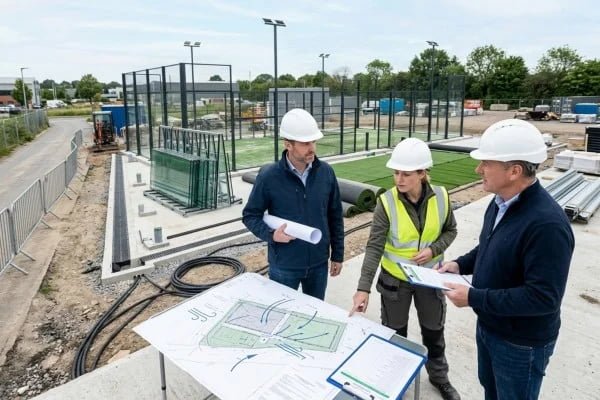
I Start With the Property, Not the Product Catalogue
An investor may prefer a panoramic or ultra-panoramic court because of visibility and appearance. However, the site must determine the final configuration.
I ask for early information about:
- Indoor or outdoor installation
- Available footprint and circulation space
- Finished floor level and drainage plan
- Soil and foundation information
- Local design wind requirements
- Building height and overhead obstructions
- Equipment access for unloading and installation
- Salt, humidity, heat, or other corrosive conditions
- Local lighting restrictions and nearby residents
- Utility capacity and electrical connection points
A manufacturer can then propose a configuration for review. The local engineer should still confirm the foundation, anchoring, structural assumptions, and applicable codes.
I Request Coordinated Technical Documents
Incomplete drawings create avoidable work for contractors. Before ordering, I recommend checking whether the supplier can provide:
- General arrangement drawings
- Foundation or pre-embedding drawings
- Component identification
- Installation drawings and sequence
- Bill of materials
- Fastener and accessory list
- Electrical and lighting information
- Packing list
- Maintenance manual
- Replacement-part identification
At QHPADEL, we provide installation drawings, foundation drawings, packing lists, and maintenance manuals with complete-court projects. We also discuss configuration details during quotation work. However, I advise every buyer to have project documents checked against the site and local rules.
I Treat Certificates as Documents to Verify
A certificate is not a universal approval for every project. Buyers should verify the issuer, product model, standard, test scope, validity, and connection to the goods being supplied.
QHPADEL states that its factory holds ISO 9001 certification and that relevant product categories have supporting certifications or test documents, including CE documentation for artificial turf, steel structures, glass, and lighting. Other listed documents cover standards such as AS/NZS 4666:2012 and AS/NZS 2208:1996 for glass, as well as specified Australian lighting standards and accessory approvals.
I recommend requesting copies and checking them with the tender authority, importer, engineer, or certification professional. The buyer should also confirm whether local approval requires additional calculations, tests, labels, translations, or inspections.
How Should I Calculate the Complete Padel Club Opening Cost?
A low court quotation can appear attractive until freight, foundations, duties, installation, and site work are added. This creates a dangerous comparison between a bare equipment price in one market and a nearly complete project price in another. I compare costs only after defining the same commercial and technical scope.
I calculate the complete opening cost by combining court equipment, transport, import expenses, civil works, installation, utilities, professional services, approvals, spare parts, and a documented contingency. I also account for schedule risk and excluded items. This landed-and-installed model allows me to compare locations and suppliers on a consistent basis.

I Build a Complete Capital Expenditure Checklist
A complete padel court system may include turf, the welded frame and mesh, structural posts, tempered glass, lighting fixtures, nets, fasteners, and accessories. The club still requires substantial work outside that package.
| Cost category | Items I would include | Commonly missed issue |
|---|---|---|
| Court equipment | Frame, glass, turf, lights, nets, fasteners | Different suppliers may quote different scopes |
| International logistics | Inland transport, port fees, ocean or land freight, insurance | Freight validity and container utilization |
| Import costs | Duties, taxes, customs clearance, inspections | Product classification and local tax treatment |
| Civil works | Excavation, slab, foundations, drainage | Ground conditions and tolerance corrections |
| Installation | Labor, supervision, lifting equipment, accommodation | Responsibility for breakage or rework |
| Utilities | Electrical distribution, controls, connection work | Lighting fixtures may exclude local wiring |
| Professional services | Architect, engineer, surveyor, permit adviser | Revisions after authority review |
| Club infrastructure | Reception, changing rooms, parking, furniture | Court supply is not a complete building |
| Opening inventory | Rackets, balls, cleaning tools, spare parts | Replacement glass and wear items |
| Contingency | Documented allowance for identified risks | A percentage cannot replace risk analysis |
I also check the applicable Incoterm. An EXW quotation transfers different costs and responsibilities than FOB, CIF, or DDP. The cheapest headline price may not remain cheapest after every responsibility is assigned.
I Compare Suppliers on Normalized Scope
I create a bid comparison sheet and place every quotation into the same format. I mark each line as included, excluded, optional, or unclear. I also review material specifications instead of comparing only court names such as “panoramic.”
The comparison should cover:
- Steel grades, sections, thicknesses, and coatings
- Glass specification and supporting documents
- Turf color, pile characteristics, Dtex, and density
- Lighting quantity, ratings, and documentation
- Fastener grades and corrosion protection
- Packaging method and glass protection
- Spare-parts package
- Drawing and installation support
- Warranty scope and exclusions
- Production schedule and replacement process
QHPADEL can supply one complete court equipment unit, while customized turf specifications have a stated minimum order quantity of six courts, equal to 1,254 square meters. I disclose that distinction because minimum quantities can affect project economics.
Our stated standard production schedule is approximately 20 days for two courts, 20–25 days for four courts, and no more than 30 days for more than four standard courts. Custom styles can require up to 35 days. I treat these as factory production estimates, not guaranteed opening dates. Shipping, customs, site readiness, weather, and local installation can extend the total schedule.
How Can the Playtomic Global Padel Report Improve Supplier Selection?
Market research and procurement are often treated as separate tasks. However, the chosen market affects the product specification, documentation, packaging, installation plan, and spare-parts strategy. A configuration suited to an indoor urban club may not suit a coastal outdoor project. I translate market screening into supplier questions before comparing quotations.
The Playtomic Global Padel Report can guide where I investigate, while project conditions define what I procure. I select suppliers by evaluating complete scope, technical documentation, manufacturing controls, packaging, delivery capacity, customization limits, and after-sales responsibilities. I also ask qualified local professionals to review application-specific structural and regulatory requirements.
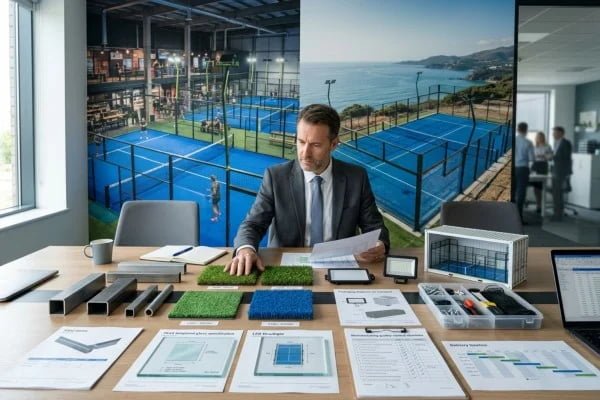
I Match the Court Configuration to the Business Model
Different projects value different features. A premium club may prioritize panoramic visibility and broadcast-friendly sightlines. A school may emphasize documentation, durability, controlled access, and straightforward maintenance. A contractor may care most about hole alignment, clear numbering, and complete fastener packs.
I recommend writing a project requirements document before requesting prices. It should define:
- Intended user group
- Indoor or outdoor location
- Expected climate exposure
- Required court style and color
- Turf specification
- Lighting expectations
- Local documentation requirements
- Installation responsibility
- Spare-parts needs
- Target delivery window
This document keeps supplier proposals comparable and reduces changes after production begins.
I Audit Quality Controls Relevant to Delivery
ISO 9001 documentation can indicate that a factory maintains a quality management system, but I still investigate the controls applied to the actual order. Useful procurement questions include:
- How does the factory check frame dimensions and hole positions?
- How are components numbered for installation?
- How does the supplier verify coating color and finish?
- How is tempered glass protected during loading?
- How are fasteners counted and packed?
- Which inspection records accompany the shipment?
- How are shortages or transit damage handled?
- Which parts should the buyer hold locally as spares?
QHPADEL operates ten production lines and states monthly capacity above 1.5 million square meters of artificial turf and 150 complete court systems. The company also reports annual export volume exceeding 600 containers. I present these as supplier capability statements that buyers should validate during due diligence. Capacity matters, but it does not replace order-specific inspection, clear specifications, or contractual delivery terms.
I Define Responsibility Before Signing
Many disputes come from unclear boundaries. The supplier may provide equipment and drawings, while the buyer arranges foundations and installation. If a foundation is outside tolerance, glass or steel components may not fit correctly even when the manufactured parts meet the agreed drawings.
I therefore define responsibility for:
- Foundation design approval
- Site measurement
- Unloading and storage
- Installation labor and supervision
- Lifting tools and access equipment
- Electrical work
- Broken glass
- Missing or damaged parts
- Local inspections
- Maintenance and warranty claims
A clear responsibility matrix is more valuable than a vague promise of “full support.”
Frequently Asked Questions
Is the Playtomic Global Padel Report enough to choose a country?
No. I use the Playtomic Global Padel Report to identify markets for deeper research. I still verify local paying demand, competition, land availability, permits, construction conditions, and the complete opening cost. A national or regional trend cannot confirm that one specific club location will be profitable.
Does fast court growth mean that a market is attractive?
Not automatically. Fast percentage growth may come from a small starting base, while rapid supply expansion may also increase competition. I examine the underlying player community, local prices, booking behavior, site availability, and planned new courts before deciding whether growth represents an opportunity or a warning.
What costs should I add to a padel court quotation?
I add freight, insurance, port fees, duties, taxes, customs clearance, foundations, drainage, installation, lifting equipment, electrical work, professional services, permits, spare parts, and club infrastructure. I also identify schedule risks and exclusions. The equipment price alone does not represent the cost of opening an operational club.
Which supplier documents should I request?
I request technical specifications, a complete bill of materials, foundation drawings, installation drawings, component lists, packing lists, maintenance instructions, warranty terms, inspection records, and relevant certificates or test reports. I verify that each certificate applies to the offered product and satisfies local procurement or regulatory requirements.
Conclusion
The Playtomic Global Padel Report is most useful when I treat it as the beginning of an investment process rather than the final answer. I use it to shortlist markets, then validate local paying demand, competition, site feasibility, permits, and the complete landed and installed cost. I also compare suppliers through normalized specifications, verified documents, and clear responsibilities.
-
"Beware Base Effects | National Statistical", https://blog.ons.gov.uk/2021/05/19/beware-base-effects/. Percentage growth measures change relative to a baseline; consequently, a small starting value can produce a large percentage increase despite a modest absolute change. Evidence role: mechanism; source type: government. Supports: Percentage changes are sensitive to the size of the baseline and should be interpreted alongside absolute values.. ↩
-
"Handbook on Measuring Digital Platform Employment and Work", https://www.oecd.org/en/publications/handbook-on-measuring-digital-platform-employment-and-work_0ddcac3b-en/full-report/component-3.html. Platform-derived data may be limited to participating users and transactions, so their coverage and representativeness should be assessed before they are generalized to a wider market. Evidence role: mechanism; source type: government. Supports: Data generated by a platform can have coverage and selection limitations that affect population-level inference.. Scope note: This supports the general methodological caution and does not establish the coverage of any particular Playtomic dataset. ↩
-
"Reservations | Department of Recreation and Wellness", https://www.loyola.edu/department/recreation-wellness/facilities/reservations.html. Facility scheduling guidance recognizes that calendar availability can be reduced by maintenance, programmed activities, events, and internal reservations as well as customer bookings. Evidence role: general_support; source type: education. Supports: Sports-facility schedules can include maintenance, programs, events, and internal reservations in addition to customer bookings.. Scope note: A calendar display alone does not reveal the purpose, payment status, or utilization of each blocked slot. ↩
-
"Collecting and Analyzing Qualitative Data | Field Epi Manual – CDC", https://www.cdc.gov/field-epi-manual/php/chapters/qualitative-data.html. Qualitative interview evidence may be affected by sampling and response biases; its findings therefore require careful contextual interpretation rather than automatic population-wide generalization. Evidence role: mechanism; source type: government. Supports: Interview findings can be affected by sampling and response bias and are not automatically generalizable to a broader population.. Scope note: Small samples can still provide useful exploratory insight when their recruitment, context, and analytical limits are reported. ↩