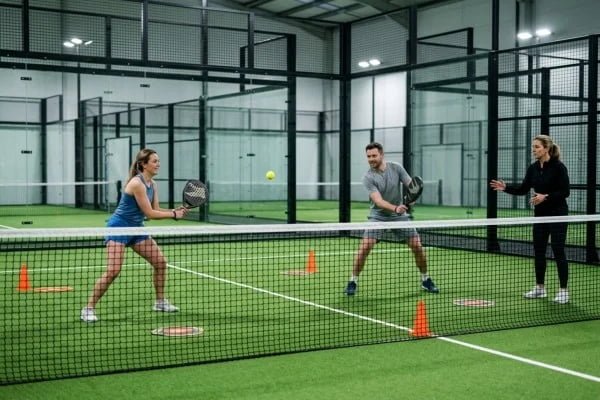
Children like to play padel for several possible reasons, but schools should not mistake initial interest for proven long-term engagement. Quick feedback, shared rallies, and social play may encourage participation. However, institutions still need a suitable court, qualified instruction, active supervision, and a complete operating plan to manage safety and accessibility.
Children may like to play padel because the game can provide visible feedback, achievable early interactions, and opportunities to participate with peers. Its enclosed format may also help instructors organize group sessions. However, enjoyment varies by child, and schools should validate engagement through supervised trials rather than assume that padel suits every age, ability, or personality.
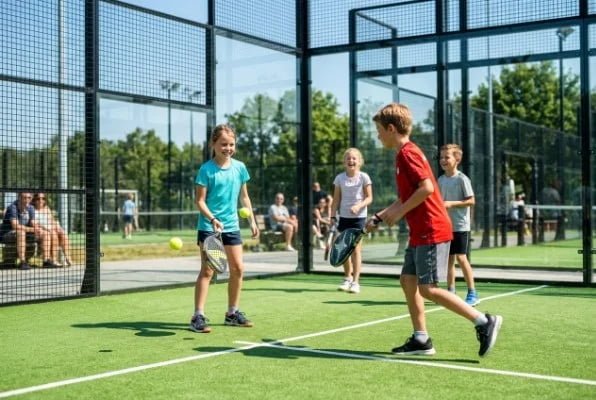
In my conversations with school and public-sector buyers, the strongest questions are rarely about whether padel looks exciting. Buyers want to know whether students can participate meaningfully, whether lessons are manageable, and whether the complete padel facility can support a safe and sustainable youth program.
Why May Children Want to Play Padel?
A new sport can attract attention, but novelty alone does not explain why children continue participating. If early sessions involve repeated frustration, confusing rules, or long periods of waiting, initial curiosity may disappear. A well-planned padel lesson can instead give children frequent opportunities to act and see the results.
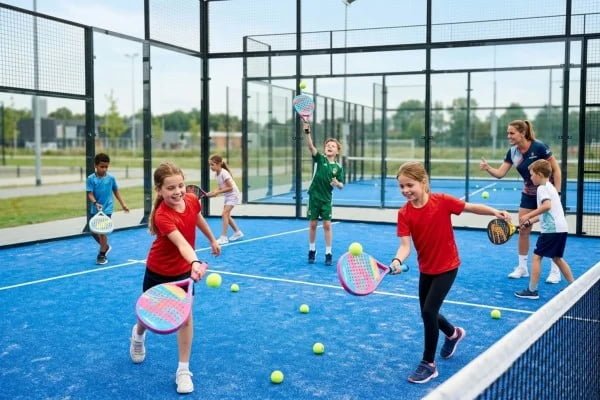
Children may want to play padel because each serve, return, bounce, and rally provides immediate visual feedback. Under suitable instruction, simplified activities can let beginners make meaningful contact with the ball early. This feedback may support engagement, although claims about faster learning, higher retention, or better development require reliable external evidence.
Immediate Feedback Can Make Participation More Understandable
Padel gives players a visible connection between an action and its result. A child swings the racket, the ball travels in a clear direction, and the next player responds. This does not prove that padel is easier than every other racket sport. However, it can make practice goals easy to explain.
An instructor might begin with tasks such as:
- Bouncing the ball on the racket.
- Sending the ball over the net from a short distance.
- Completing two controlled shots with a partner.
- Aiming toward a large target area.
- Allowing one bounce before returning the ball.
- Introducing wall rebounds only after basic court awareness develops.
Each task creates a clear outcome. The child can usually see whether the ball reached the target or continued the rally. I view this as a practical instructional advantage, not evidence that every child learns padel quickly.
The walls can also affect participation. They may keep some balls in play and create additional rally possibilities. However, beginners may find rebounds unpredictable. A coach should therefore decide when and how to introduce wall play rather than assume that the enclosure automatically makes the sport easier.
Buyers Should Separate Engagement From Learning Claims
School procurement teams often ask whether students will “pick up” padel quickly. I recommend converting that broad question into criteria that a pilot program can evaluate.
| Evaluation question | Practical method | Claim to avoid |
|---|---|---|
| Can students follow the basic activity? | Run a supervised introductory session | “Every child can learn immediately” |
| Do students receive enough turns? | Record waiting time and activity time | “Padel always keeps everyone active” |
| Can instructors adapt the task? | Test smaller groups and modified exercises | “One lesson format suits all ages” |
| Do students request another session? | Use an anonymous follow-up survey | “Initial excitement proves retention” |
| Can students use the space appropriately? | Observe movement and rule compliance | “An enclosed court controls all risks” |
A small trial can reveal more than a promotional claim. Schools can involve physical education staff, safeguarding personnel, accessibility specialists, and qualified coaches. They can also gather feedback from children without treating a single enthusiastic session as proof of sustained participation.
I have found that public buyers make better decisions when they define “easy to introduce” as a measurable operating question rather than a product feature.
How Can Social Play Help Children Play Padel?
Some sports sessions leave beginners practicing alone or waiting for their turn. Padel commonly uses doubles, which can create regular interaction between four players. That shared format may help some children feel involved, but schools should not assume that every student prefers social or team-based activities.
Doubles padel may encourage communication, turn-taking, shared problem-solving, and peer interaction1. Children can work toward a common rally goal instead of focusing only on winning. However, group dynamics require active management because confidence levels, sensory needs, physical abilities, and preferences differ among individual students.
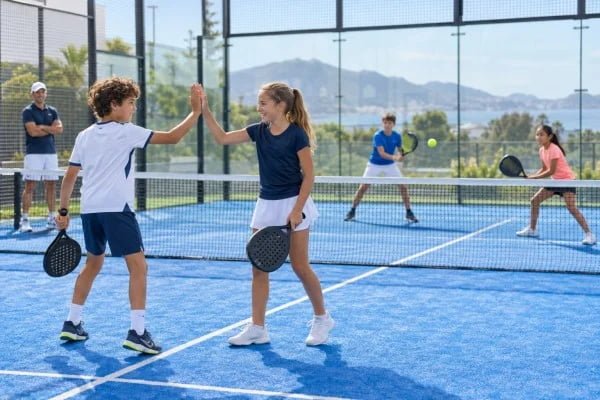
Doubles Can Create Shared Goals
A youth session does not need to begin with a competitive match. In fact, a match may introduce too many rules and decisions at once. An instructor can use cooperative exercises that give the group a simpler objective.
Examples include:
- Completing a set number of shots as a pair.
- Alternating contact between partners.
- Sending the ball into a shared target zone.
- Rotating partners after short practice intervals.
- Asking one player to call the bounce while another prepares.
- Awarding a group point for controlled play rather than speed.
These activities may help children communicate and coordinate. However, any educational or developmental benefit should be assessed by qualified educators and supported by appropriate evidence. As a court supplier, I can explain how the space and equipment affect lesson organization. I do not treat that experience as child-development research.
Group Size Still Needs Careful Planning
A standard adult doubles padel court has a playing enclosure measuring approximately 10 by 20 metres, subject to the applicable rules and local project requirements. Four players may use the court during a conventional game, but a school lesson often includes more than four students.
That difference creates an operating challenge. If 20 children are assigned to one court, most students cannot participate in a standard game at the same time. The school needs a rotation plan, off-court activities, controlled waiting areas, and enough adults to supervise transitions.
A simple planning table can help:
| Program factor | Questions for the school |
|---|---|
| Class size | How many children attend each session? |
| Active court users | How many students can participate without crowding? |
| Rotation length | How long does each group wait between turns? |
| Waiting area | Is it separated from doors, glass, and ball paths? |
| Instructor coverage | Who watches the court and the waiting group? |
| Ability differences | Can the activity be adapted without isolating students? |
| Accessibility | Can children with relevant mobility or sensory needs participate? |
I encourage buyers to review the lesson model before selecting the number of courts. A compact facility may make communication easier in some settings, but one court does not automatically provide enough capacity for a full class.
Not Every Child Wants the Same Experience
Some children may enjoy cooperative doubles. Others may prefer individual practice, lower-noise sessions, predictable routines, or less competitive activities. A good program can offer several ways to participate.
For example, instructors can use:
- Individual racket-control stations.
- Partner exercises without scoring.
- Small-group relay activities.
- Observation and officiating roles.
- Short matches with adjustable rules.
- Quiet introductory sessions with fewer participants.
This flexibility is one reason I focus on the operating plan as well as the court package. The physical court creates a setting. The school’s staff, schedule, instruction, and inclusion policies determine how that setting is used.
Is an Adult Court Suitable When Children Play Padel?
An adult-sized court may meet recognized padel dimensions, yet that compliance does not prove suitability for every youth program. Children differ in height, reach, coordination, judgment, and support needs. Schools must evaluate the relationship between the participants, equipment, teaching format, and facility.
A full-size padel court can support some supervised youth activities, but suitability should be decided through a program-specific risk and accessibility assessment. Buyers should examine age groups, class sizes, rackets, balls, gates, circulation routes, instruction, emergency access, and supervision before allowing children to play padel.
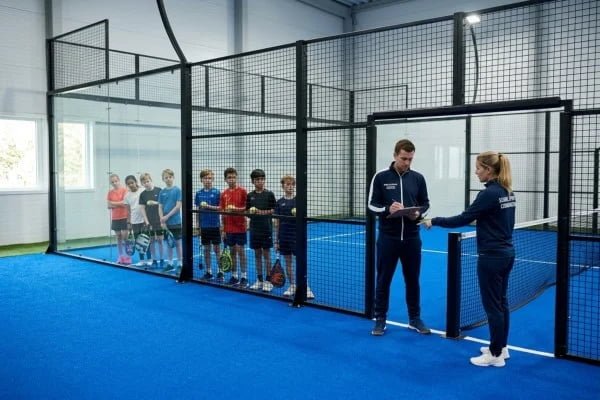
Court Dimensions Are Only One Part of Suitability
A procurement specification often begins with court dimensions, steel sections, glass thickness, turf specifications, and lighting. Those details matter, but they do not answer every operational question.
A school should also examine:
- Entry and exit: Can staff control access without creating congestion?
- Gate configuration: Are openings, handles, and nearby structural parts appropriate for the intended users?
- Circulation space: Can groups move around the court without entering vehicle routes or storage zones?
- Waiting areas: Can inactive students remain supervised without standing next to the playing enclosure?
- Equipment selection: Are rackets and balls appropriate for the planned age and ability group?
- Acoustics: Could ball and glass impact noise affect users or nearby classrooms?
- Accessibility: Does the complete route support the institution’s accessibility obligations?
- Emergency response: Can staff reach an injured or distressed participant promptly?
Qualified coaches can recommend activity modifications. Local architects, engineers, building officials, accessibility professionals, and safeguarding specialists should evaluate matters within their competence.
Modified Activities May Be More Appropriate Than Immediate Match Play
A school can introduce padel without asking beginners to play a full adult match. A staged approach may reduce complexity and allow staff to assess how students respond.
One possible progression is:
- Orientation: Staff explain boundaries, gates, glass, fencing, and safe racket spacing.
- Equipment control: Students practice carrying rackets and handling balls.
- Stationary contact: Students complete simple racket-and-ball exercises.
- Partner exchange: Pairs send the ball across a short controlled distance.
- Net activity: Students practice over the net without using the walls.
- Wall awareness: Qualified instructors introduce predictable rebound exercises.
- Cooperative rally: Players aim for continuity rather than points.
- Simplified game: Staff add selected rules when the group is ready.
This progression is only an example. A qualified coach should adapt it to the participants. Schools should also establish criteria for stopping or changing an activity if a child cannot use the space comfortably or safely.
Procurement Should Connect the Court to the Program
I often see technical specifications and operating plans developed separately. That separation can create avoidable gaps. For example, a court order may be complete from a manufacturing perspective while the school has not planned equipment storage, supervised waiting space, maintenance access, or staff training.
A more complete procurement brief should identify:
| Procurement area | Information to define |
|---|---|
| Users | Intended ages, abilities, and expected group sizes |
| Program | Curriculum use, clubs, public access, or competition |
| Site | Ground conditions, drainage, access, and nearby buildings |
| Court system | Model, materials, finishes, turf, lighting, and gates |
| Operations | Hours, staffing, bookings, and supervision |
| Maintenance | Inspection frequency, cleaning, repairs, and records |
| Documentation | Drawings, certificates, manuals, and traceability |
| Handover | Installation checks, training, defects process, and acceptance |
This joined-up approach helps institutions decide whether the proposed facility is genuinely suitable for their planned use.
What Makes a Facility Safer When Children Play Padel?
Glass walls, steel fencing, artificial turf, and product certificates can all contribute to a court specification. However, no single component makes a facility “child-safe.”2 Risk depends on the complete system, site conditions, installation quality, inspection, maintenance, instruction, and supervision.
A safer youth padel facility requires coordinated controls across design, products, construction, operations, and behavior. Buyers should verify component documents, obtain application-specific professional review, inspect the installed system, maintain records, and provide qualified instruction and adult supervision whenever children play padel.
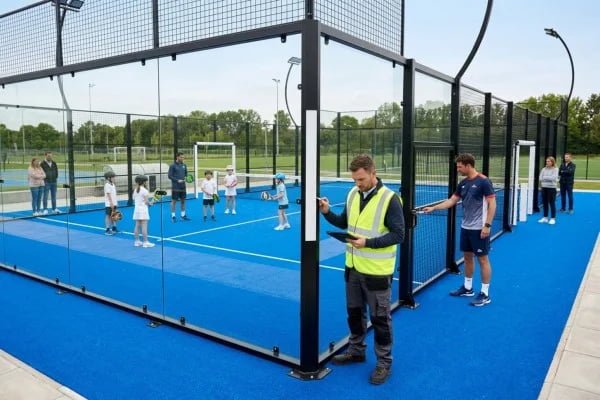
Buyers Should Evaluate the Complete System
A padel court combines multiple components. These usually include structural posts, welded frame netting, tempered glass, artificial turf, lighting fixtures, nets, fasteners, and foundations. Each component interacts with the others.
For example:
- A glass panel needs the specified material, correct dimensions, suitable edge condition, compatible holes, proper supports, and controlled installation.
- A steel frame needs suitable fabrication, corrosion protection, accurate connections, stable anchoring, and an appropriate foundation.
- Artificial turf needs correct installation, joints, infill where specified, drainage support, and regular maintenance.
- Lighting needs suitable placement, secure mounting, electrical protection, glare review, and compliant installation.
- Gates need correct alignment, reliable hardware, unobstructed movement, and routine inspection.
A certificate for one component does not cover these interactions automatically. Buyers should check the certificate holder, product identification, standard edition, test scope, issue date, validity, and any exclusions.
QHPADEL can provide documentation for relevant supplied components, including stated CE, RoHS, ISO, AS/NZS, AD 2000 WO, and PED-related documents. However, I advise every buyer to verify the documents against the exact product and tender requirement. Local authorities and qualified professionals must determine whether those documents satisfy the project’s legal and technical obligations.
Installation Quality Can Change the Risk Profile
Even a well-specified product can perform poorly when installers do not follow drawings or site tolerances. Foundation levels, anchor locations, frame alignment, glass clearances, fastener torque, turf seams, and electrical work all require control.
Schools and public bodies should consider a documented inspection and handover process:
- Confirm the approved foundation and structural drawings.
- Inspect civil works before court installation begins.
- Check delivered parts against the bill of materials.
- Record panel and component identification.
- Verify frame alignment and connection completion.
- Inspect glass before and after installation.
- Check exposed edges, protrusions, and potential entrapment points.
- Test gates and access routes.
- Review turf joints, surface condition, and drainage.
- Commission lighting through qualified electrical personnel.
- Remove construction debris and loose items.
- Record defects and close them before opening the court.
- Retain manuals, drawings, certificates, and inspection records.
At QHPADEL, we provide installation drawings, foundation drawings, packing lists, and maintenance manuals with relevant projects. We can also provide online installation guidance. These materials support the project team, but they do not replace local engineering approval, competent installation, or formal site acceptance.
Supervision and Maintenance Remain Essential
A completed court still needs an operating system. Staff should inspect the playing area before sessions and establish a process for reporting damage.
An inspection plan may cover:
| Frequency | Example checks |
|---|---|
| Before each session | Loose objects, wet areas, visible damage, gate operation |
| Routine scheduled checks | Turf seams, infill condition, net tension, fasteners |
| Periodic technical checks | Structural connections, glass condition, corrosion, lighting |
| After unusual events | Storm damage, impact damage, vandalism, flooding |
| Before reopening | Repair completion and documented authorization |
The responsible professional should set the actual frequency according to use, climate, manufacturer guidance, and local rules. Staff should close the court when damage could affect safe operation. A spare-parts process is also useful because delayed replacement can encourage facilities to remain open with known defects.
How Should Schools Decide Whether to Introduce Padel for Children?
Enthusiasm can start a project, but public procurement needs stronger justification. A school must consider educational fit, expected demand, site constraints, capital cost, staffing, maintenance, accessibility, and long-term use. Without this review, even a popular facility can become difficult to operate.
Schools should use a staged evaluation that combines a supervised pilot, stakeholder consultation, site assessment, technical review, lifecycle budgeting, and supplier due diligence. This approach tests whether children want to play padel while also checking whether the institution can operate the facility responsibly.
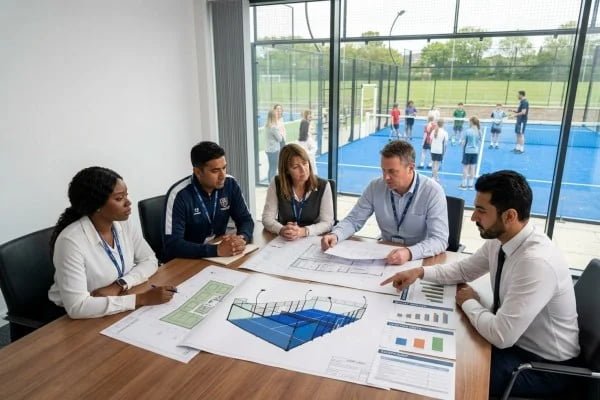
Start With a Supervised Pilot
A school does not need to purchase a court to test initial interest. It may arrange sessions at an existing compliant venue with qualified staff. The pilot should collect structured information rather than rely on informal impressions.
The school can review:
- Registration and attendance.
- Reasons for non-participation.
- Time spent actively involved.
- Instructor-to-participant demands.
- Equipment suitability.
- Accessibility barriers.
- Student feedback after the session.
- Staff observations about supervision.
- Incidents, near misses, or behavioral concerns.
- Interest in attending a later session.
These results still have limits. A short pilot cannot prove long-term retention, and participation may reflect the specific coach, venue, schedule, or group. However, it gives procurement teams local evidence for further planning.
Evaluate the Supplier as Well as the Product
A complete court quotation should make scope boundaries clear. I advise buyers to compare suppliers on more than the headline price.
A useful supplier checklist includes:
- A complete and itemized bill of materials.
- Court model and component specifications.
- Structural and foundation information.
- Applicable test reports and certificates.
- Manufacturing quality-control procedures.
- Component numbering and packing methods.
- Installation documentation.
- Lead time and shipping assumptions.
- Spare-parts availability.
- Warranty terms and exclusions.
- Responsibility for installation defects.
- Procedure for missing or damaged parts.
- References for comparable institutional projects.
QHPADEL manufactures complete court packages and artificial turf in Hebei, China. Our stated capacity exceeds 150 complete padel court systems per month3, while standard lead times depend on quantity and customization. Buyers should confirm the current production schedule, shipping route, and destination requirements before placing an order.
Calculate More Than the Purchase Price
The court package represents only part of the investment. A lifecycle budget may also need to include:
- Site surveys and professional design.
- Planning or building approvals.
- Excavation, foundations, and drainage.
- Freight, customs, and inland transport.
- Installation equipment and labor.
- Electrical supply and lighting work.
- Rackets, balls, and storage.
- Coaching and staff training.
- Cleaning and routine maintenance.
- Inspection and record-keeping.
- Repairs and replacement components.
- Insurance and operational administration.
A transparent budget helps public buyers avoid comparing an equipment-only quotation with a fully installed project price. It also helps decision-makers judge whether the institution can sustain the program after the opening event.
Frequently Asked Questions
Is padel easy for children to learn?
Some children may understand simplified padel activities quickly because the ball provides clear visual feedback. However, learning speed varies by age, ability, instruction, equipment, and previous experience. Schools should avoid universal claims and use qualified coaches to design appropriate introductory sessions.
What age can children start playing padel?
No single starting age applies to every child or program. A qualified coach and the responsible institution should assess physical readiness, attention, equipment, activity format, and supervision. A full-size adult court should not be treated as automatically suitable for all younger users.
Does a glass padel court create safety concerns?
Glass requires careful specification, handling, installation, and inspection. Buyers should verify the glass type, test documentation, edge condition, fixing method, and compatibility with the frame. Glass certification alone does not prove that the entire installed court is safe for children.
How many children can use one padel court?
A conventional doubles game involves four players, but lesson capacity depends on the activity and supervision plan. Larger classes need controlled rotations, off-court stations, safe waiting areas, and enough staff. Schools should test the proposed class format before deciding how many courts they need.
What documents should a school request from a padel court supplier?
Schools should request technical specifications, a complete bill of materials, foundation and installation drawings, relevant certificates and test reports, packing lists, maintenance instructions, warranty terms, and parts traceability. Buyers should verify that each document covers the actual supplied product and local project requirements.
Conclusion
Children may like to play padel because the sport can offer visible feedback, shared rallies, and flexible social activities. However, those possible benefits do not prove that every child will enjoy it or that every adult court suits a youth program. Schools should combine pilot sessions with qualified instruction, complete-system safety review, supplier due diligence, compliant installation, inspection, maintenance, and supervision.
-
"Influence of Sports Activities on Prosocial Behavior of Children …", https://pmc.ncbi.nlm.nih.gov/articles/PMC9180162/. Research on cooperative learning in physical education indicates that structured shared activities can create opportunities for pupils to communicate, coordinate actions, and interact with peers; such evidence supports the proposed mechanism but does not establish that padel produces these outcomes for every child. Evidence role: general_support; source type: research. Supports: Research on cooperative learning and team-based physical activity can support the proposition that structured group sport activities provide opportunities for communication and peer interaction.. Scope note: Evidence from cooperative physical education or team sports is contextual and may not directly test youth padel. ↩
-
"Risk management approaches in sports organisations – PMC", https://pmc.ncbi.nlm.nih.gov/articles/PMC11834097. Health and safety management guidance treats risk control as a system involving equipment, environment, procedures, maintenance, and supervision, rather than as a property conferred by one component alone. Evidence role: mechanism; source type: government. Supports: Safety management depends on identifying and controlling interacting risks across design, operation, maintenance, and human activity rather than relying on a single product feature.. Scope note: General safety-management guidance does not certify the safety of a particular installed padel court. ↩
-
"Padel Court Manufacturer in China | OEM Turf & Court …", https://qhpadel.com/. A dated production record or independent factory-assessment document should identify QHPADEL’s manufacturing capacity and the basis on which output exceeding 150 complete court systems per month is calculated. Evidence role: statistic; source type: other. Supports: A dated manufacturer production record, audited factory report, or verifiable corporate filing should substantiate the stated monthly capacity.. Scope note: Capacity is a supplier-reported, time-sensitive measure and does not by itself establish current availability, delivery performance, or product quality. ↩