Padel drills for beginners can feel confusing because new players often practise isolated strokes without knowing what should come next. That approach can reinforce tennis habits, poor positioning, and uncontrolled power.1 I recommend a measurable progression that develops clean contact, rally consistency, movement, wall play, and partner coordination in that order.
Padel drills for beginners are structured exercises that build control before speed.2 Players should start with short cooperative rallies, then add directional targets, controlled movement, wall rebounds, and partner positioning. Each drill should include a clear setup, success criterion, easier option, and progression condition rather than rewarding power alone.
I supply padel court systems rather than coaching services, so I view these exercises through court layout, wall use, and practical playing scenarios. A qualified padel coach should verify individual technique and workload. However, the following progression gives players and club staff a clear framework for deciding which drill comes next.
Which Padel Drills for Beginners Should Come First?
Many beginners try volleys, smashes, and fast winners before they can control the racket face.3 The ball then travels unpredictably, and the rally ends before either player can learn much. I would start with cooperative ball-control drills that make repeatable contact the first measure of success.
For most new players, the first padel drills for beginners should be short-court taps, controlled groundstroke rallies, and crosscourt target rallies. Players should progress only when they can direct the ball with a comfortable swing and maintain several cooperative exchanges without regularly losing balance or hitting beyond the intended area.
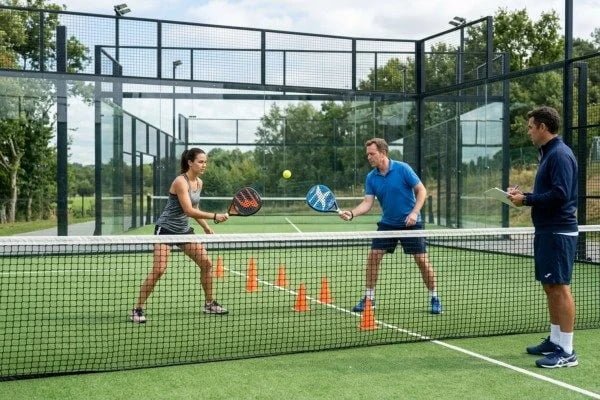
Stage 1: Cooperative short-court taps
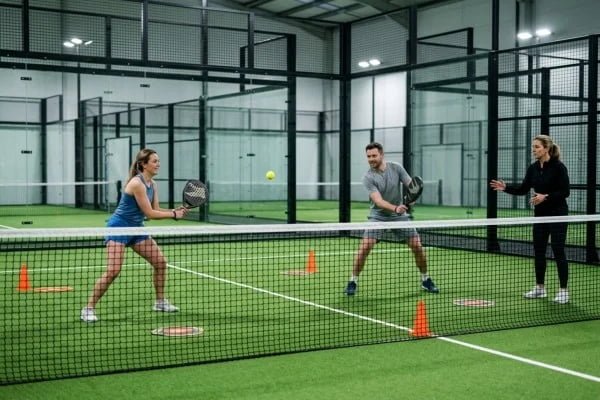
I would place two players several metres apart on the same side of the net or on opposite sides near the service line. Their objective is to exchange soft balls with compact swings. The drill does not require them to win points.
| Element | Practical guidance |
|---|---|
| Purpose | Develop clean contact, basic racket-face awareness, and ball-height control |
| Setup | Two players stand at a comfortable short distance and feed cooperatively |
| Success criterion | The pair completes 10 controlled contacts within a defined lane |
| Easier variation | One player catches the ball after each bounce before feeding it back |
| Progress condition | The pair achieves the target more than once without rushing or stepping into each other’s space |
A coach may change the distance or target number according to age, mobility, and previous racket-sport experience. I use ten contacts only as an example of a measurable target, not as a universal standard.
The players should count quality exchanges, not powerful shots. I would ask them to notice three things:
- Whether the ball meets the central area of the racket
- Whether the ball travels at a controllable height
- Whether the player recovers to a balanced ready position
- Whether the next player receives a playable feed
Stage 2: Baseline cooperative rally
The players can move behind the service line after they control the shorter feed. They should continue to cooperate, but they can now allow a deeper bounce and use a slightly longer swing.
The pair should choose a generous target zone in the middle or crosscourt area. Large targets reduce the temptation to aim at lines.4 They also produce longer rallies, which create more opportunities to practise preparation and recovery.
I would treat a six-ball controlled rally as more useful than one impressive winner followed by five errors.
The exact rally target should reflect the players’ current ability. Complete beginners may start with three exchanges. Experienced tennis players may reach a higher count quickly, although they may still need to reduce swing size and avoid attacking every comfortable ball.
Stage 3: Directional control
The players can divide the court into simple lanes with flat markers. They can then direct the ball crosscourt, down the middle, or toward a deep target. They should not aim close to the glass, fence, or lines initially.
These padel drills for beginners teach a key distinction: control means sending the ball where intended, not merely keeping it in play. A player can progress when the pair meets both conditions:
- The rally lasts for the agreed number of contacts.
- Most balls land inside the selected target zone.
Tennis converts often bring larger swings and a preference for baseline winners. Pickleball converts may feel comfortable with compact contact but need time to adjust to the larger court and rebound surfaces. I would give both groups the same control test before adding speed.
How Should Padel Drills for Beginners Add Movement?
A stationary rally can create clean contact, but a real point rarely keeps players in one place.5 Beginners may chase the ball without recovering or may run forward while their partner stays back. I add movement gradually so players connect each stroke with balance, recovery, and court position.
Movement-focused padel drills for beginners should begin with one or two controlled steps around a predictable feed. Players can then practise returning to a marked recovery position, moving forward as a pair, and retreating under control. They should increase unpredictability only after they can move without losing basic directional control.
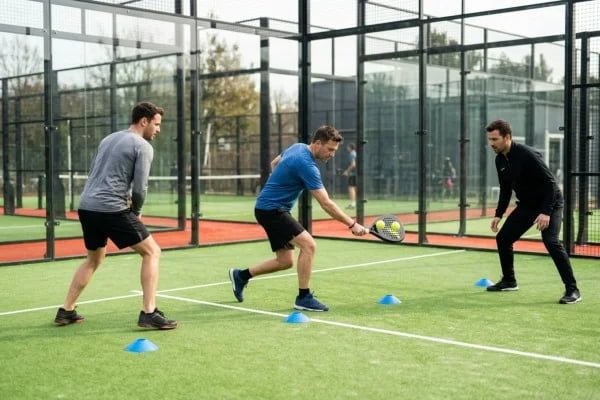
Use a hit-and-recover drill
I would place a marker at the player’s starting position. A feeder sends an easy ball slightly to the forehand or backhand side. The player moves to the ball, returns it toward a large target, and then recovers to the marker.
This exercise gives movement a visible endpoint. Without the marker, many beginners admire their shot or remain where they made contact.
| Element | Practical guidance |
|---|---|
| Purpose | Connect lateral movement, controlled contact, and recovery |
| Setup | One feeder, one hitter, one recovery marker, and a large target |
| Success criterion | The player returns several controlled feeds and recovers after each one |
| Easier variation | The feeder announces the direction before feeding |
| Progress condition | The player maintains balance and target accuracy when direction varies |
The feeder should keep the ball within the player’s comfortable reach. A qualified coach should adjust movement range and workload for the individual. Players who have pain, dizziness, or a relevant medical concern should stop and seek suitable professional advice rather than treating a general drill plan as health guidance.
Practise moving forward together
Padel uses both back-court and net positions6, but beginners often move forward one at a time. That separation can leave an open space between partners.
I recommend a simple cooperative sequence:
- Both players begin behind the service line.
- The feeder sends a comfortable ball.
- One player returns it through the middle.
- Both partners take a controlled step forward.
- The pair stops in balanced positions before the next feed.
- The pair repeats the sequence until both players reach an agreed volleying area.
The pair should not race toward the net. The drill aims to develop coordinated movement, not speed. Club staff can place matching markers on both halves of the court to show the intended positions.
Add controlled retreating movement
Players also need to leave the net without turning the drill into a desperate backward run. A coach may teach appropriate footwork based on the feed and player. From a court-use perspective, I would keep the first feeds predictable and leave generous space between the player and the rear glass.
The player can start near the service line, follow a high and slow feed, let it bounce, and return it after moving into position. The feeder should avoid balls that force an unprepared beginner into the wall or another player.
Official court dimensions and enclosure requirements appear in the International Padel Federation’s rules and technical documentation. Club operators should also verify that their court, access points, glass, fencing, turf, and surrounding areas comply with applicable local requirements.
These padel drills for beginners should progress when players can preserve three qualities at once: balance, directional control, and recovery position. Faster movement should not compensate for poor control.
How Can Beginners Learn to Use the Padel Walls?
The walls can make padel feel unfamiliar, especially to players arriving from tennis or pickleball. Many newcomers strike the ball before it reaches the rear glass or move too close to the rebound. I introduce wall exercises only after the player can judge a normal bounce and direct a basic return.
Beginner wall drills should use slow feeds that bounce on the court before reaching the rear glass. The player should allow space for the rebound, track the ball, and return it toward a large central target. Progress should depend on consistent judgement and control rather than a difficult or dramatic recovery.
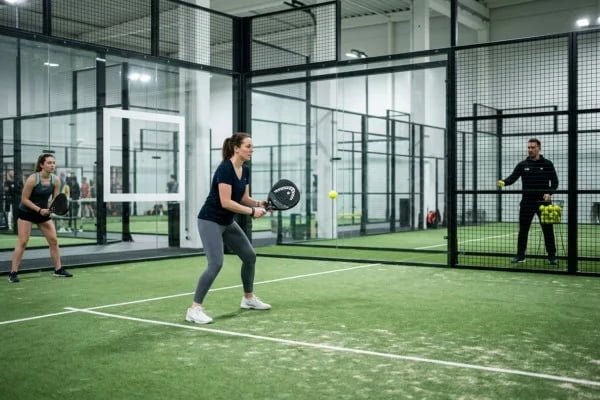
Begin without a racket swing
I would first help players understand the rebound path. One player or coach can send a gentle ball that bounces and reaches the rear glass. The learner tracks it, lets it rebound, and catches it after the wall.
This simple exercise removes the pressure of making a shot. It also lets the player observe how speed, angle, and spin affect the rebound. Different court conditions can influence ball behaviour7, so players should not assume that every rebound will travel identically.
| Element | Practical guidance |
|---|---|
| Purpose | Learn the sequence of floor bounce, wall contact, and rebound |
| Setup | Slow central feeds toward the rear glass |
| Success criterion | The player reads and catches several rebounds comfortably |
| Easier variation | The feeder uses slower balls from a shorter distance |
| Progress condition | The player judges the rebound without crowding the wall |
Add a controlled return after the glass
The learner can replace the catch with a compact return. I would use a large central target because a shot through the middle offers more margin than an attempt near the side fence or corner.
The progression can follow four steps:
- The feeder announces each ball.
- The player tracks the floor bounce and rear-glass rebound.
- The player moves into a comfortable contact position.
- The player returns the ball slowly through the middle.
The player should avoid standing directly against the glass. The player needs room to read the rebound and prepare the racket. However, I would leave exact footwork and contact-point instruction to a qualified coach who can see the player’s technique.
Introduce the corner gradually
A rear-glass feed is generally easier to read than a ball moving toward the junction of rear and side walls. The corner can produce less intuitive rebound paths.8 Therefore, I would not use difficult double-wall feeds as the first wall exercise.
A learner can progress from:
- A slow central rear-wall rebound
- A slightly angled rear-wall rebound
- A predictable rear-and-side-wall scenario
- A variable but controlled wall feed
- A cooperative rally that includes optional wall use
The player is ready for the next level when the return remains playable and the movement remains calm. The player is not ready merely because one difficult ball came back successfully.
The International Padel Federation’s Rules of Padel explain how balls interact with the court and enclosure during play. I recommend checking the current official rules rather than relying only on habits transferred from another racket sport.
From my supplier perspective, wall drills also show why court condition matters. Buyers and club managers should inspect glass alignment, fasteners, surface consistency, mesh interfaces, and the area around entrances. They should verify product certificates and installation records rather than assuming that a document automatically confirms suitability for a specific site.
How Do Partner-Based Padel Drills for Beginners Work?
Beginners sometimes behave as if doubles padel were two singles matches happening side by side.9 One player attacks while the other remains deep, or both players chase the same central ball. Partner drills solve this problem by making communication and coordinated positioning part of the scoring criteria.
Partner-based padel drills for beginners should teach pairs to move forward, retreat, and shift sideways together. The pair should also call central balls and protect shared space.10 A successful drill requires both players to finish in useful positions, even when only one partner contacts the ball.
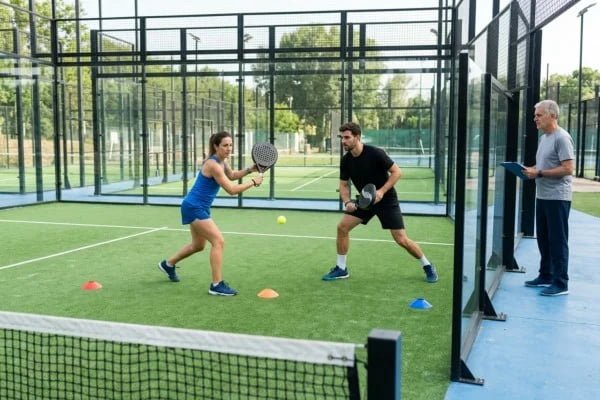
Run a shadow-positioning drill
The pair can first move without a ball. Both players start in a neutral back-court position. A leader points left, right, forward, or backward, and both partners move while maintaining a practical relationship with each other.
The drill should not force both players to stand on the same horizontal line at every instant. Real ball situations can create differences. However, the exercise should help beginners avoid large, accidental gaps.
| Element | Practical guidance |
|---|---|
| Purpose | Build awareness of partner position and shared court space |
| Setup | Two players move in response to visual or spoken directions |
| Success criterion | The pair moves without crossing paths or leaving an unnecessary central gap |
| Easier variation | Players walk through the pattern without rackets |
| Progress condition | The pair responds smoothly when directions change |
Add a “both recover” condition
The feeder sends a controlled ball to one player. That player returns it, but the pair receives credit only if both players recover to the agreed positions.
This rule changes the learners’ attention. The non-hitting partner can no longer stand still. That partner must read the feed, maintain spacing, and prepare for the next ball.
I would use a simple scoring system:
- One point for a controlled return into the target
- One point when both players recover correctly
- One point for a clear call on a central or uncertain ball
- No bonus for hitting harder
The scoring system shows that partner behaviour matters as much as stroke execution.
Practise middle-ball communication
A feeder can direct slow balls toward the space between the players. The pair must use short, agreed calls such as “mine,” “yours,” “leave,” or another clear phrase that both understand.
The drill should begin with predictable feeds. Later, the feeder can vary the ball slightly. A coach may also define which player normally takes certain middle balls because racket side, position, and tactical context can affect the decision.
Players should not treat communication as shouting after both have already committed. A useful call should happen early enough to guide movement.
Separate advice for converts
Tennis doubles players may already understand partner communication, but they can still separate too much or try to finish the point immediately at the net. Pickleball players may understand compact volleys and shared movement but need to adapt to deeper court space and wall rebounds.
I would assess both groups by the same outcome: Can the pair maintain a cooperative rally while moving as a unit? Previous experience can shorten the learning process, but it should not remove the progression checks.
These partner-focused padel drills for beginners become harder only after the pair controls the ball, communicates early, and recovers without confusion.
How Can Players Build a Measurable Beginner Drill Plan?
A practice session can feel productive even when no one measures improvement. Players may hit hundreds of balls but repeat the same mistakes. I prefer a simple progression sheet that records rally quality, target accuracy, wall-reading success, and partner coordination without turning every session into a rigid test.
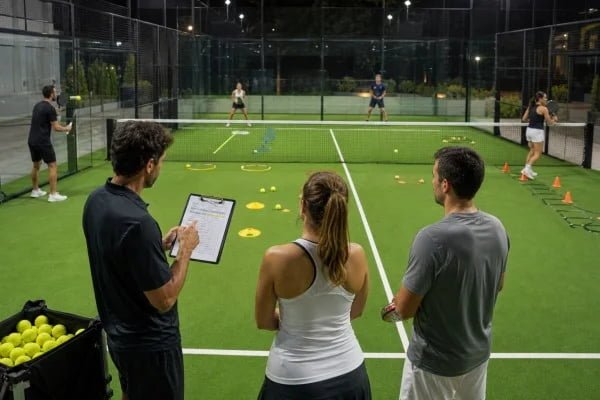
A measurable plan should arrange padel drills for beginners in five stages: contact, rally control, movement, wall use, and partner play. Each stage needs an observable success criterion. Players should repeat or simplify a drill when control breaks down and progress only when they can reproduce the skill consistently.
Use stages rather than a fixed calendar
I would not prescribe the same number of sessions for every learner. Fitness, confidence, age, coordination, and previous sporting experience vary widely. A stage-based plan adapts more easily than a statement that every beginner must master a skill within a particular week.
| Stage | Main objective | Example measurement | Sign to progress |
|---|---|---|---|
| 1. Contact | Make clean, controlled contact | Cooperative short-court exchanges | The ball repeatedly reaches the intended partner |
| 2. Rally | Maintain direction and depth | Rally count plus target accuracy | The player controls several exchanges without rushing |
| 3. Movement | Hit and recover in balance | Successful returns followed by recovery | Accuracy remains stable while the player moves |
| 4. Wall use | Read simple rebounds | Controlled rear-glass returns | The player creates space and returns a playable ball |
| 5. Partner play | Coordinate as a pair | Communication and shared recovery score | Both players move and call consistently |
Record quality, not just quantity
A long rally can include weak positioning or accidental returns. Therefore, I would track more than the number of contacts.
A simple practice record can include:
- Rally count: How many controlled exchanges did the pair complete?
- Target rate: How many balls entered the large intended zone?
- Recovery rate: How often did the player return to the marked position?
- Wall-reading rate: How many predictable rebounds produced controlled returns?
- Partner score: How often did both players move and communicate correctly?
- Perceived control: Did the drill feel calm and repeatable rather than rushed?
Players should not compare raw scores across different feeds, courts, balls, or target sizes. The record is most useful when the setup remains similar.
Apply a simple progression rule
I recommend a three-part decision:
- Repeat the drill when the player succeeds but still needs concentration to maintain control.
- Simplify the drill when the player loses balance, misses the target repeatedly, or becomes confused about positioning.
- Progress the drill when the player meets the target consistently under the current setup.
The progression should change one variable at a time.11 The feeder can vary direction, increase distance, add movement, introduce a wall, or add a partner decision. Changing all variables together makes it difficult to identify the cause of an error.
Use coaching and supplier expertise for different decisions
A qualified padel coach should evaluate stroke technique, workload, tactical choices, and player-specific progression. A court supplier should focus on the playing environment, product specifications, documentation, and installation coordination.
For club staff arranging beginner activities, I recommend checking:
- Whether the court surface is even and maintained
- Whether the glass, frames, mesh, doors, nets, and lights are in suitable condition
- Whether loose balls and training markers create avoidable obstructions
- Whether players receive a clear orientation before using walls
- Whether qualified staff can respond to technique or safety questions
- Whether local rules, insurance requirements, and facility procedures are documented
This separation of responsibilities helps buyers and players obtain advice from the right professional.
Frequently Asked Questions
How often should beginners practise padel drills?
I recommend choosing frequency according to fitness, recovery, schedule, and access to qualified guidance. A shorter session with clear targets can be more useful than a long, unstructured session. Beginners should prioritise repeatable control and stop when fatigue causes positioning, awareness, or technique to deteriorate significantly.12
What is the easiest padel drill for a complete beginner?
I consider cooperative short-court tapping one of the simplest starting exercises. Two players exchange slow balls over a short distance and aim for a large central area. The drill becomes easier when a player catches the ball after one bounce before sending a gentle feed back.
Should tennis players use different beginner padel drills?
Tennis players can use the same overall progression, but they may need extra attention on compact swings, wall use, and partner positioning. Previous racket skills can help with contact. However, players should not assume that baseline power and tennis-style movement automatically transfer to padel.
When should a beginner start practising wall rebounds?
A beginner can start simple wall tracking after controlling a normal floor bounce and a basic return. I would begin with slow, central feeds and catches before adding racket contact. A qualified coach should adjust the progression when a player struggles with movement, spacing, or rebound judgement.
Should beginners practise smashes?
Beginners can learn overhead preparation under qualified instruction, but I would not make powerful smashes an early measure of progress. Rally control, movement, wall judgement, and partner coordination create a stronger foundation. A coach can decide when overhead drills fit the learner’s technique and physical readiness.
Conclusion
Padel drills for beginners should create a progression rather than an unranked list of shots. I recommend starting with clean contact and cooperative rallies, then adding targets, movement, simple wall rebounds, and partner coordination. Players should measure control and repeatability instead of power, while qualified coaches should verify technique, workload, and individual progression.
If you are planning beginner-friendly courts for a club, school, hotel, or sports project, contact Alice Chen at QHPADEL via alice@grass-supplier.com or WhatsApp +86 185 7566 0746 to discuss complete padel court packages, technical drawings, turf options, and procurement documentation.
-
"The Transfer of Motor Skill Practice to the Game", https://digitalcommons.coastal.edu/cgi/viewcontent.cgi?article=1441&context=honors-theses. Motor-learning research indicates that repeated practice stabilizes the movement solutions used during training, while practice tasks that include relevant perceptual and decision-making demands may better support transfer to performance settings. Evidence role: mechanism; source type: research. Supports: Evidence on how practice conditions, repetition, feedback, and task context influence the acquisition and retention of movement patterns.. Scope note: This literature is generally not specific to beginner padel or to tennis-derived habits. ↩
-
"Speed or Accuracy Instructions During Skill Learning do not …", https://pmc.ncbi.nlm.nih.gov/articles/PMC8152873/. Skill-acquisition guidance commonly recommends establishing stable, accurate movement patterns under manageable conditions before increasing speed, variability, or task complexity. Evidence role: general_support; source type: education. Supports: Instructional guidance on emphasizing consistent, accurate movement execution before increasing task speed or complexity for novice learners.. Scope note: This is a broad instructional principle and does not establish a single mandatory sequence for every padel learner. ↩
-
"What’s one Padel mistake you made early on that slowed …", https://www.reddit.com/r/padel/comments/1khu4zi/whats_one_padel_mistake_you_made_early_on_that/. Studies and coaching analyses of novice racket-sport learning describe a frequent mismatch between players’ attempts at high-speed attacking actions and their still-developing control of contact, direction, and recovery. Evidence role: general_support; source type: research. Supports: Evidence or expert analysis identifying common novice errors in racket sports, including premature emphasis on forceful or advanced shots.. Scope note: The prevalence of this pattern may vary by player background, coaching environment, and sport. ↩
-
"(PDF) Task difficulty promotes tactical learning but …", https://www.researchgate.net/publication/382817340_Task_difficulty_promotes_tactical_learning_but_supresses_the_positive_learning_effects_of_autonomy_and_cognitive_effort. Research on aimed movement and speed-accuracy trade-offs shows that larger targets reduce accuracy demands and can make a task more achievable for learners developing controlled movement. Evidence role: mechanism; source type: paper. Supports: Research showing that target size affects task difficulty, movement accuracy, and speed-accuracy trade-offs.. Scope note: Evidence on target size does not directly demonstrate that every player will be less tempted to aim at court lines. ↩
-
"Influence of the players’ poses for tactical analyses in padel", https://www.sciencedirect.com/science/article/pii/S2468502X25000397. Padel match-analysis research characterizes play as involving repeated movements and positional transitions rather than exclusively stationary stroke execution, supporting the inclusion of movement in practice design. Evidence role: general_support; source type: paper. Supports: Match-analysis findings showing that padel play involves repeated positional adjustments, movement transitions, and stroke execution under changing spatial conditions.. Scope note: Competitive match data may not precisely represent the pace or movement patterns of complete beginners. ↩
-
"Padel tactics: Mastering the 3 zones to transform your game", https://www.babolat.com/us/news-articles-blog-padel-tactics/padel-tactics.html?srsltid=AfmBOoqcIr7S6Yei7WezKrskPUBG0YxoPFOEKx3S1UYNqrua8FYKp-uo. Padel performance analyses distinguish back-court, transition, and net areas, with net positioning commonly associated with offensive opportunities and back-court positioning with defensive or rebuilding phases. Evidence role: general_support; source type: paper. Supports: Tactical analyses describing offensive net play and defensive or transitional back-court play in padel.. Scope note: The tactical value of a position depends on the score, ball trajectory, opponents, and player ability. ↩
-
"Ball COR | Sports Science Laboratory", https://ssl.wsu.edu/glossary/cor/. Sports-engineering research shows that ball rebound characteristics can vary with the ball, impact velocity and angle, surface properties, and environmental conditions, which can affect perceived bounce and rebound behaviour. Evidence role: mechanism; source type: research. Supports: Sports-engineering evidence that rebound behaviour depends on ball properties, impact conditions, and surface characteristics.. Scope note: The magnitude of these effects on a particular padel court requires site- and equipment-specific measurement. ↩
-
"newtonian mechanics – Ball collision with a wall", https://physics.stackexchange.com/questions/706071/ball-collision-with-a-wall. Physics of ball-surface collisions indicates that successive impacts on differently oriented walls can produce trajectories dependent on the incoming angle, speed, spin, and rebound properties, making multi-surface rebounds more complex than a single-wall rebound. Evidence role: mechanism; source type: paper. Supports: Physics evidence that successive collisions with differently oriented surfaces create trajectories that depend on incident angle, velocity, spin, and surface properties.. Scope note: This mechanistic evidence does not by itself measure how difficult a particular corner rebound is for individual beginners. ↩
-
"Doubles Badminton Analysis with Singles-Trained Models", https://arxiv.org/html/2508.13507v1. Research on doubles racket sports treats partners as a coordinated unit whose positioning, communication, and movement coupling affect coverage of shared space and response options. Evidence role: general_support; source type: research. Supports: Research on interpersonal coordination and shared-space management in doubles racket sports.. Scope note: This evidence supports the importance of coordination but may not quantify how often complete beginners behave independently. ↩
-
"How to communicate in padel", https://www.head.com/en_US/rs/stories/how-to-communicate-in-padel. Doubles-performance literature identifies communication and coordinated spatial coverage as important features of pair play, particularly when both players can potentially reach balls directed into shared central space. Evidence role: expert_consensus; source type: paper. Supports: Doubles-sport evidence and coaching literature identifying communication and coordinated coverage as components of team performance.. Scope note: Which player should take a particular central ball remains context-dependent and may follow pair-specific tactical conventions. ↩
-
"Introduction to Motor Learning", https://media.lanecc.edu/users/howardc/PTA101/101MotorLearning/101MotorLearning_print.html. Motor-learning and instructional-design guidance supports progressively adjusting task constraints so that learners can maintain an appropriate challenge level while identifying and adapting to changing demands. Evidence role: general_support; source type: education. Supports: Instructional-design and motor-learning guidance on progressively manipulating task constraints and complexity.. Scope note: The literature does not require that only one variable be changed in every drill; simultaneous changes may be appropriate in some planned training contexts. ↩
-
"Understanding Sports Medicine: A Comprehensive Guide", https://seaver.pepperdine.edu/blog/posts/understanding-sports-medicine-a-comprehensive-guide.htm. Sports-medicine and exercise-professional guidance recognizes that fatigue can impair coordination and movement quality; reducing, modifying, or ending activity when safe technique and awareness cannot be maintained is a prudent risk-management measure. Evidence role: expert_consensus; source type: institution. Supports: Sports-medicine guidance that fatigue can impair coordination and movement quality and that training should be adjusted when safe execution cannot be maintained.. Scope note: This general guidance is not a substitute for individualized medical assessment, particularly for pain, dizziness, injury, or other concerning symptoms. ↩