Serving in padel often creates confusion because players interpret “walking” in different ways. One player sees a harmless follow-through, while another sees an illegal step. Without a clear timeline, small disagreements can become repeated fault calls. I find that separating the setup, ball contact, and post-contact movement makes the rule much easier to apply.
You cannot walk, run, or jump during the pre-contact serving action in padel under the standard FIP rule wording. Small foot movements that do not change your adopted service position may be accepted.1 After you strike the ball legally, however, you may move forward as part of your follow-through and court positioning.
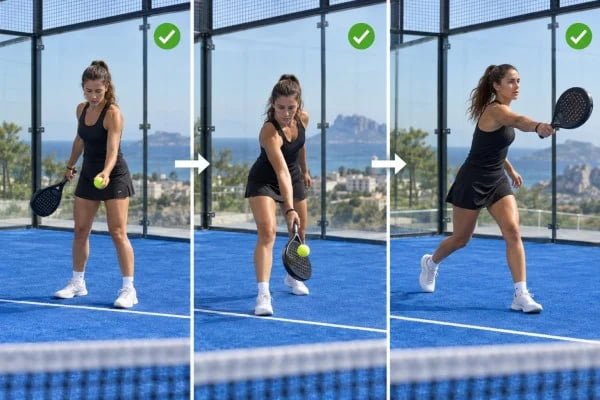
I have encountered this dispute during ordinary club matches, usually after a server steps toward the line and immediately follows the ball forward. The useful question is not simply, “Did the player walk?” Instead, I ask what each foot did before, during, and after ball contact.
Rule-source note: I base this explanation on the service provisions in the International Padel Federation’s Rules of Padel, particularly Rule 6. Players and officials should verify the latest rulebook on the official FIP website and check any national federation or event-specific regulations before making a formal ruling.
What Do the Official Rules Say About Walking While Serving in Padel?
The official wording can feel stricter than the movement players see in casual matches. This difference causes avoidable disputes. If players focus only on whether the server moved, they may penalize a legal follow-through or overlook an illegal pre-contact step.
The FIP service rule states that a player must not walk, run, or jump while serving. It also allows small foot movements that do not affect the adopted service position. At ball contact, at least one foot must remain in contact with the ground, and the server must respect the service-line boundaries.
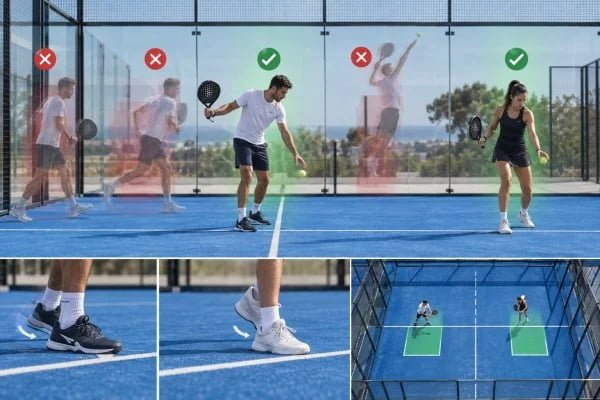
What does the relevant rule wording mean?
The English-language FIP rule wording has traditionally included several separate requirements that must be read together:
- The server begins with both feet behind the service line.
- The server stands between the imaginary extension of the centre service line and the side wall.
- The ball must bounce in the permitted area behind the service line before it is struck.
- The server must not touch the service line or the imaginary extension of the centre line with a foot during the regulated serving phase.
- At the moment of impact, the server must have at least one foot in contact with the ground.
- The player must not walk, run, or jump while serving.
- Small foot movements that do not affect the adopted serving position may be accepted.
These conditions explain why a simple yes-or-no answer can be misleading. A player can lift one foot without necessarily jumping because the other foot may remain grounded. However, that lifted foot could still form part of an illegal walking action if the player uses it to advance before striking the ball.
Similarly, two feet do not have to remain fixed flat on the court throughout the entire motion. The rule recognizes minor adjustments. A small pivot, heel lift, or balance correction may be acceptable if it does not turn into a step or materially change the service position.
Which document controls the decision?
I treat the FIP rulebook as the starting point, but I would not treat an undated quotation on a blog as the final authority for a tournament. Competition organizers may apply:
- A newer FIP edition;
- An official translation;
- National federation regulations;
- Event-specific procedures; or
- A referee’s interpretation of the observed movement.
Before an event, I recommend checking the edition number, publication date, effective date, and governing body. During a sanctioned match, the chair umpire or appointed referee should make the formal decision.2 My playing experience can help explain the rule, but it cannot replace an authorized ruling.
When Does Foot Movement Become a Fault While Serving in Padel?
Players often assume that any lifted foot creates a fault. Other players assume that every movement is legal as long as one foot stays on the ground. Both shortcuts miss important details and can lead to inconsistent calls when serving in padel.
Foot movement may become a fault when the server walks, runs, jumps, touches a prohibited line, or changes the adopted service position before contact. A small adjustment may remain legal, but a clear step toward the net or along the service line can violate the rule even if one foot stays grounded.
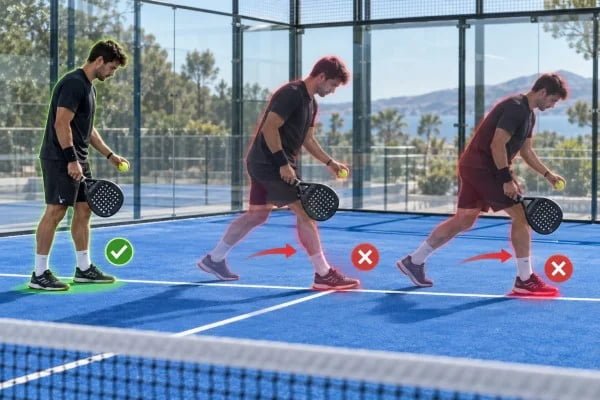
I divide the serve into three phases
I use a three-phase timeline whenever a player asks me to review a serving motion.
| Phase | What I observe | Likely rule issue |
|---|---|---|
| 1. Setup | Both feet, starting location, ball bounce and line position | Incorrect starting position or line contact |
| 2. Ball contact | Steps, grounded foot, impact height and contact location | Walking, running, jumping, foot fault or illegal contact |
| 3. Follow-through | Movement after racket-ball contact | Usually a positioning choice rather than a service foot fault |
This timeline matters because the same visible step can have a different result depending on when it begins and lands.
Phase 1: The setup
The player should establish a recognizable service position behind the service line. Both feet should begin in the permitted area. The player should also bounce the ball behind the service line and on the correct side of the imaginary extension of the centre line.
A player who continually shuffles forward before the bounce makes the call harder. Even when each movement looks small, several small movements can collectively change the adopted position. I therefore recommend starting from a stable stance rather than testing the boundary between adjustment and walking.
Phase 2: The contact action
The most important observation is the sequence immediately before racket-ball contact. I look for the following signs:
- Does one foot clearly step forward before impact?
- Does the trailing foot then follow or begin to follow?
- Does the movement give the player a run-up?
- Does either foot touch the service line?
- Does at least one foot remain grounded at impact?
- Does the player strike the ball at or below the height allowed by the applicable rule?
A single lifted foot is not automatically a jump. For example, a player may pivot or raise the heel while keeping the other foot on the ground. However, the “one foot grounded” requirement does not cancel the separate prohibition on walking. A server can keep one foot grounded and still make an impermissible advancing step.
Phase 3: The follow-through
Once the racket has contacted the ball legally, the server can recover court position. The player may cross the service line and move toward the net. That movement should not be confused with a pre-contact run-up.
Video can help when the sequence is too fast to judge in real time. A side-on recording usually shows the moment of contact and the service line more clearly than footage taken from behind the server.
Can You Move Forward After Serving in Padel?
Some players become so worried about a foot fault that they freeze behind the service line after contact. This reaction is unnecessary and may leave them in a poor tactical position. The service restriction does not require a player to remain stationary for the next shot.
Yes, a player may move forward after making legal contact with the serve. The player can cross the service line, approach the net, or adjust laterally for the return. The key distinction is timing: the forward movement must follow legal ball contact rather than operate as a pre-contact step or run-up.
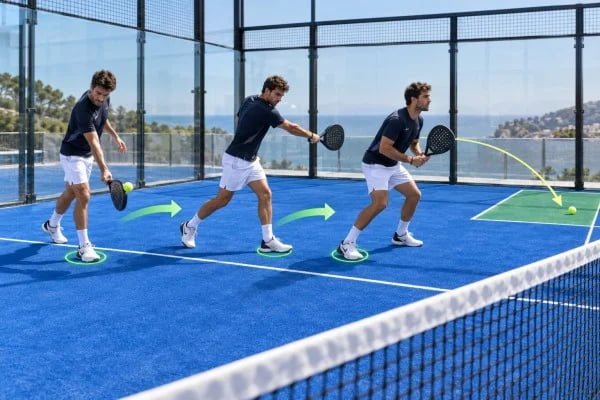
Contact separates the serve from the recovery movement
I find that players understand the issue quickly when they pause a video at the exact frame of racket-ball contact. Everything before that frame belongs to the regulated service action. Movement after that frame usually belongs to recovery and positioning.
Consider these two examples:
Example A: Likely legal sequence
- The player establishes a position behind the line.
- The player bounces the ball.
- The player strikes it while at least one foot remains grounded.
- The player’s momentum carries a foot across the line.
- The player continues toward the net.
This sequence generally reflects a normal serve followed by a normal recovery, assuming the other service requirements are satisfied.
Example B: Potentially illegal sequence
- The player establishes a position behind the line.
- The player bounces the ball.
- The player steps forward to generate speed.
- The forward foot lands or advances before racket-ball contact.
- The player strikes the ball and continues running.
The player in Example B cannot make the action legal merely by calling the step a follow-through. The relevant movement began before impact and may amount to walking or a run-up while serving in padel.
What if the step begins before contact but lands afterward?
This situation requires careful observation. The rules do not become easy to apply merely because a foot lands after impact. An official may consider the complete action, including whether the player changed the adopted serving position, initiated a walking motion, or jumped.
I would not make a universal ruling based only on the landing time. I would check:
- Which foot remained on the surface;
- Whether the body advanced before contact;
- Whether the movement resembled a step or balance adjustment;
- Whether a foot touched the line;
- Whether the player had established a stationary service position; and
- How the appointed referee interprets the full motion.
For casual play, players can avoid the dispute by keeping the base stable until contact. They can then move decisively toward their preferred position.
Why Do Tennis Habits Cause Problems When Serving in Padel?
Tennis converts often bring useful racket skills to padel, but the tennis serve creates the wrong movement template. A player may instinctively seek more height, power, or forward momentum. Those habits can produce an illegal contact point, a jump, or an obvious pre-contact step.
Tennis and padel serving rules are not interchangeable. A padel serve uses an underarm action after a bounce, while a tennis serve uses an overhead motion and permits different body mechanics. New padel players should rebuild their service routine instead of modifying a tennis run-up or jumping action.
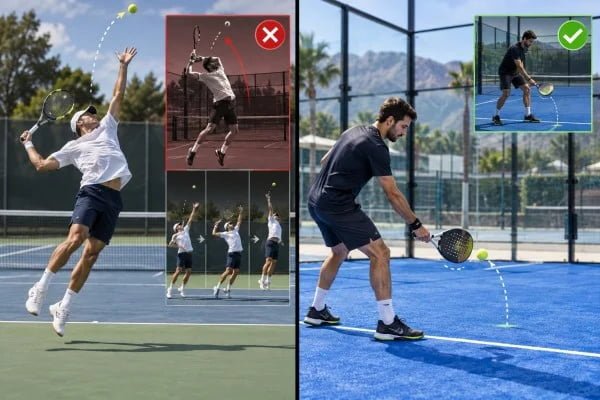
The two serves solve different problems
A tennis server often tries to create racket-head speed, height, spin, and an aggressive entry into the court. A padel server usually needs reliable placement, controlled spin, a low bounce, and enough time to establish an effective court position with a partner.
| Feature | Typical tennis serve | Standard padel serve |
|---|---|---|
| Ball preparation | Tossed into the air | Bounced on the court |
| Contact style | Overhead | Underarm |
| Foot movement | Governed by tennis foot-fault rules | No walking, running, or jumping during serve |
| Ground contact | Player may leave the ground during motion | At least one foot must be grounded at impact |
| Main practical goal | Often power and immediate advantage | Placement, spin, consistency and net transition |
The comparison is general rather than a substitute for either sport’s current rulebook. Still, it shows why a tennis player’s automatic serving motion can create trouble.
Power is not the only objective
I once watched a player add a small forward step because he believed that the step made his serve much faster. The serve did look more forceful, but it also created arguments in nearly every game. A coach later advised him to remove the step and focus on placement and spin. His service speed mattered less than his ability to start the point without uncertainty.
When I help a new player think through the motion, I emphasize a simple sequence:
- Choose the target.
- Establish the feet.
- Bounce the ball consistently.
- Strike from a controlled base.
- Move after contact.
This routine separates shot production from court recovery. It also makes the motion easier for an opponent or amateur referee to observe.
Players should seek instruction from a qualified padel coach if they need help with technique, contact height, balance, or injury-related movement. A coach can assess the whole action, while an event referee remains the appropriate authority for competition legality.
How Can You Check Your Footwork While Serving in Padel?
A serve can feel stationary even when video shows a clear step. This mismatch makes self-assessment difficult. Without a repeatable check, players often focus on the ball and overlook what their feet do in the final fraction of a second before impact.
You can check your footwork by filming from the side, identifying the exact contact frame, and reviewing each foot before and after that moment. Confirm your starting position, line clearance, grounded foot, and lack of a pre-contact step. Then separate any post-contact movement from the serving action.
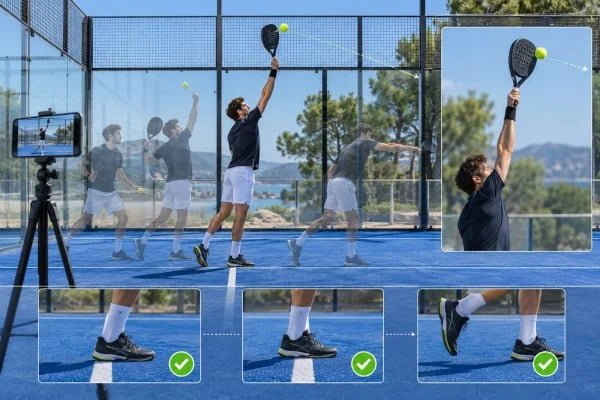
Use this five-question self-check
I use the following questions because another player can answer them through direct observation:
- Did I begin with both feet behind the service line and inside the permitted lateral area?
- Did either foot touch the service line or prohibited imaginary extension before contact?
- Did I walk, run, or jump between adopting my service position and hitting the ball?
- Did at least one foot remain in contact with the ground at impact?
- Did my clear forward movement occur only after racket-ball contact?
If the answers are yes, no, no, yes, and yes respectively, the footwork is more likely to comply with the standard FIP wording. The rest of the serve must still be legal, including the ball bounce, contact height, direction, and service-box result.
Record from a useful angle
A phone placed safely outside the playing area can provide better evidence than memory. I prefer a side view that includes:
- Both feet;
- The full service line;
- The ball bounce;
- The racket;
- The contact point; and
- The first recovery step.
A frame rate of 60 frames per second is usually more helpful than standard 30 fps for identifying close timing.3 Slow-motion recording can make the sequence even clearer, although camera distortion and a poor angle can still misrepresent line contact.
Use simple floor markers in practice
During practice, a temporary visual marker placed safely behind the line can help the player maintain a stable base. The marker should not create a trip hazard or damage the playing surface. The player can then rehearse ten serves with no forward recovery, followed by ten serves with movement beginning only after impact.
I also recommend asking an observer to call out only one issue at a time. For example, the observer might watch the front foot during one set and the back foot during the next. This approach produces more reliable feedback than asking one person to judge every service requirement simultaneously.
Apply the correct standard
Club etiquette does not replace formal rules. Some social groups tolerate movement that a sanctioned event may penalize. Other groups become unnecessarily strict and call every heel lift a fault.
Before competition, I would ask the organizer three questions:
- Which governing body’s rules apply?
- Which rulebook edition is in force?
- Who makes the final decision on a disputed serve?
That short check is especially useful for club staff, coaches, amateur referees, and players entering their first organized tournament.
Frequently Asked Questions
Can I lift my back foot when serving in padel?
You may be able to lift a foot if at least one foot remains grounded at ball contact and the movement does not become walking, running, jumping, or a material change in your adopted position. Because the complete motion matters, I recommend checking a side-view video or asking the event referee.
Can my foot cross the service line after I hit the ball?
Yes. A player can generally cross the service line after legal racket-ball contact. The movement becomes normal recovery and court positioning at that point. However, the player should not touch or cross the line prematurely as part of a pre-contact step.
Is a small shuffle allowed when serving in padel?
The FIP wording allows small foot movements that do not affect the adopted service position. A minor balance adjustment may therefore be acceptable. Several shuffles that move the player forward or sideways may amount to walking, so players should avoid using “small movement” as permission for a run-up.
Do both feet need to remain on the ground during the serve?
No. The standard rule requires at least one foot to remain in contact with the ground at the moment of ball contact. However, lifting one foot does not automatically make the whole motion legal. The server must also avoid walking, running, jumping, and prohibited line contact.
Who decides whether a walking serve is a fault?
An appointed umpire or event referee makes the formal decision in an organized competition. In an unofficiated match, players should use the applicable rules and resolve uncertainty consistently. If the motion remains disputed, I recommend replaying informally only when the competition rules permit that solution.
Conclusion
Walking while serving in padel is best judged through timing rather than a context-free yes or no. The server should establish a legal position, avoid walking, running, or jumping before contact, and keep at least one foot grounded at impact. The player may then move forward normally after striking the ball. I recommend filming your serve, checking the current FIP rulebook, and asking the event referee about close interpretations. For broader padel court planning and equipment documentation, you can contact QHPADEL’s Alice Chen at alice@grass-supplier.com.
-
"[PDF] RULES OF PADEL INTERNATIONAL PADEL FEDERATION", https://www.padelfip.com/wp-content/uploads/2025/12/FIP_Rules-of-Padel.pdf. FIP service rules permit small foot movements provided they do not affect the server’s adopted position, distinguishing minor adjustments from prohibited movement. Evidence role: definition; source type: institution. Supports: The official exception permitting limited foot movement during a padel serve.. ↩
-
"[PDF] Official Rulebook for Men’s Tournaments – Padel FIP", https://www.padelfip.com/wp-content/uploads/2025/03/Premier-Padel-Rulebook-Mens_EN-2-1.pdf. FIP competition and officiating regulations assign rule-application duties and match decisions to designated officials, including referees and umpires where appointed. Evidence role: general_support; source type: institution. Supports: The authority of designated match officials to apply rules and decide incidents in FIP-governed competition.. Scope note: The exact title, presence, and authority of an official may differ under national-federation or event-specific regulations. ↩
-
"Comparison of interpretability of 1080p30 and 720p60 motion …", https://tsapps.nist.gov/publication/get_pdf.cfm?pub_id=902511. Video-analysis research explains that increasing frame rate reduces the time between frames, which can improve identification of rapid events such as contact and foot movement. Evidence role: mechanism; source type: research. Supports: That a higher frame rate produces shorter intervals between captured frames and can improve temporal discrimination of rapid movement events.. Scope note: A 60-fps recording still has finite temporal resolution, and camera angle, shutter speed, lens effects, and occlusion can limit conclusions about a close line or contact event. ↩