Learning how to start a padel business can feel deceptively simple: secure a site, buy courts, and begin taking bookings. However, weak demand assumptions, overlooked construction costs, or unsuitable court specifications can delay opening and consume working capital. I recommend validating demand, site feasibility, and the complete financial model before committing significant funds.
To start a padel business, I would first verify local willingness to pay, realistic court utilization, competition, and customer segments. I would then confirm site feasibility, calculate the full opening cost, obtain local professional approvals, select an appropriate court system, and assign responsibility for civil works, freight, unloading, installation, commissioning, and ongoing maintenance.
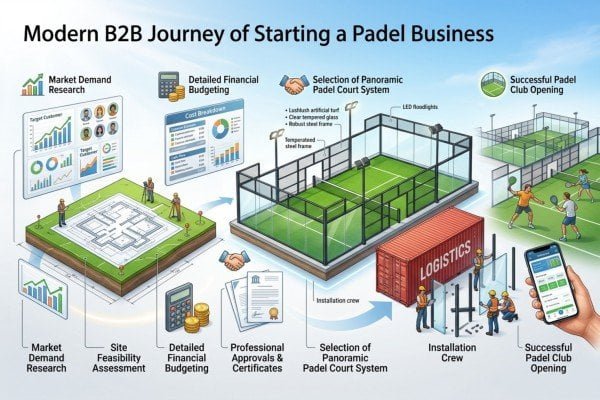
From a supplier’s perspective, I see the strongest projects move through clear decision gates. The investors do not begin with frame colors or panoramic views. They begin with evidence. The following framework explains what I believe buyers should validate before choosing a site, ordering equipment, or starting construction.
How Do I Validate Demand for a Padel Business?
Investors often contact me after seeing padel succeed in another city or country. That popularity can support an opportunity, but it cannot prove local paid demand. If an investor confuses interest with willingness to pay, even an attractive padel business can struggle to cover fixed operating costs.
I would validate demand by defining target customers, testing acceptable booking prices, mapping existing and planned competitors, and estimating utilization by day and hour. I would treat social media engagement and general sports participation as supporting signals, not final proof. Paid trials, deposits, surveys, and local booking data provide stronger evidence.1
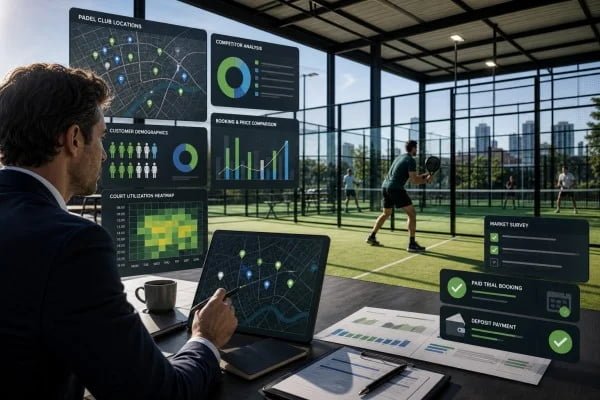
Define the Customer Before Defining the Facility
I recommend starting with a specific customer hypothesis. A club designed for corporate groups may require different operating hours, hospitality areas, and pricing from a facility aimed at students or competitive players.
I commonly see investors consider these segments:
- Recreational adults booking after work or on weekends
- Competitive players seeking leagues, coaching, and tournaments
- Families and junior players needing structured programs
- Corporate groups purchasing events or recurring sessions
- Hotel and resort guests using courts as an amenity
- Schools and universities requiring scheduled institutional access
- Tourists or expatriate communities already familiar with padel
I would estimate each segment separately. I would ask how many potential customers live or work within a realistic travel radius, what they currently spend on leisure activities, and whether they can book at the planned times.
Test Willingness to Pay
I believe a survey that asks, “Do you like padel?” offers limited commercial evidence. Many people like an idea but do not pay for it consistently.
I would use stronger validation methods where practical:
- Run temporary introductory sessions at an existing sports venue.
- Collect refundable founding-member deposits under clearly written terms.
- Test several price points instead of asking one general pricing question.
- Build a waiting list that records location, preferred times, and booking frequency.
- Interview companies, schools, hotels, and coaches about recurring demand.
- Review comparable local activities, including tennis, football, squash, fitness clubs, and bowling.
A common inquiry pattern illustrates the risk. I sometimes receive a request for six or eight courts because an investor has seen crowded clubs abroad. When I ask about local booking prices or peak-hour demand, the investor may not yet have collected those figures. In that situation, I recommend pausing the equipment decision.
Model Utilization by Time Slot
I would not calculate demand as one average percentage. A padel business can have strong evening demand and weak daytime demand.2 That imbalance affects coaching programs, staffing, lighting expenses, and total revenue.
| Time period | Demand question | Possible demand source |
|---|---|---|
| Weekday mornings | Who can play during working hours? | Retirees, tourists, schools |
| Weekday afternoons | Can coaching fill quieter periods? | Juniors, private lessons |
| Weekday evenings | How many peak slots can the market support? | Employees, leagues |
| Weekend mornings | Will families or tournaments book? | Families, clubs |
| Weekend evenings | Does local leisure behavior support play? | Groups, events |
I would build conservative, base, and higher-demand scenarios. I would not treat the higher case as guaranteed. A qualified local financial adviser can help test whether the assumptions support the investment.
What Does It Cost to Start a Padel Business?
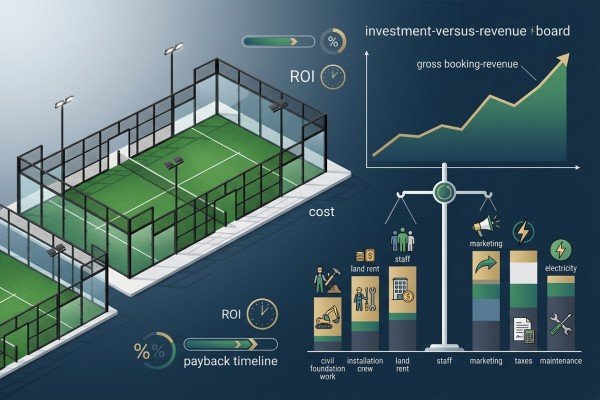
Many early inquiries focus on the court package price. That figure matters, but it represents only one part of the capital requirement. If an investor omits foundations, freight, taxes, installation, utilities, or pre-opening cash, the padel business may face a funding gap before it accepts its first booking.
The cost to start a padel business includes property, design, permits, engineering, court equipment, civil works, freight, customs, unloading, installation, utilities, supporting facilities, professional services, marketing, insurance, and working capital.3 I recommend using locally verified quotations and adding a documented contingency instead of relying on a universal cost estimate.
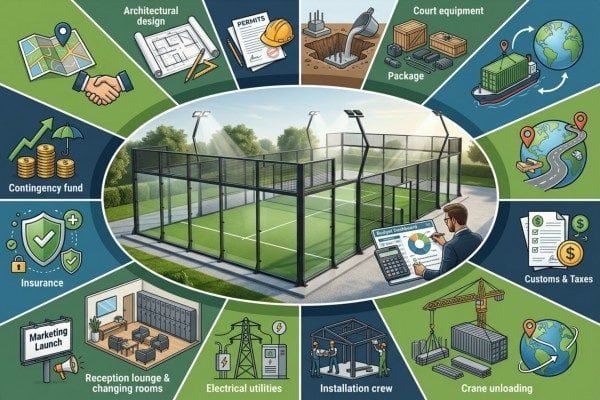
Build a Complete Cost Map
I separate costs into four groups because the timing and responsible parties differ.
| Cost group | Typical items | Recommended evidence |
|---|---|---|
| Site and approvals | Lease, purchase, survey, permits, design, engineering | Local contracts and professional quotations |
| Construction | Ground preparation, drainage, slabs, foundations, buildings | Contractor bill of quantities |
| Court delivery | Court package, freight, insurance, duties, unloading | Supplier quotation and logistics estimate |
| Opening and operation | Staff, software, marketing, utilities, maintenance, working capital | Local operating plan |
I advise investors to request clear inclusion and exclusion lists. A quotation marked “complete court” may cover the playing enclosure but exclude the foundation, forklift, installation labor, electrical cables, local transport, or drainage.
A complete padel court package can include:
- Structural steel posts and frames
- Welded mesh panels
- Tempered glass panels
- Artificial turf
- Court lighting fixtures
- Net posts and net
- Fasteners and connection accessories
- Installation and foundation drawings
- Packing lists and maintenance guidance
However, I would still confirm every item line by line. I have seen project questions arise because one party assumed that electrical distribution, lifting equipment, sealants, or specialist tools belonged to another party.
Use a Full-Cost Formula
I would model the required investment with a formula such as:
Total opening requirement = site costs + professional fees + approvals + civil works + court systems + logistics + installation + supporting facilities + pre-opening expenses + working capital + contingency4
I would also track whether each figure includes local tax. Tax treatment, import duties, permit fees, and labor costs differ substantially by jurisdiction. I cannot responsibly provide one worldwide opening-cost figure.
Protect Cash Flow During the Opening Period
A new padel business may incur expenses before revenue stabilizes. I would budget for rent, salaries, utilities, software, insurance, maintenance, and marketing during that period. I would also allow for weather delays, customs inspections, permit revisions, or corrective work.
I recommend that investors ask a qualified accountant or financial adviser to review:
- Break-even calculations
- Debt repayment requirements
- Tax assumptions
- Working-capital needs
- Sensitivity to lower booking volumes
- Sensitivity to construction delays
- Replacement and maintenance reserves
I would never treat a supplier quotation as a complete business plan. The supplier controls manufacturing scope and documentation, while the investor and local professionals control the broader commercial and construction model.
How Do I Check Whether a Site Is Suitable for a Padel Business?
A promising location can still fail the technical review. Limited access, poor drainage, insufficient ceiling height, unsuitable ground conditions, or unverified wind loads can force expensive changes. I therefore recommend confirming site feasibility before finalizing a court configuration or paying a manufacturing deposit.
A suitable padel business site must provide adequate court clearances, safe access, workable ground conditions, drainage, utilities, lighting control, and space for supporting facilities. A locally qualified engineer should verify structural, wind, snow, seismic, foundation, fire, accessibility, and building requirements before the investor approves the design.

Send Accurate Site Information
From a manufacturer’s perspective, incomplete site data creates avoidable design and quotation risk. I recommend sending the supplier and local design team a coordinated information package.
The package should include:
- A measured site plan
- Court quantity and preferred arrangement
- Indoor or outdoor conditions
- Finished floor levels
- Available ceiling or roof height
- Access routes for trucks and lifting equipment
- Locally confirmed wind, snow, and seismic criteria
- Ground or geotechnical information when relevant
- Drainage strategy
- Electrical supply and lighting requirements
- Destination port and final delivery address
- Local unloading conditions
- Installer responsibilities
- Applicable building and sports-facility rules
I often receive a message that provides only the country and requested court quantity. That information can support a preliminary discussion, but it cannot support final structural or logistics decisions. Conditions can vary within one country, especially between coastal, inland, high-altitude, and cyclone-prone regions.
Review Space Beyond the Playing Area
A standard doubles playing area is commonly 20 metres long and 10 metres wide, but the project requires more than a 200-square-metre rectangle. I would account for structural footprints, circulation, emergency access, spectator areas, maintenance access, and separation between courts. I would also confirm dimensions against the governing rules and local design requirements.
A commercial club may need space for:
- Reception and waiting areas
- Toilets and changing rooms
- Accessible circulation
- Storage and maintenance equipment
- Coaching or warm-up areas
- Food and beverage service
- Spectator seating
- Parking or drop-off access
- Mechanical and electrical equipment
- Emergency exits and fire routes
Investigate Ground, Water, and Access
I have seen anonymized projects encounter problems after court layouts were already selected. One project discovered that the unloading vehicle could not enter the site. Another needed drainage revisions because rainwater crossed the proposed slab. These issues were not equipment defects, but they affected delivery and opening.
I recommend that local professionals verify:
- Ground bearing and settlement risk5
- Slab flatness and finished levels
- Foundation or anchoring details
- Surface and subsurface drainage
- Wind exposure around buildings
- Flooding or groundwater conditions
- Truck, crane, forklift, and glass-handling access
- Noise and lighting impact on neighbors
A court supplier can provide system drawings and foundation load information. However, I believe a locally licensed engineer should adapt and approve the foundation and structure for the actual site and applicable regulations.
Which Court System Should I Choose for a Padel Business?
Court appearance strongly influences an investor’s first impression. However, appearance alone should not drive the purchase. The wrong configuration can complicate installation, increase maintenance, conflict with the environment, or provide documentation that does not satisfy the local approval process.
I would choose a padel court system according to the operating environment, structural requirements, viewing needs, maintenance capacity, budget, and installation conditions. I would compare panoramic, ultra-panoramic, classic, roofed, single, and weather-resistant options by verified specifications rather than selecting the lowest price or most attractive rendering.
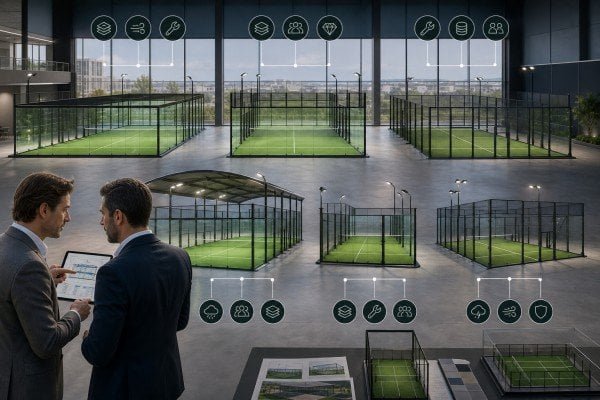
Compare the Configuration With the Use Case
Different projects prioritize different features. A tournament-oriented venue may value wide spectator sightlines. A school may prioritize durability, access control, and clear safety documentation. A hotel may focus on appearance, noise, and integration with landscaping.
| Court type | Typical evaluation priority | Procurement question |
|---|---|---|
| Panoramic | Viewing experience and commercial appearance | How does the frame support the glass and resist local loads? |
| Ultra-panoramic | Maximum sightlines and premium presentation | What installation tolerances and structural checks apply? |
| Classic | More visible framing and conventional construction | Does the configuration simplify local maintenance? |
| Single court | Smaller player format or limited application | Does local demand justify the format? |
| Roofed court | Weather protection | Who designs and approves the complete roof structure? |
| Weather-resistant design | Higher environmental loads | Which load criteria and engineering documents apply? |
I recommend treating product names as starting points, not standardized engineering guarantees. Two suppliers may use the same commercial name for different steel sections, coatings, glass arrangements, fasteners, and reinforcement details.6
Review the Bill of Materials
I would request a complete bill of materials before signing the purchase agreement. The document should identify component quantities, material specifications, finishes, and exclusions.
Key areas include:
- Steel grades, wall thicknesses, and protective coatings
- Post and mesh dimensions
- Glass thickness, processing, edge quality, and hole positions
- Turf pile height, Dtex, density, backing, and color
- Lighting power, optics, mounting positions, and drivers
- Fastener grades and corrosion protection
- Door type and opening direction
- Net, posts, and tensioning components
- Spare parts and replacement procedures
For artificial turf customization, I would also confirm minimum order quantities. At QHPADEL, for example, customized turf specifications have a minimum order quantity equivalent to six courts, or approximately 1,254 square metres based on 209 square metres per court. I would make that commercial condition clear before design approval.
Verify Documents Rather Than Accepting Logos
I advise buyers to treat certifications as documents that require verification. A logo in a brochure does not prove that a report covers the offered model, production facility, or current standard.
QHPADEL can provide documents relating to areas such as ISO 9001 factory certification and product-specific CE or other test documentation for artificial turf, steel structures, tempered glass, lighting, screws, and accessories. However, I recommend that buyers review:
- Certificate holder and manufacturer name
- Product model or scope
- Standard number and edition
- Issuing or testing body
- Issue and expiry dates
- Report references and test samples
- Relevance to local procurement rules
A local engineer, compliance consultant, or authority should decide whether the documents satisfy the project.7 I would not assume that one certificate automatically provides approval in every market.
How Should I Select Suppliers and Sequence a Padel Business Project?
A reliable product can still arrive in a poorly coordinated project. Missing drawings, unclear delivery terms, unassigned unloading work, or late foundation changes can delay installation. I therefore evaluate a supplier by its control of interfaces, not only by its quoted price.
I would select a padel court supplier by comparing manufacturing capability, technical documentation, complete scope, quality controls, delivery planning, packaging, references, warranty terms, and response procedures. I would then freeze the site data and approved design before production, while assigning every local and supplier responsibility in writing.
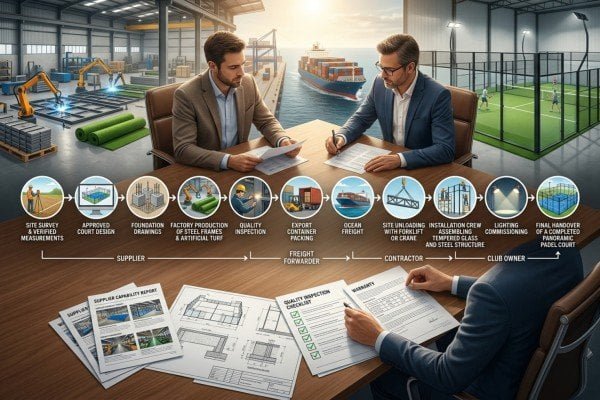
Evaluate the Supplier’s Evidence
I recommend asking every shortlisted manufacturer the same questions. A standardized request makes quotations easier to compare.
My supplier evaluation checklist includes:
- What does the quoted package include and exclude?
- Which drawings arrive before production?
- Which dimensions require buyer approval?
- How does the factory inspect welding, coating, glass, turf, and packing?
- How are components numbered for installation?
- Which spare parts come with the shipment?
- How does the supplier handle missing or damaged components?
- What does the warranty cover and exclude?
- Which party carries each freight and insurance risk?
- Which certificates and reports match the offered products?
- What installation support is available?
- What production lead time begins after design and payment approval?
At QHPADEL, our stated standard production planning is approximately 20 days for two courts, 20–25 days for four courts, and no more than 30 days for more than four standard courts. Custom designs can require up to approximately 35 days. I treat those figures as manufacturing estimates, not guaranteed opening dates. Freight, customs, civil works, local installation, inspections, and weather remain separate schedule factors.
Use Decision Gates
I would sequence the project through formal approval gates:
| Gate | Required decision |
|---|---|
| 1. Demand validation | Is there enough evidence to continue feasibility work? |
| 2. Financial feasibility | Does the full-cost model remain viable under conservative assumptions? |
| 3. Site feasibility | Can local professionals approve the intended use and construction? |
| 4. Concept selection | Which court type and facility layout suit the project? |
| 5. Technical approval | Are dimensions, loads, drawings, finishes, and scope frozen? |
| 6. Production | Has the buyer approved the final documents and payment terms? |
| 7. Logistics | Are freight, customs, unloading, storage, and access arranged? |
| 8. Installation | Are foundations accepted and responsibilities confirmed? |
| 9. Handover | Are inspections, defects, documents, and maintenance recorded? |
| 10. Opening | Are staff, systems, pricing, safety procedures, and marketing ready? |
Create a Responsibility Matrix
I have found that responsibility gaps cause more confusion than the physical number of components. An investor may assume that the installer checks the slab. The installer may assume that the civil contractor has already confirmed it. A written matrix prevents that ambiguity.
I would assign responsibility for:
- Local permits and approvals
- Structural engineering
- Foundation design and construction
- Court manufacturing
- Freight booking and insurance
- Customs clearance
- Inland delivery
- Unloading and secure storage
- Installation labor and tools
- Electrical connections
- Final inspections
- Defect reporting
- Spare parts
- Maintenance training
I would record one responsible party and one approval party for every task. I would also document notice periods, evidence requirements, and response times. This process does not eliminate risk, but it makes project interfaces visible before they become costly.
Frequently Asked Questions
How many courts should a new padel business open with?
I would base court quantity on validated demand, site capacity, funding, and the operating model. More courts can support leagues and simultaneous bookings, but they also increase construction and fixed costs. I recommend modeling several quantities and testing each option against conservative utilization rather than copying another club.
Should I lease or buy the site?
I would compare lease length, renewal rights, permitted use, landlord approvals, improvement ownership, financing, and exit conditions. A short or uncertain lease can conflict with a capital-intensive build.8 I recommend obtaining local legal and financial advice before committing to either structure.
Can I install padel courts outdoors?
Outdoor courts are possible, but I would verify wind, rain, drainage, corrosion exposure, temperature, lighting impact, and local structural requirements first. A locally qualified engineer should confirm the foundation and load criteria. The manufacturer should receive those verified criteria before finalizing the court structure.
What documents should I request from a padel court supplier?
I would request a detailed quotation, bill of materials, technical data, layout drawings, foundation information, installation drawings, packing list, maintenance manual, warranty terms, and applicable certificates or test reports. I would verify that each document covers the actual model and satisfies local project requirements.
How long does it take to open a padel club?
I cannot give one reliable global timeline because permits, site work, manufacturing, sea freight, customs, installation, and inspections vary by project. I recommend building a schedule from locally verified durations and adding contingency. The equipment production period represents only one part of the overall opening schedule.
Conclusion
Learning how to start a padel business requires more than selecting attractive courts and comparing package prices. I would validate paid demand, build a full-cost model, confirm the site with qualified local professionals, select the court system for its real environment, and document every supplier and contractor responsibility. These steps cannot guarantee commercial success, but they can expose major risks before capital is committed.
If you need a technical court quotation, bill of materials, configuration comparison, or preliminary drawing package, contact Alice Chen at QHPADEL via alice@grass-supplier.com or WhatsApp +86 185 7566 0746.
-
"How Are Preferences Revealed? – PMC – NIH", https://pmc.ncbi.nlm.nih.gov/articles/PMC3993927/. Studies of stated and revealed preferences explain that survey responses can differ from actual purchasing behavior, while observed transactions or financially consequential choices provide more direct evidence of willingness to pay. Evidence role: mechanism; source type: research. Supports: Research comparing stated-preference responses with observed or incentivized behavior in willingness-to-pay measurement.. Scope note: Such evidence supports the general validation principle; it does not establish demand for a particular padel venue. ↩
-
"Factors influencing interest in recreational sports participation …", https://pmc.ncbi.nlm.nih.gov/articles/PMC5444777/. Research on recreation and sports-facility participation documents that use can be uneven across the day and week, with work and school schedules often shaping peak and off-peak demand periods. Evidence role: general_support; source type: paper. Supports: Empirical evidence on temporal patterns in participation or use of recreational sports facilities.. Scope note: Patterns differ by locality, sport, pricing, and user population, so local booking evidence remains necessary. ↩
-
"Plan your business – Small Business Administration", https://www.sba.gov/counseling/plan-your-business/. Small-business planning guidance identifies startup budgets as including both one-time establishment costs—such as equipment, permits, professional services, and construction—and funds for operating expenses before revenues become sufficient. Evidence role: general_support; source type: government. Supports: Government small-business guidance identifying startup expenses, operating expenses, and working-capital needs.. Scope note: The categories are general business-planning guidance and do not quantify padel-project costs in any jurisdiction. ↩
-
"Major Project Program Cost Estimating Guidance", https://www.fhwa.dot.gov/majorprojects/cost_estimating/guidance.cfm. Capital-project cost-estimating guidance describes contingency as an allowance for identified uncertainty and notes that project budgets should account for direct costs, indirect costs, and risks that may arise before completion. Evidence role: mechanism; source type: government. Supports: Authoritative cost-estimating guidance on including contingency for uncertainty in capital-project budgets.. Scope note: Contingency methods and appropriate percentages depend on estimate maturity, risk analysis, procurement arrangements, and local conditions. ↩
-
"Geotechnical LFRD calculations of settlement and bearing capacity of …", https://rosap.ntl.bts.gov/view/dot/31389. Geotechnical engineering guidance explains that foundation design must consider subsurface strength and deformation because inadequate bearing capacity or excessive settlement can impair structural performance. Evidence role: mechanism; source type: government. Supports: Geotechnical guidance explaining the relationship between subsurface conditions, bearing capacity, settlement, and foundation performance.. Scope note: Only a site-specific investigation and locally qualified design professional can determine applicable foundation requirements. ↩
-
"11.104 Use of brand name or equal purchase descriptions.", https://www.acquisition.gov/far/11.104. Public-procurement guidance generally requires specifications to describe functional or technical requirements sufficiently to assess equivalence, rather than treating a commercial product name alone as evidence of comparable performance. Evidence role: general_support; source type: government. Supports: Procurement guidance on using measurable technical specifications rather than relying solely on brand or product names.. Scope note: The cited procurement principles are general and do not compare any particular padel-court products. ↩
-
"Building Codes, Standards, and Regulations: Frequently …", https://www.congress.gov/crs-product/R47665. Building-regulation frameworks are adopted and enforced by the relevant jurisdiction, so evidence of product testing or certification must be assessed against the locally applicable code, permit process, and site-specific design conditions. Evidence role: expert_consensus; source type: institution. Supports: Authoritative guidance that building codes and approval requirements are adopted, interpreted, and enforced by relevant local jurisdictions.. Scope note: The responsible reviewing professional and approval pathway vary by country, region, and project type. ↩
-
"Capital Asset Categories Leasehold Improvements", https://fmx.cpa.texas.gov/fmx/pubs/afrrptreq/cap_assets/index.php?section=categories&page=leasehold. Commercial leasing guidance notes that tenants making substantial improvements should evaluate lease duration, renewal options, ownership of improvements, and termination provisions because these terms affect the period available to recover capital expenditure. Evidence role: general_support; source type: education. Supports: Commercial real-estate guidance on aligning lease terms with the cost and recovery period of tenant improvements.. Scope note: The commercial significance of a lease term depends on local law, negotiated rights, financing, and the project’s expected cash flows. ↩