Padel in the UK is still attracting players, venue developers, and commercial buyers, but national momentum can hide weak local opportunities. A new club may face nearby competition, planning constraints, or poor off-peak demand. I therefore treat the headline growth story as a starting point and test each proposed location separately.
Yes, dated national evidence shows that padel in the UK continued growing through 2024, with increases in annual participation, courts, and venues. However, national growth does not guarantee that a specific club will succeed. Investors should verify local court supply, repeat demand, achievable pricing, accessibility, and off-peak utilisation before committing capital.
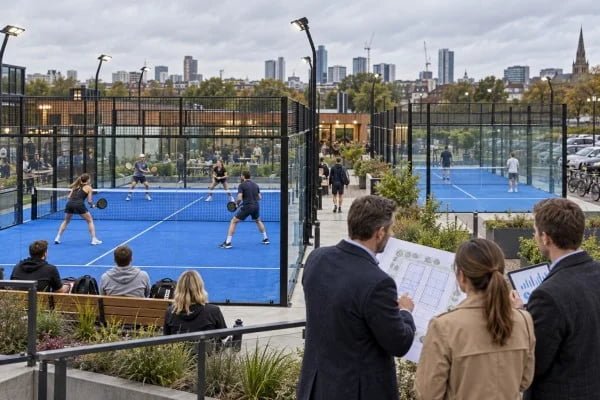
From my position as a court manufacturer handling UK enquiries, I can see continued commercial interest. However, enquiries are not market statistics. I use them to identify the questions serious buyers are asking, then encourage each buyer to validate local demand before ordering equipment.
Is Padel in the UK Still Growing According to Dated Data?
A simple “yes” can be misleading because participation, operating courts, proposed courts, and profitable venues are different measures. If buyers combine them, they may overestimate demand. I prefer to separate each indicator and attach a clear date and definition to every figure.
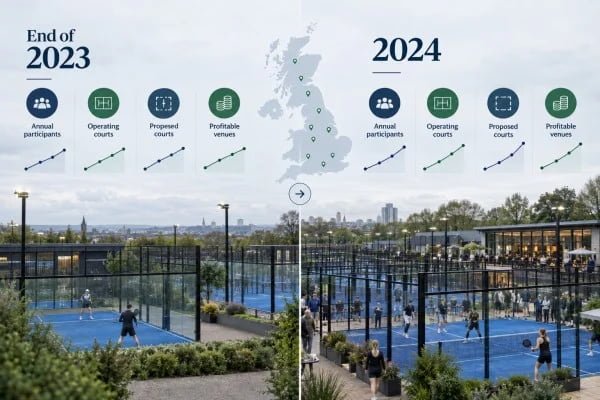
The most defensible answer is that padel in the UK was still growing in the most recent dated national evidence available for this analysis. The LTA reported approximately 400,000 annual players and 450 courts at the end of 2023, followed by more than 600,000 players and over 700 courts during 2024.1
What do the national figures actually show?
The LTA Padel Strategy 2024–2029 used an end-of-2023 baseline of approximately 400,000 adults and juniors playing at least once during the year, around 450 courts, and more than 150 venues across Britain. Public LTA updates during 2024 subsequently referred to more than 600,000 annual participants and over 700 courts.
Those figures indicate expansion, but I would place three qualifications beside them:
-
The LTA generally reports on Great Britain, not the entire United Kingdom.2
Northern Ireland may fall outside a dataset described as “Britain.” I would not silently present a Great Britain figure as a complete UK total. -
Annual participation does not mean regular participation.3
A person who played once during a holiday or corporate event can appear in an annual participation estimate. That player does not have the same commercial value as someone booking every week. -
A court count does not describe capacity equally.
One outdoor court at a private sports club is not equivalent to six covered courts at a dedicated commercial venue. Opening hours, weather protection, pricing, and booking access all affect usable supply.
| Growth indicator | What it can show | What it cannot prove |
|---|---|---|
| Annual participants | Public awareness and trial activity | Weekly retention or repeat bookings |
| Operating courts | Existing physical supply | Whether venues are busy or profitable |
| Number of venues | Geographic expansion | The number of courts within each catchment |
| Planning applications | Development interest | That the courts will be built or opened |
| Supplier enquiries | Purchasing interest | Nationwide market growth |
| Tournament entries | Competitive engagement | Mainstream local demand |
I also distinguish operating courts from planned courts. Planning approval, funding, landlord consent, construction, and final opening are separate stages. A press release describing 12 planned courts should not be added to an operating-court total.
For current project work, I recommend checking the LTA padel court finder alongside local authority planning portals and direct calls to nearby venues. Buyers should record the date of each check because court supply can change quickly.
I see the national data as evidence of a growing category, not proof that every postcode needs another club.
What Does Padel Growth in the UK Really Measure?
Popularity creates excitement, but excitement can encourage buyers to rely on the wrong metric. If a feasibility study counts social media attention or one-time players as stable demand, its revenue assumptions may become fragile. I focus instead on how participation develops into repeated, payable court use.
Padel growth can refer to more people trying the sport, more regular players, additional operating courts, new venue openings, or higher booking revenue. These indicators are related but not interchangeable. For a proposed club, repeat bookings, retention, off-peak use, and sustainable net pricing usually provide more useful evidence than national awareness alone.
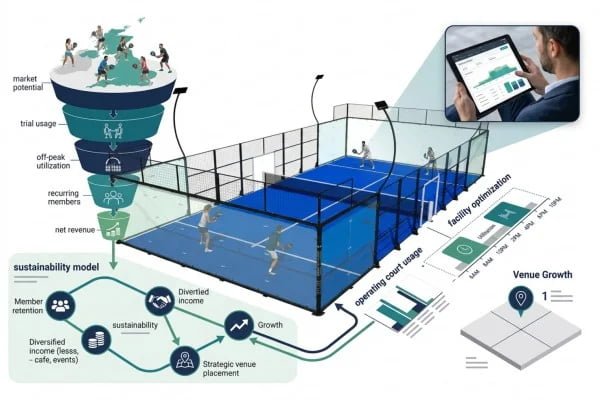
Participation is only the top of the funnel
I often compare padel demand with a funnel:
- A person becomes aware of the sport.
- The person tries it once.
- The person books again.
- The person develops a weekly habit.
- The person joins leagues, lessons, or social sessions.
- The person remains active through winter and outside peak times.
National participation estimates mainly help buyers understand the top part of that funnel. A venue depends much more heavily on the lower stages.
A strong opening month can also give the wrong impression.4 New venues often benefit from launch events, introductory discounts, press coverage, and curiosity. Buyers should ask whether demand survives when promotional pricing ends.
Court growth is not the same as capacity growth
I also examine the format of new supply. Four uncovered courts may have less practical annual capacity than three well-designed covered courts, especially when rain, wind, limited daylight, and neighbouring properties restrict operation.5
The following questions reveal more than a simple court count:
- How many nearby courts are indoor, covered, or fully outdoor?
- How many hours can each venue legally and practically operate?
- Can the public book courts, or are they restricted to members?
- Does each competitor offer coaching, leagues, junior sessions, and equipment hire?
- What are the peak and off-peak prices?
- How far in advance are desirable slots booked?
- Are venues planning additional courts?
I once received an enquiry that initially appeared to come from an area with very limited supply. A closer review showed several courts in the planning pipeline and a private venue that did not appear prominently in general web searches. That experience reinforced my view that desktop research should be followed by telephone checks and site visits.
Revenue growth requires its own evidence
A club can have busy courts without producing an acceptable return. Revenue must cover staffing, rent or property costs, utilities, booking software, marketing, coaching arrangements, maintenance, insurance, finance, rates, and future replacement work.
I would therefore keep three claims separate:
- Padel is becoming more popular.
- More padel courts are opening.
- A proposed venue can operate profitably.
The first two claims may support the third, but they do not prove it. A qualified UK accountant or investment adviser should review financial assumptions, while planning and engineering professionals should assess site-specific constraints.
Can a Local Area Support Another Padel Venue?
National growth can create local saturation when several developers choose the same attractive city or demographic. A weak catchment analysis may leave a new club competing for the same limited group of regular players. I screen the location, audience, access, and competing supply before discussing court specifications in detail.
A local area may support another padel venue when its realistic catchment contains enough repeat players, existing courts are constrained or consistently busy, access is convenient, and the proposed format serves an unmet need. Buyers should test these conditions with booking observations, competitor research, surveys, trial events, and conservative financial modelling.

Start with a realistic catchment
A broad population figure rarely tells me enough. Travel behaviour differs between central London, a commuter town, a university area, and a rural leisure destination.
I recommend mapping potential customers by realistic journey time rather than drawing an arbitrary radius. The analysis should consider:
- Evening and weekend traffic
- Public transport links
- Safe walking and cycling access
- On-site parking capacity
- Nearby workplaces and universities
- Schools, hotels, gyms, and residential developments
- Existing tennis, squash, football, and leisure communities
- Competing padel venues inside and just outside the catchment
I would also segment the likely audience. A premium central venue may depend on corporate and affluent adult players. A suburban club may need families, juniors, coaching, and memberships. A university project may need affordable group programming rather than premium pay-and-play rates.
Audit nearby padel supply
A competitor audit should examine more than Google Maps results. I would check the LTA venue finder, venue websites, booking platforms, local planning portals, social media pages, and direct telephone enquiries.
A practical audit table could look like this:
| Factor | Questions to verify | Why it matters |
|---|---|---|
| Court quantity | How many courts operate within the catchment? | It estimates visible supply |
| Court format | Are courts indoor, covered, panoramic, or outdoor? | It affects weather resilience and positioning |
| Availability | Can players find evening and weekend slots? | It indicates peak-time pressure |
| Off-peak bookings | Are weekday mornings and afternoons used? | It tests depth of demand |
| Price | What is the actual payable rate after discounts? | It supports realistic revenue modelling |
| Audience | Are players members, students, families, or corporate groups? | It identifies market gaps |
| Pipeline | Which applications are approved, pending, or withdrawn? | It reveals future competition |
I would observe booking calendars over several weeks rather than checking them once. A fully booked Saturday could coincide with a tournament. Conversely, an empty weekday morning might be normal and manageable if coaching, schools, or corporate programmes can fill it later.
Look for an unmet need
A new facility does not always need an untouched area. It can succeed by solving a problem that existing venues do not address.
Possible gaps include:
- Covered courts in a weather-exposed market
- Early-morning or late-evening access
- Dedicated junior coaching
- Disability-inclusive programming
- Higher-specification competition courts
- Affordable community sessions
- Corporate leagues
- A club experience with food, social space, and events
However, each gap needs verification. I would not assume that players will pay more for a panoramic court or travel farther for a premium clubhouse without local evidence.
Which Metrics Show Whether Padel Demand Is Sustainable?
Peak evening bookings can make a project look stronger than it is. However, fixed property and staffing costs continue throughout the day. If demand disappears outside a few popular hours, the venue may struggle even while customers complain that Friday evenings are full.
The most useful indicators of sustainable padel demand are repeat-booking frequency, player retention, revenue per available court hour, off-peak utilisation, price resilience, coaching conversion, and customer acquisition cost.6 Buyers should measure these by court, time band, and customer segment instead of relying only on total bookings or opening-month occupancy.
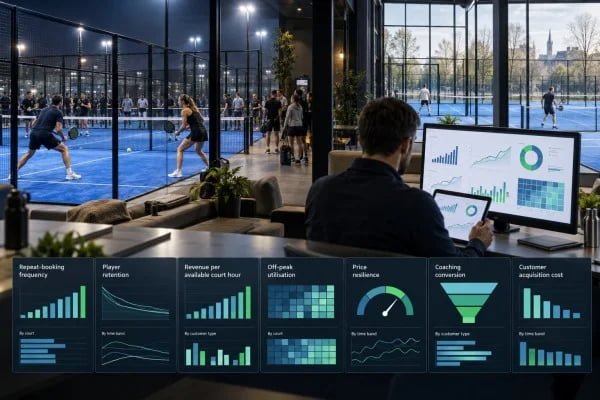
Measure utilisation by time band
A single monthly utilisation percentage can conceal operational weakness. I prefer a time-band approach.
| Time band | Example period | Main question |
|---|---|---|
| Peak | Weekday evenings | Can pricing remain sustainable without excessive discounts? |
| Shoulder | Late afternoon and Sunday evening | Can leagues or coaching build regular use? |
| Off-peak | Weekday mornings and early afternoons | Can schools, seniors, students, or corporate groups fill capacity? |
| Seasonal risk | Dark, wet, or cold periods | Does the facility format protect playable hours? |
A court that reaches 90% utilisation for 20 peak hours but only 15% utilisation during the remaining available hours has a different commercial profile from a court with balanced use throughout the week.
I would calculate revenue per available court hour, not just revenue per booked hour:
Revenue per available court hour = total court-related revenue ÷ total bookable court hours
This measure exposes the cost of empty capacity. Buyers can also calculate it after discounts and booking commissions to understand the net rate actually received.
Track repeat behaviour
A database of 2,000 registered users can sound impressive, but inactive registrations contribute little to ongoing demand. I would monitor:
- Percentage of first-time players who return within 30 days
- Average bookings per active customer
- Three-month and six-month retention
- League and social-session participation
- Coaching-to-independent-play conversion
- Percentage of bookings made by repeat customers
- Customer acquisition cost by channel
- Cancellation and no-show rates
I also recommend separating court bookings from coaching, events, memberships, retail, and food or beverage revenue. Each stream has different staffing requirements and margins.
Stress-test price assumptions
Published prices do not always equal realised prices. Introductory promotions, memberships, student offers, coach allocations, cancellations, and booking-platform fees can reduce net revenue.
A cautious model should test at least three cases:
- Base case: Supported by observed local prices and conservative utilisation.
- Downside case: Lower off-peak use, delayed opening, and weaker retention.
- Stress case: New competitor entry, planning restrictions, or a slower winter period.
I provide court package information as a manufacturer, but I do not treat equipment pricing as a complete investment model. Buyers should include site acquisition, foundations, drainage, electrical works, access, professional fees, planning, installation, contingency, and ongoing operating costs.
How Should UK Buyers Evaluate a Padel Court Project?
Commercial interest can push buyers toward product comparisons too early. A technically attractive court cannot repair a poor site or an unsupported demand forecast. I therefore begin UK discussions with the project location, nearby supply, target users, and development stage before recommending a court type.
UK buyers should evaluate a padel project in stages: validate local demand, confirm site and planning feasibility, define the operating model, obtain qualified structural and civil input, and only then compare court systems and suppliers. The procurement specification should cover the complete bill of materials, documentation, certifications, installation responsibilities, logistics, warranties, and spare parts.
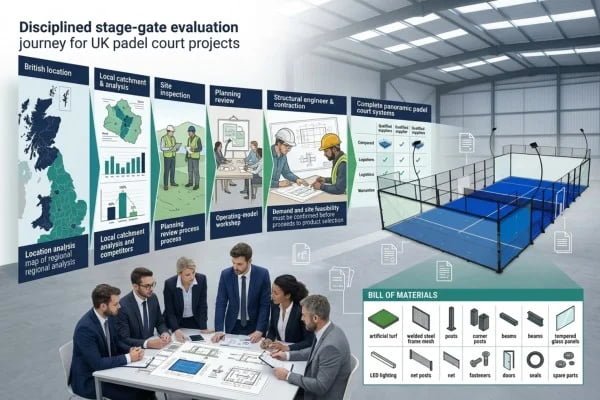
My first screening questions
When a UK enquiry reaches me, I normally begin with questions such as:
- Where is the proposed site?
- How many padel courts already operate nearby?
- Which courts are planned or under construction?
- Who is the target player?
- Will the project be commercial, institutional, residential, or hospitality-based?
- Will the courts be indoor, covered, or outdoor?
- Has the buyer obtained planning and professional site advice?
- What wind, drainage, foundation, lighting, and access conditions apply?
- What opening hours does the financial model assume?
- How many courts does the buyer expect to add later?
These questions do not prove market growth. They help identify whether the buyer has progressed from general interest to a defined project.
Compare complete scopes, not headline prices
A low quotation may exclude items required for installation. I recommend asking every supplier for a line-by-line bill of materials covering:
- Structural steel frames and posts
- Welded mesh panels
- Tempered glass
- Artificial turf and infill requirements
- LED lighting fixtures
- Nets and posts
- Anchors, bolts, screws, and accessories
- Component labels and packing lists
- Installation and foundation drawings
- Maintenance instructions
- Recommended spare parts
- Packaging and container-loading arrangements
At QHPADEL, we manufacture complete padel court packages and provide installation drawings, foundation drawings, packing lists, and maintenance manuals. Our standard production guidance is approximately 20 days for two courts, 20–25 days for four courts, no more than 30 days for larger standard orders, and up to 35 days for custom styles. Buyers should confirm the schedule against the final specification and shipping plan.
Verify documents rather than accepting a logo
Our factory states ISO 9001 certification, while relevant components have supporting CE and other test documentation depending on the item. However, I encourage buyers to verify every document rather than relying on a certificate logo in a brochure.
Buyers should check:
- Certificate holder and manufacturer name
- Product model and scope
- Standard and edition
- Issuing or testing organisation
- Issue and expiry dates
- Report numbers
- Whether the supplied configuration matches the tested product
- Any local UK requirements not addressed by the document
A CE document alone does not confirm that a complete court is suitable for a particular site. A qualified UK structural engineer should assess site-specific loads, foundations, anchoring, exposure, and local requirements. Planning professionals should also advise on permission, lighting, noise, access, and operating-hour conditions.
Frequently Asked Questions
How many people play padel in the UK?
The LTA reported approximately 400,000 annual participants in Britain for 2023 and referred to more than 600,000 during 2024. Buyers should check the date, geography, and participation definition before using these figures because annual participation includes occasional players and does not directly measure regular weekly demand.
Are there too many padel courts in the UK?
I do not think a national court total can answer that question. Some catchments may remain underserved, while others may have several operating or planned venues. Buyers should map local courts, formats, booking availability, prices, travel times, and planning applications before judging whether an area has excess supply.
Is a padel club in the UK a good investment?
A padel club may be commercially viable, but popularity alone does not make it a good investment. The result depends on site costs, planning, court utilisation, repeat bookings, pricing, staffing, weather protection, and financing. I recommend independent financial, planning, legal, and engineering evaluation before making an investment decision.
How many courts should a new padel club install?
The appropriate number depends on demand, site capacity, programming, and available capital. Multiple courts can support leagues, coaching, and social events more effectively than a single court, but unused capacity increases risk. I suggest modelling a phased expansion where the site layout and infrastructure allow it.
Should a UK venue choose indoor, covered, or outdoor padel courts?
The choice depends on the site, budget, local weather, planning position, and operating model. Covered or indoor courts can protect playable hours, while outdoor courts may require less building work. Buyers should obtain site-specific advice on structures, wind loads, foundations, drainage, lighting, acoustics, and planning requirements.
Conclusion
The dated evidence shows that padel in the UK continued to expand through 2024, but national participation and court growth do not guarantee local club performance. I would test each project through catchment analysis, competitor checks, repeat-demand evidence, off-peak utilisation, conservative pricing, and professional site review. Buyers should then compare complete court packages, technical documents, installation scope, and supplier reliability.
If you are evaluating a UK padel project, contact Alice Chen at QHPADEL via alice@grass-supplier.com or WhatsApp +86 185 7566 0746 to discuss court specifications, documentation, production planning, and a complete bill of materials.
-
"LTA announces new padel strategy", https://www.ltapadel.org.uk/news/2024/september/lta-announces-new-padel-strategy/. The Lawn Tennis Association’s padel strategy and dated public updates report the relevant participation and court figures, subject to the geographic scope and participation definitions used in each publication. Evidence role: statistic; source type: institution. Supports: The LTA’s reported annual-participation and court-count figures for the stated periods.. Scope note: The figures measure annual participation and court supply; they do not directly measure weekly play, venue occupancy, or profitability. ↩
-
"Office for National Statistics", https://en.wikipedia.org/wiki/Office_for_National_Statistics. LTA reporting should be cited for its stated geographic coverage; Great Britain comprises England, Scotland, and Wales, whereas the United Kingdom also includes Northern Ireland. Evidence role: definition; source type: institution. Supports: The geographic coverage identified by the LTA source and the distinction between Great Britain and the United Kingdom.. Scope note: Coverage can vary by individual LTA dataset, so the geography should be checked for each quoted figure. ↩
-
"What determines participation in sport for older adults … – PMC", https://pmc.ncbi.nlm.nih.gov/articles/PMC10994306/. Annual sport-participation estimates classify respondents according to the survey’s stated activity threshold, which may include occasional participants and is not equivalent to a measure of regular weekly booking behaviour. Evidence role: definition; source type: institution. Supports: The participation threshold used for the cited annual padel estimate and its distinction from regular participation measures.. Scope note: The exact threshold and recall period must be taken from the methodology of the specific dataset cited. ↩
-
"NOVELTY EFFECTS OF NEW FACILITIES ON …", https://economics.umbc.edu/files/2014/09/wp_03_1011.pdf. Studies of promotional acquisition and customer retention show that introductory incentives and initial novelty can affect early usage patterns, so opening-period demand may not represent stabilized repeat demand. Evidence role: mechanism; source type: paper. Supports: That introductory promotions and novelty can influence initial customer acquisition and that early demand need not represent longer-term retention.. Scope note: Evidence from other service sectors is contextual and should not be treated as direct proof of the size or duration of a padel-specific launch effect. ↩
-
"Effects of weather on sport", https://en.wikipedia.org/wiki/Effects_of_weather_on_sport. Research and sports-facility guidance indicate that adverse weather, daylight constraints, and site operating conditions can reduce the usable availability of outdoor recreation facilities, while weather protection can improve continuity of access. Evidence role: mechanism; source type: research. Supports: That weather exposure, daylight, lighting restrictions, and site conditions can affect the availability and use of outdoor sports facilities.. Scope note: This evidence supports the operational mechanism rather than proving a fixed capacity difference between any particular number of padel courts. ↩
-
"Practical Applications of Revenue Management in Full Service …", https://oasis.library.unlv.edu/cgi/viewcontent.cgi?article=4195&context=thesesdissertations. Service and sport-management research commonly evaluates demand quality using repeat use and retention alongside capacity utilisation, realised revenue, pricing, and customer-acquisition measures. Evidence role: general_support; source type: research. Supports: That repeat use, retention, capacity utilisation, realised revenue, and acquisition economics are established measures relevant to service-facility performance.. Scope note: No universal metric set is specific to every padel venue; the relative importance of these measures depends on the operating model and local market. ↩