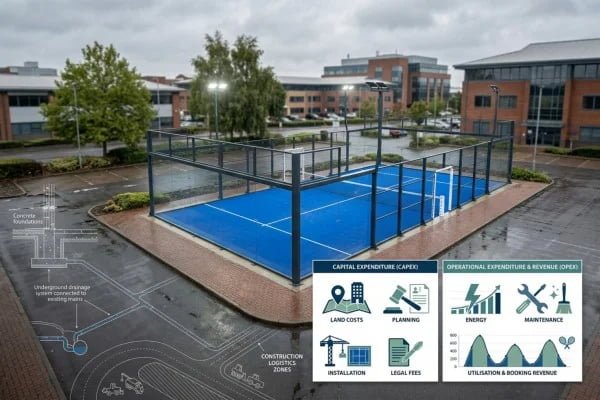
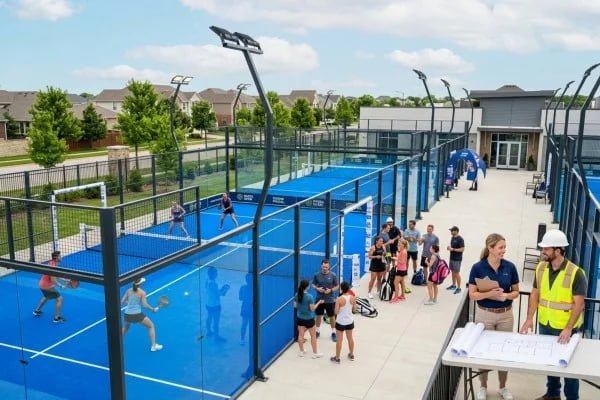
Padel in Saudi Arabia is growing quickly, but entering this market requires more than confirming that clubs and players exist. Investors can face expensive problems when a court design is not prepared for high temperatures, intense UV exposure, sand, wind, and demanding commercial use. I recommend treating padel court procurement as a climate, quality-control, and project-delivery decision from the start.
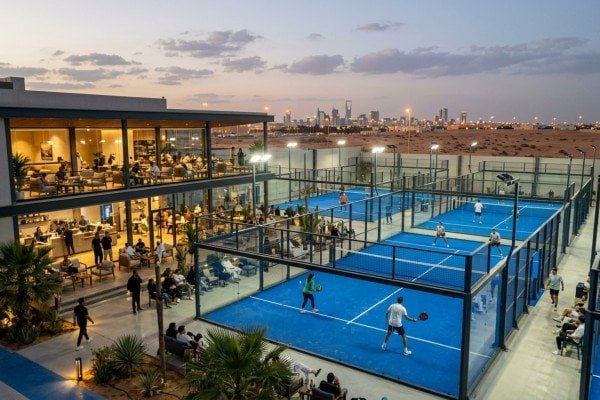
Yes, there is padel in Saudi Arabia, and the market has become increasingly attractive to club operators, entrepreneurs, distributors, hotels, and real-estate investors. The opportunity is supported by rising interest in active lifestyles and sports infrastructure1. However, a successful project depends on selecting a court package that is engineered, documented, packed, and installed appropriately for local climate conditions and commercial operating demands.
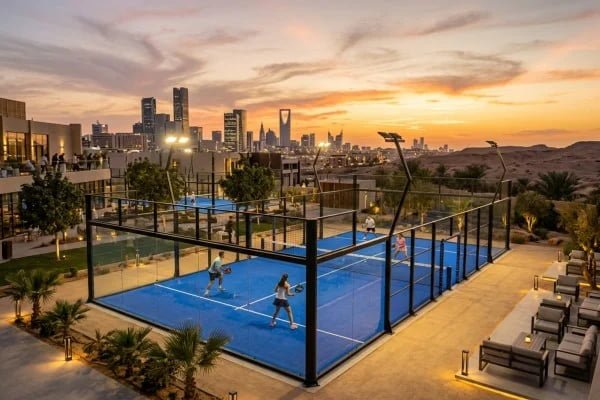
When speaking with Middle Eastern investors, I often find that the first question is about market demand. The next questions are more important: Will the turf survive the sun? Can the steel resist corrosion? Will every component arrive correctly? Those questions determine whether a promising padel investment becomes a reliable operating venue.
Is Padel in Saudi Arabia a Serious Business Opportunity?
I understand why investors ask whether padel is established before committing capital to a court project. Market excitement can create pressure to move fast, while incomplete site planning or poor supplier selection can turn a fast decision into a long operational problem.
Padel in Saudi Arabia represents a developing commercial opportunity for operators who match court capacity, site location, pricing, and product durability to their business model. Demand alone does not guarantee returns. Investors should validate local customer demand and then select a court system that can support frequent bookings, climate exposure, maintenance needs, and safe daily use.
The Market Question Is Only the Starting Point
The Saudi padel market has drawn attention from sports entrepreneurs, hospitality businesses, real-estate developers, and equipment distributors. That attention makes sense. Padel has a social format, a relatively accessible learning curve2, and flexible positioning for both competitive and recreational players.
Still, I advise buyers not to stop at the question, “Is padel popular?” A better question is:
“Can my proposed site operate a durable court system profitably for several years?”
A commercial padel facility has several connected cost centers:
- Court equipment and spare parts
- Civil works and foundations
- Freight, customs, unloading, and inland transport
- Installation labor and lifting equipment
- Lighting and electrical connections
- Booking software, staffing, and marketing
- Turf cleaning, glass inspection, and replacement planning
A court that appears inexpensive at purchase can become expensive if its frame coating degrades early, its artificial turf flattens under heavy play, or its supplier provides incomplete installation documents.
Consider the Venue Model Before Buying Courts
Different commercial models create different specification priorities.
| Venue model | Typical procurement priority | Main operational concern |
|---|---|---|
| Dedicated padel club | Capacity, player experience, visual design | Court uptime and booking utilization |
| Hotel or resort | Appearance, safety, moderate-use durability | Guest experience and low maintenance |
| Real-estate development | Landscape integration and long-term asset value | Compliance, handover, and aesthetics |
| School or university | Safety and documentation | Controlled access and durable materials |
| Distributor | Standardized SKUs and supplier reliability | Repeatable quality and delivery timing |
For example, a chain club may prioritize panoramic or ultra-panoramic court visibility because spectatorship and social-media content matter to its customer experience. A school buyer may prioritize secure fencing, safety glass documentation, and clear maintenance procedures instead.
Based on our project delivery feedback, the strongest buyers begin their sourcing process with a project brief. That brief should define the site dimensions, number of courts, operating hours, expected player traffic, local wind exposure, foundation responsibility, and installation team capability.
That preparation helps investors compare quotations fairly. It also makes it harder for suppliers to hide missing scope behind a low initial price.
What Climate Challenges Does Padel in Saudi Arabia Create?
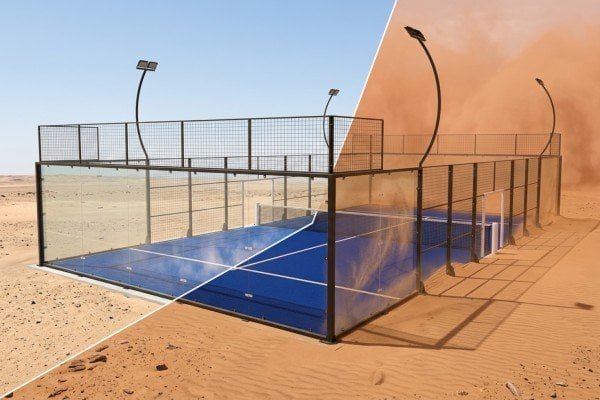
A standard court package may look acceptable in a catalog, but Saudi climate exposure can reveal weaknesses quickly. Heat, UV radiation, blowing sand, and wind can affect turf, coatings, fixtures, fasteners, and the overall playing environment.
Padel in Saudi Arabia requires buyers to assess heat resistance, UV stability, corrosion protection, wind-load design, drainage, and maintenance access. A court should not be selected only because it has artificial turf, steel fencing, and glass walls. Buyers need evidence of the material construction, protective systems, and engineering assumptions behind those visible components.
Artificial Turf: More Than Color and Pile Height
Artificial turf is often the first product buyers compare. Many quotations list pile height, yarn color, density, and Dtex. These are useful starting points, but they do not explain everything about field performance in hot climates.
I encourage buyers to ask how a supplier controls:
- Yarn composition: The yarn formulation affects resilience and long-term appearance.
- UV stabilization: UV additives can help reduce degradation caused by sunlight exposure3.
- Backing construction: The backing supports tuft bind and dimensional stability.
- Tuft density: Higher density can affect ball behavior, comfort, and wear characteristics.
- Infill recommendations: The specified sand type and quantity affect stability and playability.
- Drainage design: Outdoor courts need a system that helps water move through and away from the surface.
Buyers should ask for the stated UV testing basis, test report availability, and the exact turf specification included in the offer. A vague statement such as “UV-resistant turf” is not enough for a high-exposure project.
At QHPADEL, we can customize turf color, Dtex, and density for qualifying orders. However, I always recommend that buyers evaluate the specification against their intended use, maintenance plan, and climate conditions rather than choosing a turf simply because it has the lowest price.
Steel Protection Needs Clear Questions
Steel frame quality also requires deeper inspection. A seller may say “galvanized steel” without explaining the coating process, coating thickness, steel profile dimensions, welding controls, or paint system.
For outdoor courts, buyers can ask:
- What steel grade and profile dimensions are used?
- Is the frame hot-dip galvanized, pre-galvanized, or treated another way?
- What zinc coating thickness is specified?
- What surface-preparation process occurs before powder coating?
- What powder-coating system and thickness are specified?
- How are weld areas treated and inspected?
- What maintenance is recommended for coastal or dusty areas?
The right answer will depend on the site. A court near the coast may need a different corrosion-risk assessment from an inland court4. I am not a local Saudi construction authority, so I recommend that buyers confirm environmental requirements with qualified local engineers and project professionals.
Wind, Sand, and Heat Affect the Whole System
A padel court is a connected structural system. It includes steel panels, posts, glass, mesh, fasteners, turf, lighting, and anchors. Sand and dust can increase cleaning needs. High temperatures can affect surface temperatures and user comfort5. Wind exposure can affect structural design assumptions.
For sites with elevated wind exposure, buyers should ask whether a supplier offers a wind-resistant or hurricane-resistant model and, more importantly, what design criteria support that claim. “Hurricane resistant” should not be treated as a marketing label. Buyers should request applicable engineering information and arrange independent project-specific review where required.
How Should Buyers Evaluate Padel Courts in Saudi Arabia?
Many buyers compare suppliers using a short spreadsheet: price, delivery time, court type, and photos. That approach is understandable, but it can miss the procurement risks that create the biggest delays after payment.
Buyers sourcing padel courts in Saudi Arabia should evaluate the supplier’s manufacturing control, documentation quality, component traceability, structural details, certification records, and ability to provide a complete bill of materials. The best supplier is not necessarily the lowest-priced seller; it is the supplier whose scope, quality controls, and responsibilities are clear and verifiable.
Separate Manufacturers From Generic Traders
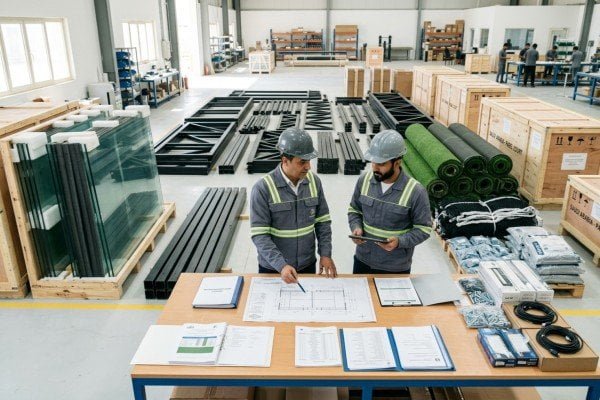
A trading company can sometimes provide useful sourcing support. However, buyers should understand whether the company controls production, inspects components, manages packaging, and can solve technical issues after shipment.
When I speak with serious international buyers, I suggest asking practical questions that are difficult to answer with generic sales language:
- Can you provide a detailed BOM for one complete court?
- Are all steel profiles, glass panels, turf rolls, lights, and fasteners itemized?
- Can you provide production photos and packing photos from similar orders?
- Can you explain component numbering for installation?
- Can you provide installation drawings and foundation drawings?
- What is your replacement process for transit damage or missing parts?
- Who is responsible for technical clarification during installation?
- Can you provide relevant certification documents for review?
A specialized manufacturer should be able to answer these questions clearly. The answers do not need to be overly complicated. They need to be specific.
Certifications Are Documents to Verify
Certifications can support procurement evaluation, but buyers should not treat a logo on a brochure as proof that every supplied component meets every local requirement.
For example, QHPADEL states that its factory is ISO 9001 certified. Its artificial turf, steel frame structure, tempered glass, and LED lighting have listed certification documentation. Buyers should request the applicable certificates, check the scope, verify validity, and confirm that the documents relate to the product configuration being offered.
Here is why this matters:
| Document or test record | What a buyer should check | Why it matters |
|---|---|---|
| ISO 9001 certificate | Factory name, scope, expiry date | Indicates a documented quality-management system |
| CE-related records | Product category and scope | Helps assess declared conformity documentation |
| Tempered glass documentation | Glass thickness, standard, traceability | Supports safety and replacement planning |
| Lighting certificates | Voltage, model number, electrical scope | Helps align equipment with local electrical needs |
| Material test reports | Material grade and batch relevance | Supports quality-control checks |
Certification records do not replace local code compliance, independent engineering review, or site-specific approvals6. They are part of a larger due-diligence process.
Compare Court Packages Line by Line
A low quotation may exclude items that another supplier has included. Buyers should compare scope rather than comparing only the total amount.
A complete package may include:
- Artificial turf and recommended infill
- Steel frame and welded mesh panels
- Structural posts and connection hardware
- Tempered glass panels and glass fittings
- LED light fixtures and poles
- Net, net posts, and accessories
- Bolts, anchors, screws, and spare fasteners
- Installation drawings and foundation drawings
- Packing list and component labels
- Maintenance guidance
At QHPADEL, our complete court packages can include these core systems, but I still advise every buyer to review the final BOM before production. A clear BOM is one of the most practical ways to reduce site disputes later.
How Can Delivery and Installation Risks Be Controlled?
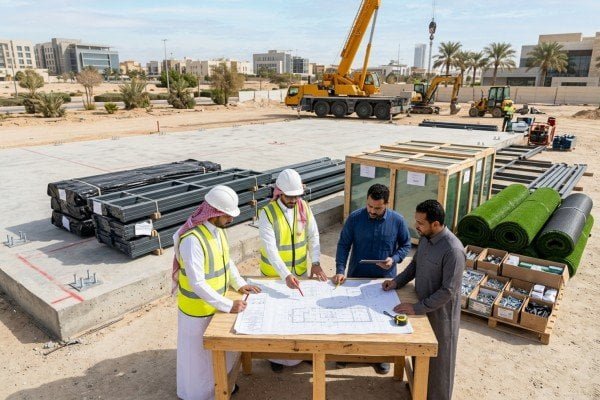
Many project delays do not begin in the factory. They begin when a container arrives and the site team discovers unclear foundations, missing labels, inaccurate embedded plates, or uncertainty over who should solve an installation issue.
For padel in Saudi Arabia, delivery and installation planning should be treated as part of product selection. Buyers need accurate foundation drawings, clear pre-embedding requirements, labeled components, packing lists, installation instructions, and defined after-sales responsibilities. Local contractors should review documents before civil works begin, not after containers arrive.
Foundation Accuracy Is Not a Minor Detail
A padel court frame relies on a foundation that matches the supplier’s engineering layout. If anchor points, embedded plates, level tolerances, drainage slopes, or concrete dimensions are incorrect, the installation team may face misalignment issues7.
Based on project delivery feedback, I have seen that some buyers focus heavily on the court structure but delay the civil review. This creates avoidable pressure later.
Before the foundation is poured, the buyer, local contractor, and supplier should align on:
- Final court model and dimensions
- Orientation and access routes
- Foundation drawing revision number
- Anchor or pre-embedding positions
- Finished-floor level and flatness tolerances
- Drainage strategy
- Electrical conduit locations for lighting
- Site access for unloading and glass handling
- Installation sequence and lifting requirements
I recommend that a qualified local civil or structural professional review the design against local regulations, soil conditions, wind conditions, and construction requirements. A court supplier can provide product drawings, but local professionals remain important for site-specific decisions.
Packaging and Component Identification Matter
A complete padel court includes many parts. Glass panels require careful handling. Steel components need stable packing. Small hardware needs count verification. Turf rolls need protection from damage and contamination during transport and storage.
A useful packing process includes:
- Package numbering that matches the packing list
- Component tags that match installation drawings
- Separate protection for glass and hardware
- Container loading photos where practical
- Clear instructions for unloading sequence
- Spare fasteners and small accessories
- A documented process for reporting shortage or damage
QHPADEL has more than 9 years of export experience and exports over 600 containers annually, according to our business information. Even with export experience, I believe every project should have an agreed inspection and claims process. Logistics is not risk-free. The goal is to make any issue identifiable, documented, and solvable quickly.
Define After-Sales Accountability Before Payment
The phrase “after-sales support” can mean different things to different suppliers. Buyers should define it in writing.
For example, distinguish between:
- Manufacturing defects
- Missing components
- Transit damage
- Installation errors
- Foundation inaccuracies
- Normal wear from commercial operation
- Damage caused by improper maintenance
This distinction protects both the buyer and supplier. It also gives local contractors a clearer escalation process when a site issue occurs.
What Questions Should Investors Ask Before Ordering?
Investors often receive many supplier messages, catalogs, and quotations. Too much information can make comparison harder. A short, disciplined question list can reveal whether a supplier understands commercial court delivery.
Before ordering a court for Saudi Arabia, investors should ask suppliers for a complete technical quotation, climate-relevant material details, certification documents, foundation drawings, lead-time confirmation, packing information, and written responsibility boundaries. These questions reduce ambiguity before production and help buyers compare offers on total project value instead of headline price.
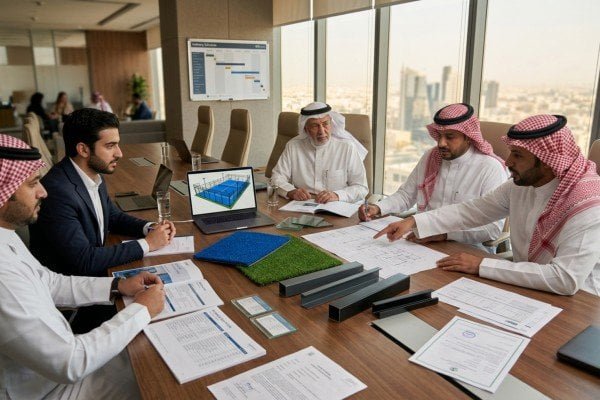
A Practical Pre-Order Checklist
I recommend using the following checklist during supplier evaluation:
| Procurement area | Questions to ask |
|---|---|
| Court design | Is this classic, panoramic, ultra-panoramic, single, roofed, or custom? |
| Structural system | What are the steel profiles, coating process, and design assumptions? |
| Wind exposure | Is a higher wind-load design needed for this site? |
| Turf | What are the yarn, Dtex, density, backing, UV information, and infill recommendation? |
| Glass | What thickness, dimensions, processing, and documentation apply? |
| Lighting | What fixture model, wattage, beam distribution, and electrical documentation apply? |
| Documentation | Will I receive foundation drawings, installation drawings, BOM, and maintenance manual? |
| Packaging | How are glass, frame components, turf, and hardware packed and labeled? |
| Lead time | When does production begin, and what triggers shipment readiness? |
| Warranty | What is covered, excluded, and required for a claim? |
Do Not Rush the Customization Stage
Customization can improve the commercial appeal of a venue. Frame colors, turf colors, Dtex, and density can support a club’s visual identity and operating goals. However, customization should not create confusion about the base specification.
At QHPADEL, turf customization has a stated MOQ of six courts, or approximately 1,254 square meters based on the provided court-area calculation. Buyers should confirm the exact MOQ, production schedule, and approved sample requirements before finalizing a custom order.
I also recommend that buyers confirm lead times in the proforma invoice and production plan. Standard production timing can vary by order quantity and customization level. According to our stated capability, two courts can be produced in about 20 days, four courts in around 20–25 days, and larger standard orders within 30 days, while custom styles may require up to 35 days. Actual project timing should also include design confirmation, payment terms, shipping schedules, customs clearance, and site readiness.
Frequently Asked Questions
Is padel popular in Saudi Arabia?
Padel is gaining visibility in Saudi Arabia among sports entrepreneurs, clubs, hospitality businesses, and active-lifestyle consumers. However, each investment should still be supported by local demand research, location analysis, operating-cost estimates, and a realistic assessment of court durability in the intended environment.
What type of padel court is best for Saudi Arabia?
The best court depends on site wind exposure, expected usage, budget, aesthetics, and local engineering requirements. Buyers should evaluate panoramic, ultra-panoramic, classic, roofed, and higher wind-resistance options based on documented material details rather than choosing only from product photos.
Does Saudi heat damage artificial padel turf?
High heat and UV exposure can affect artificial turf over time8, especially where product formulation, backing quality, installation, or maintenance are inadequate. Buyers should request detailed turf specifications, UV-related documentation where available, maintenance guidance, and professional evaluation for the specific site conditions.
What documents should a padel court supplier provide?
A qualified supplier should normally provide a detailed quotation, BOM, foundation drawings, installation drawings, packing list, and maintenance guidance. Buyers should also request applicable certification documents and verify that the product scope, issuing body, validity period, and model details match the offered court package.
How long does it take to manufacture a padel court?
Manufacturing time depends on court quantity, design, customization, and supplier capacity. Buyers should request a written production schedule rather than relying on a verbal estimate. They should also allow additional time for technical approval, sea freight, customs procedures, site preparation, and installation coordination.
Conclusion
Padel in Saudi Arabia offers a real commercial opportunity, but market enthusiasm should be matched with disciplined procurement. I recommend that investors look beyond attractive court renders and low initial quotations. They should assess UV-resistant turf, steel protection, wind-load considerations, verifiable documentation, complete BOM accuracy, foundation coordination, and after-sales accountability. If you are comparing court packages for a Saudi project, contact Alice Chen at alice@grass-supplier.com or visit www.qhpadel.com to request drawings, specifications, and a complete procurement discussion.
-
"Developing an active lifestyle for children considering … – PMC", https://pmc.ncbi.nlm.nih.gov/articles/PMC9512172/. Saudi Vision 2030 and Quality of Life program materials describe national objectives to increase physical activity and expand sport and recreation opportunities and facilities. Evidence role: general_support; source type: government. Supports: Official Saudi policy and reporting on increasing sports participation and developing sports and recreation infrastructure.. Scope note: These sources support the wider sports-participation and infrastructure context, not demand or profitability for a particular padel venue. ↩
-
"Perceived quality of padel users: adaptation and validation of …", https://pmc.ncbi.nlm.nih.gov/articles/PMC11695294/. Studies of padel participation describe a predominantly doubles-based game and report features that may facilitate recreational entry for players with varied prior experience. Evidence role: general_support; source type: research. Supports: Research or authoritative sport descriptions indicating that padel is commonly played in doubles and is often characterized as accessible to novice recreational participants.. Scope note: Perceived accessibility is subjective and does not by itself establish demand in a specific Saudi location. ↩
-
"Photodegradation and photostabilization of polymers … – PMC", https://pmc.ncbi.nlm.nih.gov/articles/PMC4320144/. Polymer-weathering research shows that ultraviolet radiation can initiate photo-oxidative degradation in exposed polymers and that stabilizer systems can improve resistance to this process. Evidence role: mechanism; source type: paper. Supports: Materials-science evidence that ultraviolet exposure can degrade polymeric materials and that UV stabilizers are used to limit photo-oxidative degradation.. Scope note: The degree of protection depends on the specific yarn polymer, additive package, exposure conditions, and product construction. ↩
-
"Marine Atmospheric Corrosion of Carbon Steel: A Review – PMC", https://pmc.ncbi.nlm.nih.gov/articles/PMC5506973/. Atmospheric-corrosion classification guidance identifies chloride deposition, humidity, and time of wetness as factors that can make coastal steel exposure more corrosive than inland exposure. Evidence role: mechanism; source type: institution. Supports: Corrosion-engineering guidance that airborne salts and atmospheric conditions at coastal sites can increase corrosivity relative to many inland environments.. Scope note: Corrosivity is site-specific; distance from the coast alone is insufficient to assign a protective coating system. ↩
-
"The effect of synthetic grass sports surfaces on the thermal …", https://pmc.ncbi.nlm.nih.gov/articles/PMC11272752/. Field studies have measured elevated artificial-turf surface temperatures under sunny conditions, identifying solar exposure and ambient weather as important contributors to heat conditions experienced by users. Evidence role: mechanism; source type: research. Supports: Measured evidence that artificial-turf surfaces can become substantially hotter under solar radiation and may contribute to heat exposure concerns.. Scope note: Surface temperature and comfort vary with turf design, color, infill, weather, footwear, activity level, and available shade. ↩
-
"Building Codes, Standards, and Regulations: Frequently …", https://www.congress.gov/crs-product/R47665. Regulatory guidance on construction products distinguishes product conformity information from the separate obligation to satisfy applicable building rules and project-specific design and approval requirements. Evidence role: general_support; source type: government. Supports: Official guidance distinguishing product conformity documentation from compliance with applicable building regulations and project-specific approval requirements.. Scope note: The applicable approval process and responsible authority depend on the Saudi project location, procurement route, and type of development. ↩
-
"(PDF) Anchor Bolt Tolerances ASCC Position Statement #14", https://www.academia.edu/41790429/Anchor_Bolt_Tolerances_ASCC_Position_Statement_14. Structural-steel erection guidance identifies inaccurate anchor locations, elevations, and embedded components as sources of fit-up difficulties and corrective work during installation. Evidence role: mechanism; source type: institution. Supports: Construction guidance showing that anchor-bolt locations, embedded components, and concrete tolerances must align with erection requirements to avoid fit-up problems.. Scope note: The required tolerances for a padel court should be specified by the relevant structural design and verified for the particular site. ↩
-
"The effect of synthetic grass sports surfaces on the thermal …", https://pmc.ncbi.nlm.nih.gov/articles/PMC11272752/. Accelerated-weathering and field-exposure studies report that ultraviolet radiation and elevated temperatures can contribute to aging of polymeric synthetic-turf components over time. Evidence role: mechanism; source type: paper. Supports: Research demonstrating that ultraviolet radiation and thermal aging can alter the physical or chemical properties of polymer materials used in synthetic turf.. Scope note: Accelerated-aging results indicate relative durability mechanisms but cannot precisely predict the service life of a particular court in Saudi conditions. ↩