Padel drills at home are a common starting point for beginners who lack regular court access or a practice partner. One customer once asked me, “Can I improve anything before I join a club?” The wrong exercises can waste time or create safety risks, but carefully selected drills can build useful movement, control, coordination, and reactions.
Padel drills at home are simple exercises that develop selected fundamentals without requiring a full court or partner. Players can practice footwork, racket control, hand-eye coordination, and reaction skills in a safe indoor or outdoor space. However, home drills cannot replace qualified coaching, court practice, wall play, partner communication, or match experience.
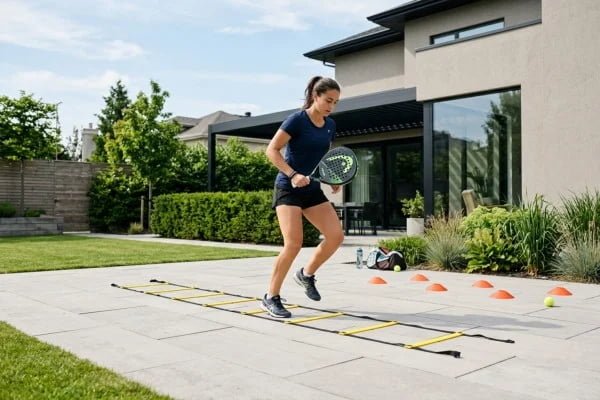
In my conversations with players, coaches, parents, and club customers, I have found that the most useful question is not, “Which drill should I copy?” Instead, I suggest asking, “Which ability am I trying to improve?” That question makes home practice safer, simpler, and easier to evaluate.
How Should I Choose Padel Drills at Home?
A long list of exercises can make practice more confusing rather than more productive. Beginners may copy advanced movements without understanding their purpose or checking the available space. I recommend choosing one target ability first and then matching the drill to the player, equipment, environment, and safety risk.
The best padel drills at home match a specific goal, such as footwork, racket control, coordination, or reaction speed. Before starting, I recommend checking the minimum clear space, nearby people, breakable objects, required equipment, difficulty level, and suitability for children. Each session should remain supplementary to court practice and technical feedback.
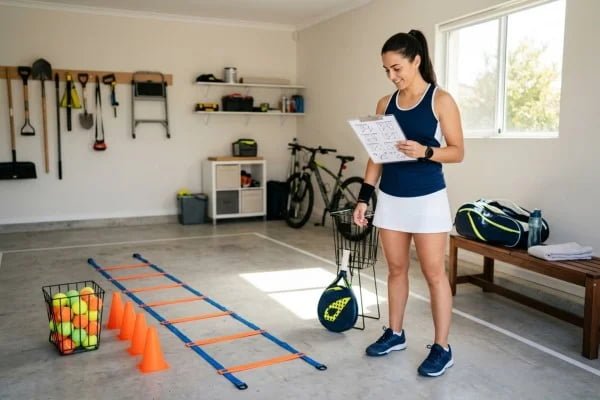
Start With an Ability, Not an Exercise
When beginners ask me for home exercises, I usually divide the options into four practical categories:
- Footwork drills develop balance, ready-position habits, and controlled changes of direction.
- Racket-control drills help players become more comfortable with the racket face and grip pressure.
- Coordination drills connect visual tracking with hand or racket movement.
- Reaction drills require players to respond to an unpredictable visual or ball cue.
This classification helps prevent random practice. For example, bouncing a ball repeatedly on a racket may improve basic racket familiarity, but it does not automatically teach a correct volley1. Similarly, fast side-to-side movement may feel athletic, but it does not teach when a player should move during a point.
Use a Simple Selection Checklist
I recommend evaluating every proposed drill with the following questions:
- What skill does the drill target?
- Can the player perform it slowly and under control?
- Is there enough clearance for the racket, body, and ball?
- Could the ball hit a person, pet, window, television, vehicle, or light fixture?
- Does the drill need adult supervision?
- Could poor technique become a repeated habit without feedback?
| Training goal | Possible home format | Suggested clear area | Main limitation |
|---|---|---|---|
| Basic footwork | Shadow movement without a ball | About 2 × 2 metres | The drill lacks real ball timing |
| Racket familiarity | Controlled upward ball taps | About 2 × 2 metres | The drill does not reproduce match strokes |
| Hand-eye coordination | Ball drop and catch | About 1.5 × 1.5 metres | The drill has limited tactical value |
| Reaction practice | Partner-directed catch or bounce | About 2 × 2 metres | The cue is simpler than match play |
| Swing rehearsal | Slow shadow swings | Racket length plus full clearance | Technical errors need coach review |
These dimensions are practical starting points, not universal safety standards. The player’s height, racket length, furniture, floor condition, and movement speed can change the space requirement. I always favor more clearance when there is any doubt.
Which Footwork Padel Drills at Home Are Useful?
Beginners often focus on hitting while overlooking how they arrive at the ball. Poor spacing can leave a player reaching, leaning, or swinging while off balance. Home practice cannot reproduce a live rally, but I find that controlled shadow movement can help beginners become more aware of posture, balance, and recovery.
Useful footwork padel drills at home include ready-position resets, lateral steps, forward-and-back movement, and slow split-step timing. Players should use a non-slip surface2 and remain under control. The goal is not maximum speed. The goal is to develop balanced movement patterns that can later be tested and corrected on a padel court.
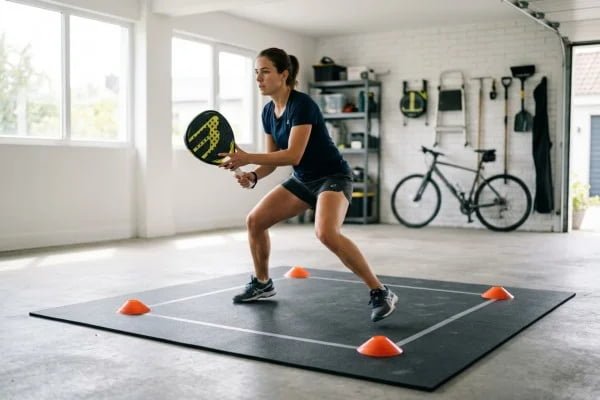
Ready Position and Reset Drill
I suggest starting without a racket. The player stands in a comfortable athletic position with the feet apart, knees relaxed, and body balanced. Another person points left, right, forward, or backward. The player takes one or two controlled steps, stops in balance, and returns to the starting position.
This drill has a clear purpose: moving and recovering without crossing the feet unnecessarily or losing posture.
- Minimum space: I suggest about 2 × 2 metres of clear floor.
- Equipment: The player needs no equipment at first.
- Difficulty: I consider it beginner-friendly.
- Children: I consider it suitable when an adult checks the surface and controls the pace.
- Main risk: A slippery floor, rug edge, or nearby furniture can cause a fall.
Side-Step Lane
The player places two soft markers a short distance apart. The player moves laterally between them while facing forward. The player should avoid turning the drill into a race. I prefer quiet, balanced steps over fast but uncontrolled movement.
Soft markers can include flat training discs or two pieces of tape that leave no residue. I do not recommend hard objects that could cause injury if stepped on.
Shadow Approach and Recovery
The player begins in a ready position, moves diagonally forward, pauses as if preparing for a controlled volley, and then returns to the starting point. The player can hold a racket only after checking ceiling height, wall clearance, people, pets, windows, and furniture.
I recommend rehearsing the movement slowly before adding a racket. A full-speed swing in a confined room creates unnecessary risk and may reinforce poor technique.
Home footwork practice has important limits. A real ball changes the timing, spacing, and decision. An opponent also changes where and when the player must move. Padel includes net movement, defensive positioning, transitions, and recovery after glass rebounds. A living room cannot reproduce those situations.
I therefore treat these padel exercises as movement preparation. A coach or experienced instructor should review application-specific technique, especially if the player feels knee, ankle, hip, shoulder, or back discomfort. Players should stop if movement causes pain rather than trying to train through it.3
Which Racket-Control Padel Drills at Home Can Beginners Try?
A racket can make a simple home exercise unsafe if the player ignores clearance. Windows, low ceilings, hanging lights, furniture, children, and pets all increase the risk. I advise beginners to inspect the area with the racket held at full reach before they attempt any bounce, tap, or shadow swing.
Beginner racket-control padel drills at home can include gentle upward taps, alternating racket-face taps, stationary ball balancing, and slow shadow preparation. Players should use soft equipment, moderate force, and sufficient clearance. These exercises build familiarity with the racket, but they do not confirm correct stroke technique or replace coach-led hitting practice.
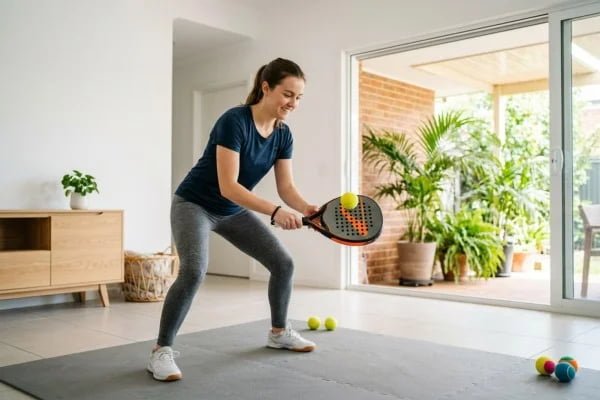
Stationary Ball Balance
The player places a soft ball on the racket face and tries to keep it stable. The player can then move the racket slightly forward, backward, left, and right.
- Purpose: The drill develops basic awareness of racket-face angle.
- Minimum space: I suggest about 1.5 × 1.5 metres.
- Equipment: The player needs a padel racket and a soft foam ball.
- Difficulty: I consider the drill easy.
- Children: The drill can suit children with adult supervision.
- Limitation: The exercise does not teach a match stroke.
Controlled Upward Taps
The player taps the ball upward with the same side of the racket. The player should keep the ball below a safe height and use gentle contact. If control becomes inconsistent, the player should stop and reset instead of chasing the ball across the room.
A beginner can later alternate between the two racket faces. However, the exercise should remain a control challenge rather than a contest for maximum height or speed.
Ball Roll Around the Racket Face
The player balances the ball and slowly guides it around the racket surface. This exercise requires little force, so it can be a practical option when overhead clearance is limited. It still requires protection for nearby breakable objects because a dropped ball can roll unexpectedly.
| Racket drill | Primary purpose | Ball choice | Typical difficulty |
|---|---|---|---|
| Stationary balance | Racket-face awareness | Foam or soft ball | Easy |
| Gentle upward taps | Basic touch and tracking | Foam or low-pressure ball | Easy to moderate |
| Alternating-face taps | Grip and face adjustment | Soft ball | Moderate |
| Slow shadow preparation | Movement familiarity | No ball | Easy |
| Full swing with a ball | Not recommended in confined spaces | Not applicable | Higher risk |
Keep Shadow Swings Slow
I sometimes hear beginners say that they practice powerful smashes indoors without a ball. I do not recommend full-speed swinging in a normal household space. The racket can strike a ceiling, wall, person, fixture, or object even when no ball is present.
Slow shadow preparation may be useful when clearance is generous, but technical feedback remains important. Grip, contact point, shoulder position, and follow-through can differ by shot and player. I am a court supplier rather than a certified coach, so I recommend asking a qualified padel coach to assess stroke mechanics.
How Can Coordination and Reaction Padel Drills at Home Help?
Players may confuse coordination with technique. Catching or tapping a ball can improve familiarity with visual tracking, but it does not prove that a player can choose the correct shot during a rally. I use coordination and reaction exercises as low-barrier preparation, not as evidence of match readiness.
Coordination and reaction padel drills at home include drop-and-catch exercises, wall-free bounce catches, partner direction cues, and controlled ball tracking. These drills can challenge the eyes, hands, and feet without requiring full strokes. Players should keep the ball speed low and use unpredictable cues only after they can move safely.
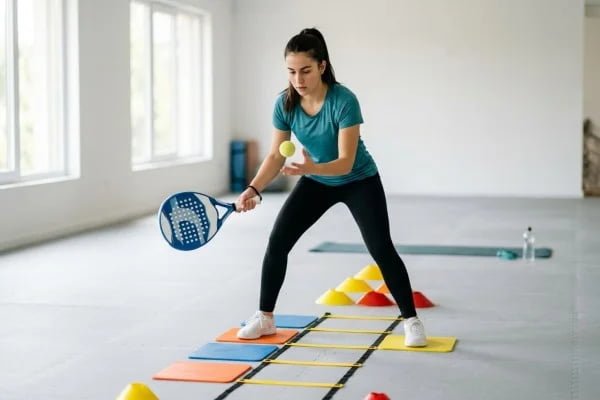
Drop, Bounce, and Catch
The player holds a soft ball at waist height, drops it, allows one bounce, and catches it with the opposite hand. The player can switch hands after each attempt. A more challenging variation uses a small lateral step before the catch.
- Purpose: The drill combines tracking, movement, and catching.
- Minimum space: I suggest about 1.5 × 1.5 metres.
- Equipment: The player needs one soft ball.
- Difficulty: I consider the basic version easy.
- Children: I consider the drill suitable with age-appropriate equipment and supervision.
- Main risk: A hard or highly bouncing ball can escape into unsafe areas.
Partner Direction Cues
A partner stands at a safe distance and gives a visual cue by pointing left or right. The player takes one controlled step and returns to the center. The partner can later vary the cue, but the player should not move faster than the available space allows.
The cue partner must also remain outside the racket path if a racket is introduced. I prefer performing this drill without a racket at first.
Two-Hand Ball Transfer
The player holds one soft ball and moves it around the waist, under one leg, or from hand to hand at chest height. The movement should remain comfortable. This drill can support general coordination, although it has only an indirect connection to padel technique.
Why I Avoid Indoor Wall Hitting
Padel is a wall-based sport, so hitting against a household wall can sound like an obvious solution. However, a residential wall does not reproduce court-glass rebound consistently4. Indoor hitting can also damage paint, plaster, furniture, windows, or nearby electronics. Noise may affect other residents.
A purpose-built rebound surface in a controlled training area is different from an ordinary home wall. Before using any wall, I would check:
- The player has permission to use the surface.
- The area has no people, pets, vehicles, or breakable objects nearby.
- The floor provides reliable grip.
- The ball cannot leave the controlled area.
- A qualified coach has explained the exercise and its technical purpose.
Even under those conditions, the rebound does not recreate court glass, fencing, opponent pressure, or tactical decision-making. I treat wall-free drills as the safer default for most homes.
How Should Children Perform Padel Drills at Home?
Children should not copy adult routines without changes. An adult racket, a fast ball, or a high-intensity movement pattern may be unsuitable for a child’s size, coordination, or surroundings. I recommend that parents prioritize safety, enjoyment, and simple skill exploration rather than speed, power, or repetitive performance targets.
Children’s padel drills at home should use age-appropriate rackets, foam balls, short practice rounds, slow movement, and adult supervision.5 Parents should simplify one skill at a time and stop when attention or control declines. A qualified coach should guide technical development, while home activities should remain playful and supplementary.
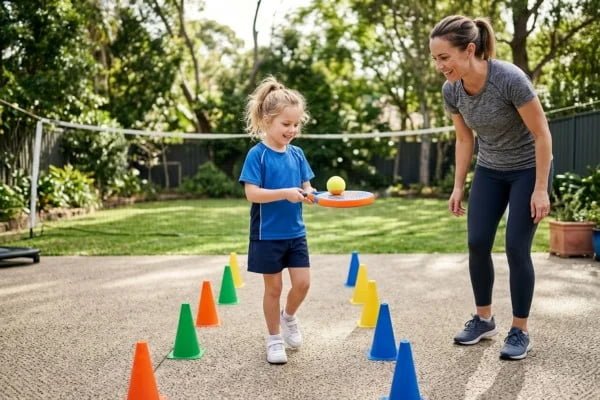
Adapt the Equipment
I recommend a lightweight junior racket when a racket is necessary. A foam ball or another soft training ball can reduce speed and potential property damage, although no ball is completely risk-free. The parent should confirm that the chosen product is suitable for the child’s age and intended use.
Children should not swing close to siblings, pets, furniture, windows, glass doors, lamps, or televisions. An adult should define a visible practice boundary and remain present.
Adapt the Challenge
A child may enjoy the following simple activities:
- The child can balance a foam ball on a stationary racket.
- The child can drop and catch a ball with two hands.
- The child can move between two soft floor markers.
- The child can copy an adult’s slow ready-position movement.
- The child can roll a ball toward a target instead of hitting it.
- The child can call out a color or number shown by an adult before moving.
I would not treat an exact number of attempts or a fixed duration as a scientific prescription. The appropriate amount depends on age, attention, coordination, health, and experience. I prefer a few short rounds with pauses. The adult can stop the activity before fatigue causes poor control.
Use a Child-Specific Safety Check
| Safety factor | What I recommend checking |
|---|---|
| Supervision | An attentive adult should remain within control of the activity. |
| Equipment | The racket and ball should suit the child’s size and ability. |
| Floor | The surface should remain dry, level, and free from loose rugs. |
| Clearance | The area should contain no glass, sharp corners, or fragile objects. |
| Intensity | The child should use controlled movement rather than maximum speed. |
| Enjoyment | The activity should stop if the child becomes frustrated or distracted. |
Parents should seek qualified guidance if a child has a medical condition, previous injury, pain, or specific physical-development concern. I cannot assess those factors through a general article. I also recommend professional coaching when a child begins learning actual strokes because early feedback can help identify technique issues that a home game may hide.
What Can Padel Drills at Home Not Teach?
Home practice can feel productive because the environment is predictable. That predictability also creates a major limitation. A player may control a stationary tap successfully but struggle when a ball rebounds from glass, changes speed, or arrives while an opponent moves toward the net.
Padel drills at home cannot fully teach wall rebounds, partner positioning, opponent reading, shot selection, court coverage, or match pressure. They also cannot provide reliable technical correction. I recommend using home exercises to prepare selected fundamentals and using court sessions, partner practice, and qualified coaching to integrate those fundamentals into real play.
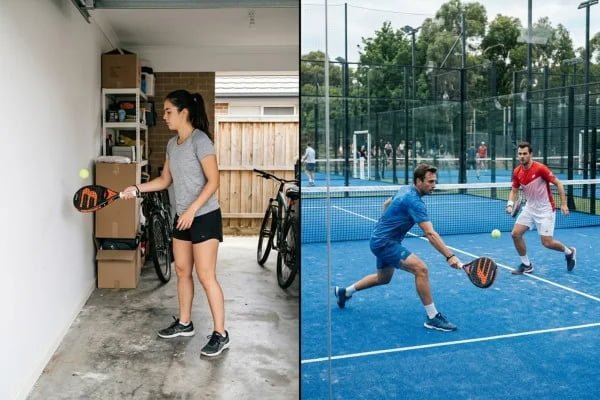
Home Practice Versus Court Practice
| Skill area | Home practice can support it | Court or coach input remains important |
|---|---|---|
| Balance and basic movement | Yes, through controlled shadow movement | Yes, for real ball timing and positioning |
| Racket familiarity | Yes, through gentle taps and balancing | Yes, for correct contact and shot mechanics |
| Coordination | Yes, through catching and tracking | Yes, for movement under rally pressure |
| Wall play | Very little in a normal home | Yes, because court rebounds are essential |
| Partner communication | No meaningful substitute | Yes, because doubles positioning is interactive |
| Tactical decisions | Only through study or visualization | Yes, because decisions depend on live play |
| Match confidence | Only indirectly | Yes, because actual points create pressure |
Signs That a Player Needs Court or Coach Feedback
I recommend moving beyond home practice when:
- The player wants to learn a specific stroke.
- The player repeatedly loses balance during a movement.
- The player feels pain or unusual discomfort.
- The player cannot understand grip or racket-face instructions.
- The player wants to practice glass rebounds.
- The player wants to improve doubles positioning or tactical choices.
- The player has formed a habit that may be technically incorrect.
- The parent wants structured development for a child.
In conversations with clubs and players, I have noticed that beginners sometimes want home practice to provide certainty before their first lesson. I understand that concern. However, beginners do not need to become “court ready” at home. A qualified introductory session should account for limited experience.
I suggest using home work to become comfortable with a racket, ball, and basic movement. The court then provides the space, markings, glass, net, and interaction that define the sport.6 Coaching provides observation and correction that a written drill cannot deliver.
Frequently Asked Questions
Can I practice padel at home without a court?
Yes, I recommend practicing selected fundamentals such as balance, controlled footwork, ball tracking, and racket familiarity. However, a home environment cannot reproduce court dimensions, glass rebounds, net positioning, partner movement, or match decisions. Home practice should supplement, rather than replace, time on a proper court.
Can I perform padel drills at home without a racket?
Yes. I consider racket-free exercises a practical starting point for many beginners. Players can practice ready-position resets, lateral steps, ball drops, catches, visual cues, and controlled recovery movements. Racket-free practice also reduces risk when the available space has limited ceiling or wall clearance.
Is it safe to hit a padel ball against an indoor wall?
I generally do not recommend hitting against an ordinary indoor wall. The ball may damage property, rebound unpredictably, or strike another person. A household wall also does not reliably reproduce padel glass. Players should use a purpose-designed practice area and obtain appropriate guidance before attempting rebound exercises.
What equipment do I need for beginner home practice?
I suggest starting with soft floor markers and one foam or low-speed training ball. A padel racket is optional for basic movement and coordination drills. If the player uses a racket, the practice area must provide full clearance from people, pets, windows, furniture, ceilings, and fixtures.
How often should children practice padel at home?
I do not treat one exact schedule as suitable for every child. Age, attention, health, experience, and enjoyment all matter. I recommend brief, supervised practice rounds with regular pauses. Parents should stop when control or interest declines and seek qualified advice for structured technical or physical training.
Conclusion
Padel drills at home can give beginners and children an accessible way to explore footwork, racket control, coordination, and reactions. I recommend choosing every drill by its purpose, space requirement, equipment, difficulty, and safety risk. Home practice cannot replace a court, partner, wall play, or qualified coaching, but it can support a more confident introduction to the sport.
For clubs or facility developers planning a dedicated training environment, contact Alice Chen at QHPADEL via alice@grass-supplier.com or +86 185 7566 0746 to discuss complete padel court systems and project documentation.
-
"Specificity and variability of practice – PubMed", https://pubmed.ncbi.nlm.nih.gov/2094928/. Motor-learning literature finds that transfer is task-specific: a simplified ball-control activity may develop familiarity with an implement and object, but does not alone establish the perceptual and movement requirements of a competitive volley. Evidence role: mechanism; source type: paper. Supports: Motor-learning evidence that transfer is task-specific and that simplified coordination tasks do not necessarily produce a complete sport-specific skill.. Scope note: The conclusion is a general motor-learning principle rather than a direct test of padel racket taps. ↩
-
"[PDF] INTRODUCTION TO PREVENTING SLIPS, TRIPS AND FALLS", https://obis.osha.gov/dte/grant_materials/fy06/46e0-ht10/stf_fg_mod_1.pdf. Public safety guidance identifies slippery or poorly maintained floor surfaces as important contributors to slip and fall incidents, supporting the use of stable, dry, non-slip practice areas. Evidence role: general_support; source type: government. Supports: Occupational and public-safety guidance identifying slippery or unsuitable walking surfaces as contributors to slips, trips, and falls.. Scope note: This guidance addresses general slip prevention rather than padel-specific training. ↩
-
"Taking care of your back at home: MedlinePlus Medical Encyclopedia", https://medlineplus.gov/ency/article/002119.htm. Health guidance advises stopping an activity that causes pain and seeking clinical assessment when symptoms are severe, persistent, recurrent, or associated with injury warning signs. Evidence role: general_support; source type: government. Supports: Authoritative health guidance advising individuals to stop activity that causes pain and obtain medical advice for persistent or severe symptoms.. Scope note: Appropriate action depends on symptom severity and medical history; general guidance is not an individual diagnosis. ↩
-
"RULES OF PADEL INTERNATIONAL PADEL FEDERATION", https://www.padelfip.com/wp-content/uploads/2024/11/FIP-Rules-of-Padel.pdf. Official padel court regulations define a purpose-built enclosure incorporating specified glazed and metallic-mesh wall sections; an ordinary residential wall is not the regulated court-glass surface used in padel play. Evidence role: definition; source type: institution. Supports: Official padel court regulations specifying the court’s glazed and mesh enclosure elements, which differ materially from an ordinary household wall.. Scope note: Court regulations establish that the surfaces differ, but they do not quantify the rebound behavior of every household wall. ↩
-
"Safety, Health, and Injury Prevention Recommendations – CDC", https://www.cdc.gov/early-care/safety/index.html. Pediatric and sports-medicine guidance emphasizes age-appropriate equipment, supervision, and developmentally suitable progression when children participate in organized or informal physical activity. Evidence role: expert_consensus; source type: institution. Supports: Pediatric or sports-medicine guidance supporting age-appropriate equipment, supervision, and gradual activity progression for children.. Scope note: General youth-activity guidance does not prescribe a specific padel drill, duration, or equipment model for every child. ↩
-
"Padel", https://en.wikipedia.org/wiki/Padel. The International Padel Federation’s rules define padel as being played on a regulated enclosed court with prescribed dimensions, a central net, and wall or glazed enclosure elements. Evidence role: definition; source type: institution. Supports: The official definition and required physical configuration of a padel court, including dimensions, net, and enclosure features. ↩