Many players step onto the court without realizing that padel eyeglasses are crucial safety gear. High-speed balls and close-quarter racket swings create severe eye injury risks in enclosed spaces.1 If you ignore eye protection, you risk permanent damage. Fortunately, selecting the right protective eyewear solves this problem effectively.
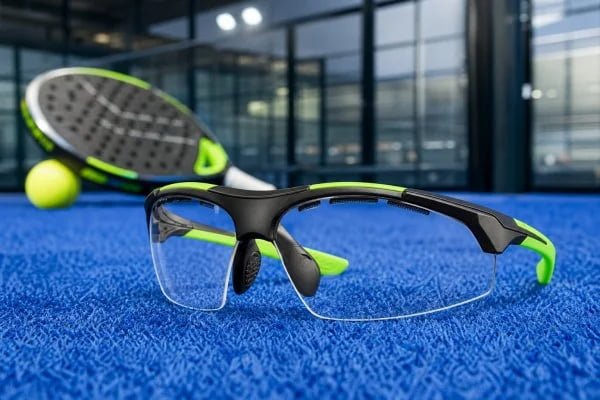
The best padel eyeglasses feature shatterproof polycarbonate lenses and wrap-around, impact-resistant frames. They must include anti-fog coatings and ventilated designs for humid court conditions. Additionally, high-quality sports eyewear uses rubberized nose pads and temple grips to ensure absolute stability during rapid, sudden movements on the court.
Finding the perfect pair requires more than trusting flashy marketing claims. I speak with club operators and players daily. I constantly see buyers misunderstand what actually keeps players safe. Let us break down the exact specifications you need to evaluate.
Why is the "one-size-fits-all" myth dangerous for padel eyeglasses?
Players often grab generic sports sunglasses and expect them to work perfectly. This mistake leaves you vulnerable. Regular sunglasses shatter upon heavy impact. You need specialized gear built specifically for the unique hazards of this fast-paced sport.
A "one-size-fits-all" approach fails because padel presents unique impact risks. Enclosed glass courts, close-quarter volleys, and rebounds demand certified protective sports eyewear. Generic glasses lack the structural integrity to withstand a direct hit from a padel ball traveling at high speeds.
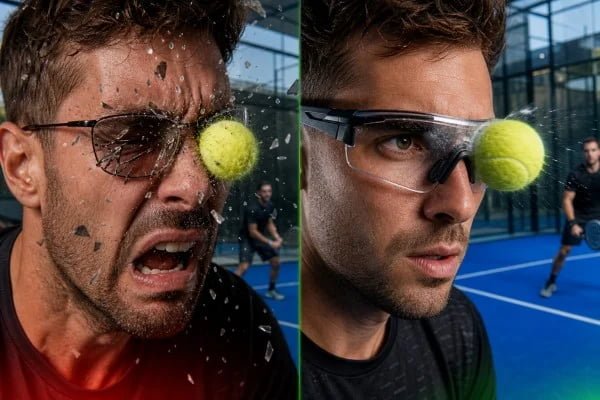
I often hear players say they just use their cycling or running glasses on the court. This habit worries me. Padel is a confined, high-energy sport played inside a 10-meter by 20-meter enclosed box. You face ball speeds that regularly exceed 100 km/h.2 Furthermore, your partner swings a solid composite racket mere feet away from your face.
Generic sunglasses prioritize lightweight aesthetics over structural defense. They use acrylic or basic plastic lenses. These materials crack or splinter when hit by a hard object. If a ball strikes your face, shattered plastic causes more damage than the ball itself.
The True Risks on the Court
Padel introduces highly specific physical hazards that do not exist in open-court sports like traditional tennis. You must understand these dynamics:
- Direct ball impacts: Smashes and fast volleys at the net give you only milliseconds to react.
- Racket collisions: In doubles play, clashing rackets or accidental backswings near the face happen frequently when chasing lobs.
- Unpredictable rebounds: Balls bounce rapidly off the tempered glass walls and the welded steel frame netting.
You must treat your eyewear as a critical risk-management tool. When club operators install our panoramic courts, I always advise them to mandate eye safety gear for beginner clinics.
While I am not a medical professional, I strongly advise buyers to verify standard safety ratings. Look for certifications like ASTM F803 or ANSI Z87.1.3 These independent standards prove the lenses and frames can survive high-velocity impacts. Proper padel eyeglasses act as a physical shield. Never compromise on this baseline structural integrity just to save a few dollars.
How do you decode technical specs for protective padel eyeglasses?
Marketing jargon easily overwhelms equipment buyers. Manufacturers boast about aerospace materials and polarizing tech. However, flashy words do not stop a high-speed ball. You must separate essential safety requirements from unnecessary luxury upgrades.
You decode the specifications by focusing on two non-negotiable features: shatterproof polycarbonate lenses and durable, impact-resistant frames. Polycarbonate offers maximum impact resistance without adding weight. The frame must absorb shock and wrap around the face to protect your peripheral vision from stray balls.
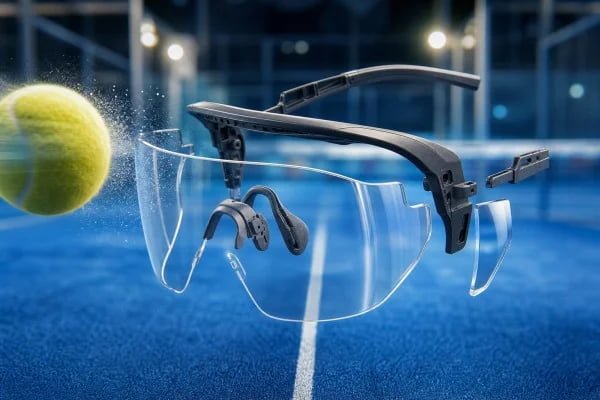
When I evaluate sports equipment, I ignore the marketing hype. I look directly at the material composition. You should apply this exact same discipline when evaluating padel eyeglasses. Buyers must know what materials actually stop a fast-moving object.
Polycarbonate Lenses: The Gold Standard
Polycarbonate is the only lens material you should accept for court sports.4 It is up to 10 times more impact-resistant than standard plastic or glass. It absorbs the kinetic energy of a fast-moving padel ball without shattering. If you require prescription lenses, you must specifically request prescription polycarbonate from your optometrist. Regular prescription glass will shatter into your eyes during an accident.
Frame Construction and Wrap-Around Design
The frame material matters just as much as the lens. Standard metal frames bend permanently and can cut the skin upon impact. Rigid cheap plastics snap easily under pressure. You want frames made from TR90 nylon or similar flexible, high-memory polymers. These materials bend temporarily under extreme pressure and immediately return to their original shape.5
You also need a wrap-around frame design. Padel relies heavily on peripheral vision. A wrap-around shape provides several crucial benefits:
- Side protection: It blocks balls striking from wide angles after rebounding off the side glass.
- Unobstructed views: It eliminates blind spots caused by thick, flat frame hinges.
- UV Protection: If you play outdoors, it blocks harmful sunlight from entering through the sides of your eyes.
Comparing Lens and Frame Materials
| Component | Ideal Material | Why It Works for Padel | Materials to Avoid |
|---|---|---|---|
| Lenses | Polycarbonate | Shatterproof, lightweight, high impact resistance | Glass, basic acrylic |
| Frames | TR90 / Flexible Nylon | Shock-absorbent, retains shape, lightweight | Metal, rigid cheap plastic |
| Hinges | Pinless / Flexible | Breaks away safely under extreme force | Sharp metal screws |
Treat safety specifications as technical documents you must verify. Just as you verify CE certifications for court structures, you must verify the material safety of your padel eyeglasses.
How do anti-fog features improve your padel eyeglasses?
Foggy lenses frustrate players constantly. When your vision clouds over during a match, you miss crucial shots. Players often remove their glasses in frustration. This exposes them to immediate danger. Proper ventilation solves this annoying issue.
Anti-fog features maintain clear vision during intense rallies. The best padel eyeglasses utilize factory-applied anti-fog coatings and strategic frame ventilation holes. These elements manage moisture buildup and heat generation, which is especially critical when playing on indoor courts or in highly humid environments.
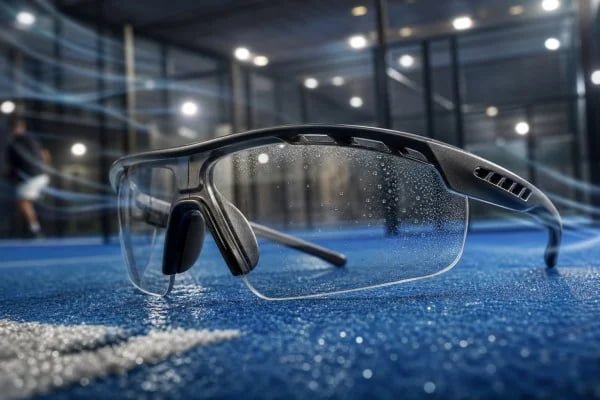
Fogging is the number one complaint I hear from players trying new protective eyewear. Padel is a highly intense cardiovascular workout. Your body generates massive amounts of heat and sweat. When you play inside enclosed indoor club facilities, ambient humidity levels spike rapidly.
If your lenses fog, you cannot see the ball clearly. If you cannot see the ball, you will naturally take the glasses off. The very moment you remove them, you lose all physical protection. This creates a dangerous vulnerability.
The Science of Fogging on the Court
Fog occurs when hot, moist air from your face hits the cooler inner surface of the lens.6 To combat this physical reaction, high-quality sports glasses use a strict two-pronged approach.
First, they employ chemical anti-fog coatings. Manufacturers bake these treatments into the polycarbonate during the production process. These specialized coatings prevent water molecules from grouping together into visible, opaque droplets.7 Instead, the moisture spreads instantly into a thin, completely invisible film.
Second, they feature mechanical ventilation. Good frame designs include physical vents.
Key Ventilation Features to Check
- Lens cut-outs: Small intentional gaps between the lens edge and the frame allow trapped hot air to escape upward.
- Sweat bars: A foam or rubber strip positioned across the top brow prevents forehead sweat from dripping down onto the inner lens surface.
- Distance from the face: The frame should sit slightly away from your cheeks. If the bottom of the lenses touches your skin directly, they will fog up immediately.
You must maintain these anti-fog coatings properly. Never wipe your inner lenses with a harsh, abrasive towel or your sweaty shirt. Use only clean microfiber cloths. Proper airflow and maintenance make the difference between a minor distraction and a major safety hazard.
How do you ensure stability and fit for your padel eyeglasses?
Padel demands aggressive sprints and sudden stops. If your glasses slide down your nose, they become a massive distraction. Constantly adjusting your eyewear breaks your concentration. You need gear that locks securely into place.
You ensure stability by choosing padel eyeglasses with hydrophilic rubber nose pads and textured temple grips. These materials actually increase their grip as you sweat.8 A secure, wrap-around fit prevents the glasses from bouncing or shifting during the jerky, rapid movements required on the court.
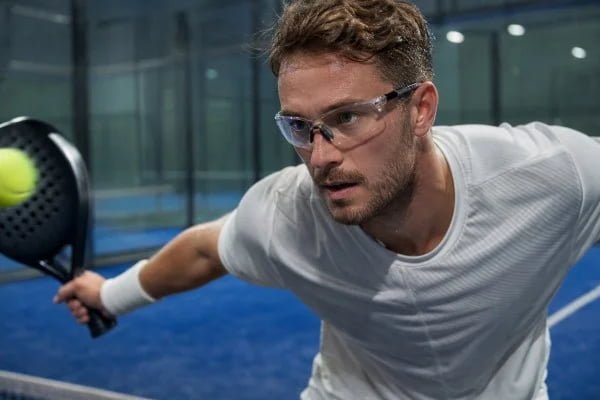
A competitive padel match involves constant, aggressive directional changes. You sprint forward for tight drop shots. You backpedal furiously to return deep lobs. You pivot sharply to play balls off the back glass. Through all this rapid, violent movement, your padel eyeglasses must remain completely stationary on your face.
I have seen players lose critical points simply because they had to push their glasses back up their nose mid-rally. Poor fit ruins your focus. Fit and stability dictate both your comfort and your performance.
The Role of Hydrophilic Rubber
Standard plastic nose pads become extremely slippery when wet. Advanced sports eyewear utilizes hydrophilic rubber components instead. The term "hydrophilic" literally means the material attracts water. As you sweat heavily on the court, these rubber pads actually grip your skin more tightly.
You should look for this specialized rubber in two key locations:
- The nose bridge: Adjustable, hydrophilic nose pads allow you to customize the fit for your specific face shape.
- The temple tips: The arms of the glasses should gently squeeze the sides of your head just behind your ears.
Evaluating the Field of Vision
Stability should never compromise your field of view. When you try on a new pair of padel eyeglasses, you must evaluate your peripheral vision. Perform the "shake test" by moving your head aggressively side to side. Move your eyes without turning your head. Thick frames or poorly placed hinges create blind spots. In padel, a blind spot means you lose track of the ball as it bounces rapidly off the side glass.
Many advanced players opt for semi-rimless designs. These specific frames lack a lower rim entirely. They provide an unobstructed, downward view of the court.9 This helps immensely when you are digging out incredibly low balls near the artificial turf. A secure fit combined with clear peripheral vision allows you to play aggressively and safely.
Frequently Asked Questions
Do I really need to wear padel eyeglasses?
Yes. Padel involves enclosed spaces, high-speed ball rebounds, and close-proximity racket swings. Protective eyewear prevents devastating eye injuries caused by direct impacts from heavy balls or clashing composite rackets.
Can I use my regular prescription glasses on the padel court?
No. Regular prescription glasses use standard glass or basic plastic lenses that shatter upon high-speed impact. You should purchase certified prescription sports glasses featuring polycarbonate lenses and flexible, impact-resistant frames.
How do I stop my sports glasses from fogging up?
Choose glasses with built-in ventilation holes and factory-applied anti-fog coatings. Ensure the frame sits slightly away from your cheeks. This allows proper air circulation and heat dissipation during intense, sweaty rallies.
What lens color is best for outdoor padel courts?
For outdoor panoramic courts, polarized or tinted lenses reduce severe sun glare.10 For indoor or shaded courts, clear or lightly tinted contrast-enhancing lenses (like yellow or rose) work best to track the ball against the court background.
Conclusion
Choosing the best padel eyeglasses requires a careful evaluation of safety specifications, ventilation technology, and mechanical fit. You must prioritize shatterproof polycarbonate lenses and secure wrap-around frames over flashy marketing claims. Proper eye protection ensures you play confidently without risking permanent injury from high-speed impacts or erratic rebounds.
At QHPADEL, we understand every rigorous detail of court safety, from the impact-absorbing artificial turf you run on to the AS/NZS certified tempered glass walls around you. If you are a club operator, engineering contractor, or equipment distributor looking for premium, fully certified padel court systems, contact us today to discuss your next facility project.
-
"Ocular injuries in padel: findings from a survey on …", https://pubmed.ncbi.nlm.nih.gov/42010296/. Clinical and sports-injury literature documents that impacts from balls and rackets in racket sports can cause ocular trauma; padel-specific incidence may vary by setting and reporting practice. Evidence role: general_support; source type: paper. Supports: Published evidence on ocular injuries or eye-trauma mechanisms associated with padel, racket sports, or impacts from sports balls and rackets.. Scope note: Evidence from racket sports generally supports the injury mechanism but does not necessarily quantify risk specifically in padel. ↩
-
"Padel vs. tennis doubles: a comparison of performance … – PMC", https://pmc.ncbi.nlm.nih.gov/articles/PMC12213881/. Biomechanical or match-analysis studies can document ball velocities in padel and identify whether strokes such as smashes exceed 100 km/h under measured conditions. Evidence role: statistic; source type: paper. Supports: Measured ball velocities in padel competition or biomechanical testing, including the circumstances in which speeds above 100 km/h occur.. Scope note: Peak speeds from elite or laboratory samples should not be interpreted as the speed of every rally or player level. ↩
-
"1910.133 – Eye and face protection.", http://www.osha.gov/laws-regs/regulations/standardnumber/1910/1910.133. ASTM F803 addresses protective eyewear intended for selected sports, whereas ANSI/ISEA Z87.1 specifies performance and marking requirements for occupational and educational eye and face protection. Evidence role: definition; source type: institution. Supports: The intended scope and performance-testing framework of ASTM F803 sports protective eyewear and ANSI/ISEA Z87.1 eye and face protection.. Scope note: A standard designation should be verified on the product and interpreted according to its stated scope; compliance with one standard does not automatically establish suitability for every sport. ↩
-
"Sports and Eye Safety: Tips for Parents and Teachers", https://www.nei.nih.gov/eye-health-information/healthy-vision/how-eyes-work/sports-and-eye-safety-tips-parents-and-teachers. Eye-safety guidance commonly recommends polycarbonate lenses for sports protection because of their impact resistance; the protective value also depends on the eyewear’s complete certified design and fit. Evidence role: expert_consensus; source type: institution. Supports: Ophthalmology and eye-safety guidance identifying polycarbonate as a commonly recommended impact-resistant lens material for sports protective eyewear.. Scope note: This support does not establish that polycarbonate is the only acceptable material in every certified court-sport eyewear system. ↩
-
"High‐Performance Recyclable Polyester Elastomers Through …", https://pmc.ncbi.nlm.nih.gov/articles/PMC12243709/. Technical material data may show that certain polyamide thermoplastics used in eyewear combine low weight with flexibility and elastic recovery; actual frame durability depends on polymer formulation and frame construction. Evidence role: mechanism; source type: research. Supports: Mechanical properties, including flexural behavior and elastic recovery, of TR90-type nylon or comparable thermoplastic polyamide materials.. Scope note: TR90 is a trade designation used inconsistently, so properties cannot be assumed for every frame marketed under that label. ↩
-
"Optical–Structural Optimization for Condensation Suppression …", https://pmc.ncbi.nlm.nih.gov/articles/PMC12610868/. Optical-surface fogging results when humid air reaches conditions that allow water to condense into droplets on a lens; those droplets scatter light and reduce visibility. Evidence role: mechanism; source type: research. Supports: The thermodynamic mechanism by which water vapour condenses into light-scattering droplets on a cooler optical surface.. ↩
-
"Long-lasting and stable anti-fog coating combined with active … – PMC", https://pmc.ncbi.nlm.nih.gov/articles/PMC12511366/. Studies of anti-fog surfaces report that hydrophilic coatings can reduce light-scattering droplets by spreading condensed water into a more continuous film, thereby improving optical clarity. Evidence role: mechanism; source type: paper. Supports: Research showing that hydrophilic anti-fog surfaces can reduce optical fogging by encouraging condensate to spread as a more transparent film instead of discrete droplets.. Scope note: Performance varies with coating chemistry, abrasion, contaminants, humidity, and cleaning practices. ↩
-
"Influence of epidermal hydration on the friction of human skin …", https://pmc.ncbi.nlm.nih.gov/articles/PMC2607440/. Tribology research indicates that moisture can alter friction at skin–elastomer interfaces, but whether grip increases depends on the elastomer, surface texture, sweat level, contact load, and motion. Evidence role: mechanism; source type: paper. Supports: Experimental evidence on how moisture affects friction between skin and elastomeric materials used in wearable contact surfaces.. Scope note: General skin-friction research does not directly validate the performance of every hydrophilic eyewear pad. ↩
-
"The effect of protective sports eyewear on peripheral visual …", https://pubmed.ncbi.nlm.nih.gov/3700954/. Vision and eyewear-design research indicates that frame geometry can obstruct parts of the visual field; reducing or repositioning a lower rim may reduce downward obstruction for some designs. Evidence role: general_support; source type: paper. Supports: Evidence on how spectacle-frame rims and frame geometry can obstruct portions of the visual field.. Scope note: The effect is model-specific and does not mean that every semi-rimless frame provides an unobstructed view. ↩
-
"Protecting your eyes from the sun’s UV light", https://www.nei.nih.gov/research-and-training/research-news/protecting-your-eyes-suns-uv-light. Optical guidance explains that polarized lenses can reduce glare from reflective horizontal surfaces, while tinted lenses lower overall light transmission; their usefulness depends on lighting conditions and the visual task. Evidence role: mechanism; source type: education. Supports: Optical guidance explaining that polarized lenses selectively reduce horizontally polarized reflected glare and that tinted lenses reduce transmitted visible light.. Scope note: Reducing glare does not by itself demonstrate improved ball tracking or safety in padel. ↩