Learning how to build a padel club can feel deceptively simple: find land, buy courts, and start taking bookings. However, weak demand research, an unsuitable site, or missing project costs can quickly undermine the investment. I recommend treating the club as a staged project that moves from market validation to technical assessment, procurement, and controlled installation.
To build a padel club from scratch, I first validate local demand and define the target customer. I then confirm site dimensions, approvals, drainage, utilities, access, and structural conditions. After calculating the total installed cost, I specify the court package, coordinate civil works and shipping, inspect every delivery, supervise installation, and complete a documented handover.
I manufacture and export complete padel court systems, so I see many projects at the quotation and delivery stages. The most successful inquiries usually arrive with clear site information and a realistic project scope. The weakest inquiries often begin with an equipment price before the investor has verified demand, land, or installation conditions.
How Do I Validate Demand Before I Build a Padel Club?
A new club can have attractive courts and still struggle if the local market cannot support its pricing or location. This risk becomes more serious when an investor copies a successful concept from another city. I start with customers, competing venues, playing habits, and credible evidence of demand before I discuss court quantities.
I validate demand by identifying the intended players, measuring existing participation, reviewing nearby competitors, testing acceptable prices, and estimating realistic utilization by time slot. I use this evidence to decide the club concept, court count, amenities, location criteria, and investment ceiling. I do not rely only on national growth figures or social media interest.

Define the target customer first
I begin by asking a simple question: Who will book the courts repeatedly? A premium hospitality venue, a community sports club, and a university facility require different locations, operating models, and equipment configurations.
A club may target:
- Social players who want affordable evening bookings
- Competitive players who value court quality and organized leagues
- Families who need safe surroundings and convenient amenities
- Corporate groups that book events or recurring sessions
- Hotel guests who expect a premium experience
- Schools or universities that prioritize durability and supervised access
- Coaches who need reliable off-peak availability
I often receive inquiries that start with, “What is the price for four panoramic courts?” I usually need more context before that number becomes useful. Four courts may suit one location, but the same count may create excess capacity or long waiting lists elsewhere.
Collect local evidence
I recommend combining several demand signals instead of trusting one optimistic forecast:
- Visit competing clubs. I would check their court count, booking availability, pricing, coaching activity, league schedules, and customer reviews.
- Review time-slot occupancy. I would separate weekday daytime, weekday evening, and weekend demand. An average utilization figure can hide empty off-peak periods.
- Survey likely players. I would ask about travel time, preferred booking duration, acceptable price, and interest in coaching or memberships.
- Run a low-cost test. I might build an email waiting list, host a temporary event, or partner with an existing sports venue.
- Interview local coaches and sports groups. I would treat their comments as evidence to test, not as guaranteed future bookings.
- Check substitute activities. I would assess tennis, pickleball, football, squash, gyms, and other leisure options competing for the same budget and time.
Translate demand into a club concept
I use demand evidence to create at least three scenarios.
| Scenario | Typical assumption | Planning response |
|---|---|---|
| Conservative | Slow player adoption and weak off-peak use | I phase construction or reduce the initial court count |
| Base case | Gradual community growth and stable evening demand | I select a balanced court count and operating budget |
| Upside case | Strong coaching, leagues, events, and repeat bookings | I preserve space and utilities for later expansion |
I would calculate revenue separately for court hire, coaching, memberships, events, food and beverage, and retail. I would also challenge every assumption. A court cannot be sold twice during the same hour1, and peak-time demand does not guarantee daytime revenue.
I treat a demand forecast as a decision tool, not a promise of occupancy, revenue, or return on investment.
A local commercial adviser can help test market assumptions. An accountant can evaluate taxation and cash flow. I recommend using market-specific evidence before committing to land, long leases, or equipment deposits.
How Do I Assess a Site Before I Build a Padel Club?
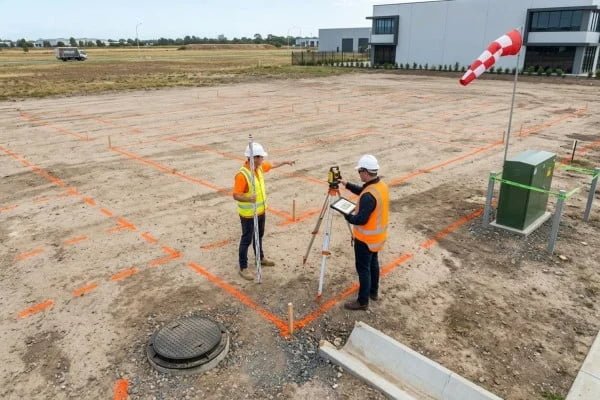
An attractive property can become an expensive problem when its usable dimensions, floor condition, drainage, height, wind exposure, or access do not support the planned facility. I assess the site before requesting a final quotation because the site determines the court configuration, civil work, handling plan, and approval pathway.
I assess a padel club site by verifying usable length and width, clear height, foundation capacity, level tolerances, drainage, wind exposure, lighting power, vehicle access, unloading space, and emergency routes. I also ask qualified local professionals to confirm zoning, planning permission, fire safety, accessibility, structural design, and other applicable requirements.
Confirm dimensions and circulation space
A standard padel playing enclosure generally has a 10-by-20-metre internal playing area2. However, the total project footprint is larger because the club needs structural components, entry points, circulation, seating, maintenance access, and separation from walls or other courts.
I never recommend planning a building around the nominal playing area alone. I ask the project team to confirm:
- The surveyed usable area
- Column positions and beam depths
- Court orientation
- Space between courts
- Player and maintenance access
- Spectator areas
- Emergency exits and evacuation routes
- Reception, toilets, changing rooms, and storage
- Future expansion space
- Any accessibility requirements
Indoor clear height also matters. Padel rules and competition standards may specify minimum unobstructed heights3, while recreational or higher-level facilities may benefit from greater clearance. I advise investors to verify the current rules that apply to their competition level and jurisdiction rather than relying on a single general number.
Investigate the ground and foundation
The court structure needs a suitable base, but manufacturer drawings do not replace local engineering. Soil conditions, frost depth, seismic conditions, drainage, wind actions, slab design, and existing-building loads can vary significantly.4
I normally provide product dimensions, post locations, fixing information, and foundation reference drawings within the agreed supply scope. A qualified local engineer should review that information and design or approve the foundation for the actual site.
I would request the following checks:
- Topographic or dimensional survey
- Geotechnical review where necessary
- Concrete condition and thickness for existing slabs
- Surface level and flatness
- Anchor zones and reinforcement conflicts
- Drainage direction and discharge points
- Groundwater and flood exposure
- Local wind, snow, and seismic design requirements
Wind exposure deserves special attention for outdoor and rooftop projects. Glass and steel court systems create structural loads that must be evaluated for the specific location.5 I would not select a “hurricane-resistant” or reinforced configuration based only on a product name. I would require project-specific design criteria and qualified structural review.
Check utilities, access, and approvals
A technically suitable court area can still fail operationally if the project lacks adequate electrical capacity, internet coverage, water, parking, or delivery access.
I ask whether a full-size container or delivery vehicle can reach the unloading point. I also ask whether the team has forklifts, cranes, pallet jacks, lifting straps, or indoor handling routes. Long glass packages and steel components require planned movement and safe storage.
Local authorities and licensed professionals should verify:
- Land use and planning permission
- Building approval
- Fire and emergency requirements
- Electrical design
- Accessibility
- Noise and operating-hour restrictions
- Signage and parking rules
- Food-service or alcohol licenses, if relevant
- Occupational health and safety obligations
I advise buyers to complete this feasibility work before placing a court order. A lower equipment price cannot compensate for an unusable site.
How Much Does It Cost to Build a Padel Club?
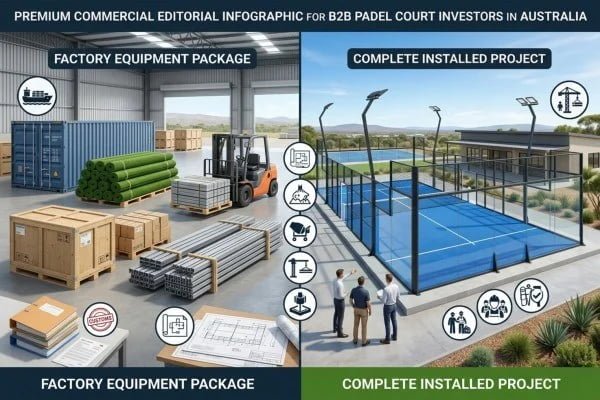
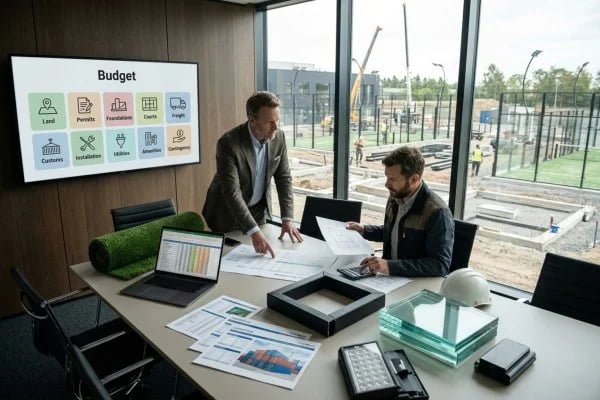
Court equipment is only one part of the investment. Buyers can underestimate the project when they compare factory quotations without including foundations, freight, import charges, installation, electrical work, professional fees, or operating reserves. I therefore build the budget around the total installed and operational project, not the court package alone.
The cost to build a padel club includes property, design, approvals, civil works, court equipment, lighting, freight, customs, unloading, installation, utilities, amenities, professional services, insurance, opening expenses, and contingency. I recommend obtaining local quotations for every work package because land, labor, taxes, structural requirements, and import costs vary widely by market.
Build a complete cost model
I separate the budget into clear packages so that the investor can assign responsibility and compare quotations fairly.
| Cost category | Items I would include | Commonly missed risk |
|---|---|---|
| Property | Purchase, lease deposit, rent, legal review | Rent during approvals and construction |
| Design and approvals | Architect, engineers, surveys, permits | Redesign after authority comments |
| Civil works | Excavation, slab, drainage, access paths | Unsuitable soil or existing concrete |
| Court equipment | Frame, glass, turf, lights, net, fasteners | Excluded accessories or spare parts |
| Logistics | Inland transport, ocean freight, insurance | Port storage, demurrage, or special handling6 |
| Import costs | Duty, tax, broker, inspections | Incorrect tariff classification |
| Installation | Labor, lifting equipment, accommodation | Rework caused by foundation errors |
| Club facilities | Reception, toilets, changing rooms, seating | Ventilation, acoustics, and accessibility |
| Technology | Booking system, Wi-Fi, access control, CCTV | Recurring software and support fees |
| Opening costs | Marketing, staffing, training, stock | Cash needed during demand ramp-up |
| Contingency | Scope changes and unknown conditions | Contingency set too low or spent early |
I avoid publishing a universal price per court because that number can mislead buyers. A basic outdoor project on prepared land has a different cost structure from an indoor conversion, rooftop installation, coastal site, or premium hospitality club.
Compare quotations on the same basis
I ask buyers to create a quotation normalization sheet. Every supplier should price the same scope, delivery term, technical specification, and quantity.
I would check:
- Court model and structural configuration
- Steel grades, profiles, coatings, and finish
- Glass specification and quantity
- Turf yarn, Dtex, density, color, and roll layout
- Lighting fixture quantity, power, optics, and controls
- Nets, anchors, fasteners, doors, and accessories
- Spare parts package
- Packaging method
- Installation documentation and support
- Incoterm and delivery destination
- Warranty scope and exclusions
A low EXW price may become expensive after inland transport, export handling, freight, customs, delivery, and installation. In contrast, a higher equipment quotation may include stronger packaging, a more complete bill of materials, or better documentation.
Model operating cash flow conservatively
I would build monthly cash-flow scenarios rather than relying on an annual revenue headline. I would include staffing, rent, electricity, cleaning, software, insurance, maintenance, marketing, coaching arrangements, payment processing, and replacement reserves.
I would also test:
- A delayed opening
- Lower-than-planned occupancy
- Strong peak demand but weak daytime use
- Price discounting
- Seasonal weather effects
- Higher freight or construction costs
- Repairs and replacement glass
- Slower membership growth
I recommend that an accountant or financial adviser review the model. I can help define court supply costs, but I cannot verify local revenue, tax, finance, or return assumptions.
How Do I Specify and Procure a Complete Padel Court System?
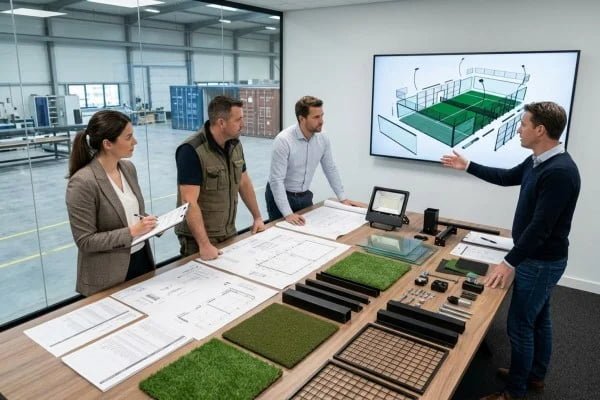
Padel procurement creates risk when the buyer purchases a visual design without defining the technical scope. Missing fasteners, incompatible drawings, unsuitable turf, or unclear installation responsibilities can delay the opening. I treat procurement as an interface between the site designer, civil contractor, manufacturer, freight provider, installer, and club operator.
I procure a padel court system by issuing a written specification, complete bill of materials, approved drawings, document schedule, packaging requirements, inspection plan, delivery terms, warranty conditions, and responsibility matrix. I also verify certificates and test reports against the exact supplied components instead of accepting marketing statements as proof of project compliance.
Select the court configuration by use case
Panoramic and ultra-panoramic courts are popular because they offer broad viewing areas and strong visual appeal. Classic configurations can also remain appropriate for some budgets and operating models. The right selection depends on more than appearance.
I would evaluate:
- Indoor or outdoor use
- Recreational or competition use
- Spectator and broadcast priorities
- Local wind and environmental exposure
- Expected playing hours
- Maintenance capability
- Replacement-part availability
- Installation skill
- Budget and future standardization
Frame color and turf color can support branding, but I would finalize structural and operational requirements first. Turf should be compared through measurable specifications such as yarn type, Dtex, pile characteristics, density, backing, infill requirements, drainage behavior, and relevant test documentation.
Require a complete BOM
A bill of materials, or BOM, should identify every supplied component. I would expect the agreed package to clarify whether it includes:
- Structural posts and frames
- Welded mesh panels
- Tempered glass panels
- Glass fixings and protective components
- Artificial turf
- Adhesive or seaming materials, if applicable
- Silica sand requirements, if applicable
- LED fixtures and mounting hardware
- Electrical cabinets or controls, if included
- Court net and posts
- Doors, handles, and locks
- Anchors, bolts, screws, and covers
- Labels and component numbering
- Special installation tools
- Recommended spare parts
QHPADEL can supply complete court packages and supporting documents such as installation drawings, foundation drawings, packing lists, and maintenance manuals. However, I always define the document scope in the contract. I also ask the local project team to review the drawings before production.
Verify quality and certification documents
QHPADEL reports an ISO 9001-certified factory7 and component certifications covering selected turf, steel, glass, lights, screws, and accessories. These documents can support buyer due diligence, but buyers should verify them rather than treating a certificate list as automatic approval.
I recommend checking:
- The certificate holder and manufacturing entity
- The product model or component covered
- The referenced standard
- The issuing or testing organization
- The issue and expiry dates
- The report number and traceability
- Whether the document applies to the supplied configuration
- Whether local authorities accept the evidence
For example, a CE-related document does not automatically confirm compliance with every local building, electrical, or structural rule8. Australian or New Zealand test references may be useful in relevant markets, but the project team must confirm their applicability.
Approve milestones before shipment
I use controlled approval points:
- Site data received
- Technical specification agreed
- Drawings reviewed
- Colors and turf confirmed
- BOM approved
- Production started
- Inspection completed
- Packing list checked
- Shipping documents approved
- Balance payment and dispatch authorized
QHPADEL’s stated standard production timing ranges from about 20 days for two courts to no more than 30 days for larger standard orders, while custom styles may require up to 35 days.9 I treat these as factory planning references, not guaranteed club opening dates. Drawing approval, payment, holidays, shipping schedules, customs, civil works, and local installation can change the overall timeline.
How Do I Coordinate Shipping, Installation, and Handover?
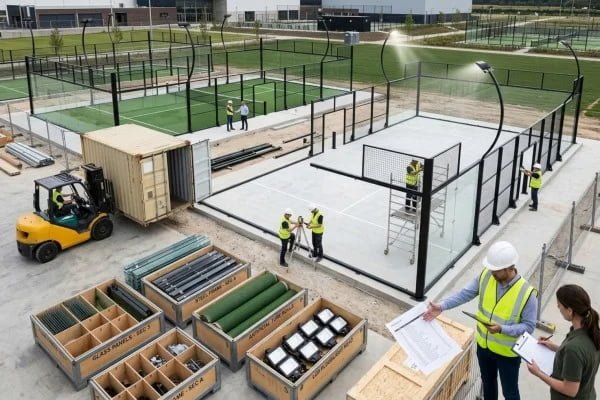
A completed factory order does not mean the club is ready to open. The project still faces shipping, customs, unloading, storage, installation, testing, and defect resolution. I reduce these risks by connecting the manufacturer’s packing plan with the contractor’s site schedule and the operator’s handover requirements.
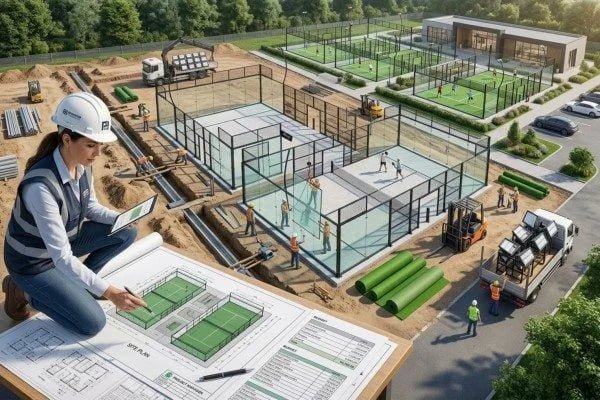
I coordinate delivery and installation through a shipping schedule, verified packing list, unloading plan, receiving inspection, foundation check, installation sequence, issue log, testing procedure, and signed handover record. I assign each task to a named party before dispatch so that missing equipment, site errors, freight damage, and installation questions receive prompt action.
Plan logistics before production ends
I would confirm the commercial delivery term under the current Incoterms agreed in the contract. EXW, FOB, CIF, and DDP can allocate costs and risks differently10, so I would ask a freight forwarder and customs broker to explain the actual responsibilities.
QHPADEL is located about 120 minutes from Tianjin Port and reports annual exports exceeding 600 containers. That export workflow helps with container planning and documentation, but each destination still has its own import requirements.
Before dispatch, I ask the buyer to confirm:
- Consignee and notify-party details
- Import eligibility
- Tariff classification with a broker
- Required certificates and translations
- Port and final delivery address
- Container access restrictions
- Unloading labor and machinery
- Secure, dry storage
- Installation start date
- Inspection and claim deadlines
Inspect the site before delivery
I prefer a formal pre-installation checklist. The local contractor should verify actual dimensions instead of stating that the foundation is “basically ready.”
The checklist should record:
- Finished slab dimensions
- Levels and tolerances
- Anchor areas
- Concrete strength and curing status
- Drainage completion
- Electrical connection points
- Lighting circuit readiness
- Access and lifting conditions
- Material storage area
- Safety barriers and work permits
A local engineer or licensed contractor should approve these conditions when required. Manufacturer drawings can guide coordination, but they do not certify the local construction.
Control receiving and installation
I recommend photographing the sealed container, opening process, package condition, labels, and unloaded components. The receiving team should compare quantities against the packing list before installers spread the materials across the site.
The usual installation flow may include:
- Surveying and setting out
- Positioning structural posts and frames
- Installing mesh and structural members
- Handling and fitting tempered glass
- Installing lighting supports and fixtures
- Laying and joining artificial turf
- Adding and brushing infill where specified
- Installing the net and accessories
- Tightening and checking fixings
- Cleaning, testing, and recording defects
The exact sequence depends on the system and site. Trained personnel should handle glass, lifting operations, anchors, and electrical connections.
In feedback shared by customers and installation partners, clear labels and organized fastener packages often reduce avoidable confusion. I treat that feedback as external installation experience rather than my own on-site observation. I use it to improve packing lists, component identification, and remote guidance.
Complete a documented handover
I would not end the project when the last glass panel is installed. I would close it through a punch list and handover package.
The final records may include:
- Approved drawings
- Final BOM and packing list
- Certificate and test-document file
- Installation records
- Electrical testing records
- Anchor or torque records where applicable
- Glass inspection
- Turf and infill checks
- Lighting checks
- Spare-parts inventory
- Maintenance manual
- Warranty conditions
- Open-defect list and resolution dates
- Staff training record
I also recommend keeping spare glass, fasteners, net components, turf repair materials, and selected wear parts where the operating model justifies them. The club operator should establish routine inspection intervals based on manufacturer guidance, usage, environmental exposure, and local safety obligations.
Conclusion
I treat learning how to build a padel club as a staged investment process, not a simple equipment purchase. I first validate real customer demand. I then confirm site feasibility, approvals, total installed cost, technical specifications, logistics, and installation responsibilities. A complete BOM, verified documents, controlled receiving process, and formal handover can prevent many avoidable delays.
If your project has reached the site-assessment or court-procurement stage, contact Alice Chen at QHPADEL via alice@grass-supplier.com or WhatsApp +86 185 7566 0746 to review your court scope, drawings, documentation, and delivery requirements.
-
"[PDF] Retrospective: Introduction to Operations Management", https://ocw.mit.edu/courses/15-760a-operations-management-spring-2002/3a2597887c580db1a7807bd1731b7280_lecture18_mar18.pdf. Operations-management literature treats service capacity as finite over a given period: a resource can provide only its available service time, and utilization measures the share of that capacity used. Evidence role: mechanism; source type: education. Supports: Operations-management literature defines service capacity as limited by available time and resources, making utilization central to revenue planning.. Scope note: The source supports the general capacity constraint; actual court revenue also depends on booking durations, closures, pricing, cancellations, and demand. ↩
-
"[PDF] RULES OF PADEL INTERNATIONAL PADEL FEDERATION", https://www.padelfip.com/wp-content/uploads/2025/12/FIP_Rules-of-Padel-1.pdf. The International Padel Federation’s Rules of Padel define the court’s playing area as a rectangle 10 metres wide and 20 metres long. Evidence role: definition; source type: institution. Supports: The International Padel Federation’s official rules specify a rectangular playing area measuring 10 metres wide by 20 metres long.. ↩
-
"[PDF] RULES OF PADEL INTERNATIONAL PADEL FEDERATION", https://www.padelfip.com/wp-content/uploads/2025/12/FIP_Rules-of-Padel.pdf. The International Padel Federation’s court rules address unobstructed vertical clearance above the playing area, including recommended or required heights for facilities covered by the rules. Evidence role: definition; source type: institution. Supports: Official padel rules address unobstructed vertical space above the court and may specify a higher clearance for new facilities.. Scope note: The applicable height can depend on the edition of the rules, the competition level, and local building requirements. ↩
-
"Engineering and risk research—A strategic vision for extending …", https://pubs.usgs.gov/publication/cir1555/full. Engineering guidance from public authorities explains that subsurface conditions and site-specific environmental loads are inputs to safe foundation and structural design. Evidence role: mechanism; source type: government. Supports: Government engineering guidance explains that site investigation and applicable environmental and structural loads inform foundation and structural design.. Scope note: Such guidance establishes the design principle but does not approve the design of a particular padel-court installation. ↩
-
"[PDF] 1 EQUIVALENT STATIC WIND LOADS VS. DATABASE-ASSISTED …", https://tsapps.nist.gov/publication/get_pdf.cfm?pub_id=924579. Structural-wind engineering guidance shows that design wind actions depend on local wind climate, terrain exposure, structural geometry, and code-defined load combinations. Evidence role: mechanism; source type: research. Supports: Structural engineering standards and research describe how wind actions depend on location, exposure, geometry, and design criteria.. Scope note: This evidence supports the need for project-specific analysis; it does not determine the adequacy of any named court model. ↩
-
"Detention and Demurrage – Federal Maritime Commission", https://www.fmc.gov/detention-and-demurrage/. Maritime-shipping authorities describe demurrage and detention as charges associated with delayed container movement or use beyond the time allowed under applicable shipping terms. Evidence role: definition; source type: government. Supports: Maritime-shipping authorities define demurrage and detention charges and describe their relationship to container availability and port dwell time.. Scope note: Actual port storage, demurrage, detention, and handling charges depend on carrier tariffs, terminal rules, customs delays, and the shipment contract. ↩
-
"Is Padel Played in the USA?", https://qhpadel.com/is-padel-played-in-the-usa/. A valid ISO 9001 certificate from an accredited certification body would document whether the identified QHPADEL manufacturing entity’s quality-management system is certified, including the certificate scope and validity dates. Evidence role: case_reference; source type: institution. Supports: A current certificate issued by an accredited certification body should identify the certified legal entity, scope, standard, certificate number, and validity period.. Scope note: ISO 9001 certifies a quality-management system rather than the performance, safety, or regulatory compliance of every individual court component. ↩
-
"CE marking – obtaining the certificate, EU requirements – Your Europe", https://europa.eu/youreurope/business/product-rules-compliance/general-product-compliance/ce-marking/index_en.htm. European Commission guidance states that CE marking indicates conformity with applicable EU harmonisation requirements for a product; it is not a universal certification of compliance with every national or site-specific construction requirement. Evidence role: definition; source type: government. Supports: European Commission guidance explains the scope of CE marking and its relationship to applicable EU harmonisation legislation.. Scope note: Which EU rules apply depends on the product category and intended use, while non-EU jurisdictions may use different conformity systems. ↩
-
"How to Start a Padel Business?", https://qhpadel.com/how-to-start-a-padel-business/. QHPADEL’s dated production documentation should be used to verify the stated lead-time ranges for standard and custom court orders. Evidence role: case_reference; source type: other. Supports: A dated supplier production schedule, quotation, or contract record should state the applicable manufacturing lead time and conditions for the specified order.. Scope note: Supplier lead times are planning estimates and may change with drawing approval, order specifications, production capacity, holidays, payment milestones, and force-majeure or transport disruptions. ↩
-
"Know Your Incoterms", https://www.trade.gov/know-your-incoterms. ICC Incoterms rules distinguish EXW, FOB, CIF, and DDP by assigning delivery, transport, insurance, export/import clearance, cost, and risk responsibilities differently between the parties. Evidence role: definition; source type: institution. Supports: Incoterms rules define different delivery, cost, risk-transfer, and customs-clearance obligations for EXW, FOB, CIF, and DDP.. Scope note: The precise obligations still depend on the named place or port, the contract wording, and the applicable Incoterms edition. ↩