
If you are managing sports infrastructure projects, you are likely wondering where to find reliable padel court suppliers in Indonesia. Managing procurement for civil engineering projects in Southeast Asia is stressful enough without supply chain bottlenecks. Standard local procurement often leads to blown budgets, hidden costs, and delayed project handovers.
To find the best padel court suppliers in Indonesia, look beyond local importers to direct-factory manufacturers offering Delivered Duty Paid (DDP) shipping. Direct procurement eliminates intermediary markups, resolves unpredictable customs clearance delays, and ensures strict control over the total cost of ownership for your contracting projects.
Navigating cross-border logistics requires more than just browsing a product catalog. Let us examine how professional B2B buyers evaluate manufacturing partners, secure comprehensive bill of materials (BOM), and engineer steel structures to survive harsh tropical climates.
Why are local padel court suppliers in Indonesia often just a costly illusion?
You need construction materials on-site fast, so buying from a vendor based in Jakarta or Bali seems logical. However, these local intermediaries rarely hold complete inventory. This leads to unexpected project delays and hidden markups that destroy your profitability.
Most local padel court suppliers in Indonesia are actually trading distributors who import from overseas factories. By bypassing these middlemen and partnering with a manufacturer that provides Delivered Duty Paid (DDP) logistics, contractors secure a fixed landed cost and bypass local port clearance bottlenecks.
The Hidden Risks of Local Procurement
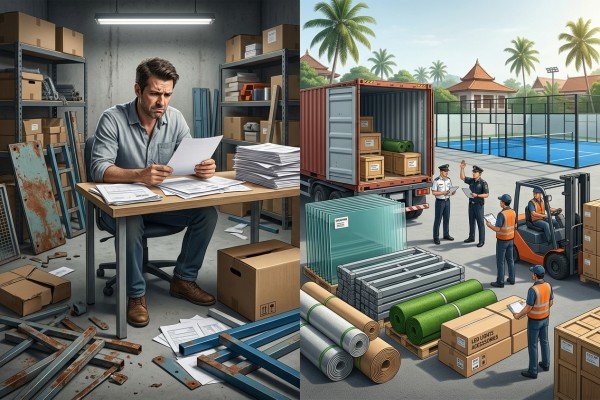
I frequently see civil engineering contractors start projects believing they have secured a fixed domestic price from a local intermediary. The reality usually shifts once the equipment arrives at Tanjung Priok or Tanjung Perak. Because local distributors often consolidate shipments or lack dedicated customs teams, containers sit at the port. You end up paying unpredictable port storage fees, and the timeline delays directly impact your labor costs.
DDP vs. Traditional Import Methods
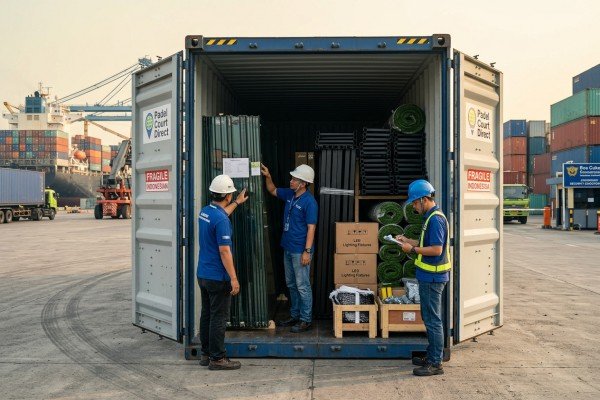
Taking control of your supply chain means understanding your shipping terms. Sourcing directly from an export-experienced factory utilizing DDP terms changes the financial equation. With DDP, the manufacturer assumes responsibility for the freight, export duties, import taxes, and the final truck delivery to your job site.
If you use standard CIF (Cost, Insurance, and Freight) terms, you are left to manage local customs agents yourself. A direct DDP model protects your Total Cost of Ownership (TCO).
Comparing Procurement Strategies
| Procurement Route | Cost Predictability | Logistics Control | Typical Price Impact |
|---|---|---|---|
| Local Distributor | Low (Hidden fees) | Poor (Dependent on intermediary) | +30% to 50% Markup |
| Direct Factory (CIF) | Medium (Port fees vary) | Medium (Buyer manages import) | Baseline Factory + Freight |
| Direct Factory (DDP) | High (Fixed landed cost) | High (Door-to-door tracking) | Highly optimized TCO |
Choosing a factory with years of export volume—such as moving over 600 containers annually—ensures they have the established freight forwarding networks necessary to execute DDP shipments seamlessly into Southeast Asia.
How does a zero-missing-parts BOM protect contractor margins?
Your foundation is cured, the heavy lifting equipment is rented, and your installation crew is on the clock. Suddenly, you realize you are short by a dozen specialized structural bolts. A single missing component halts the entire project and creates severe liabilities.
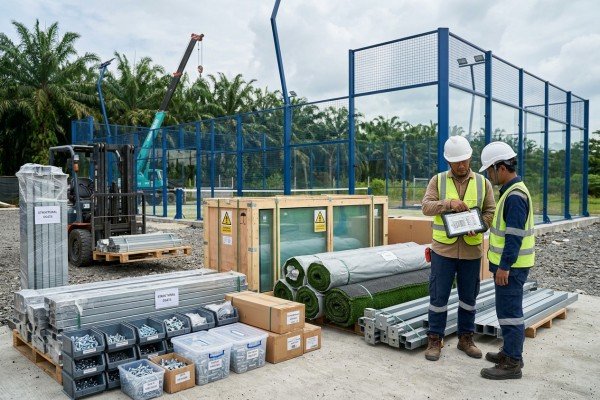
A zero-missing-parts Bill of Materials (BOM) guarantees every structural post, glass pane, and fastener arrives exactly as specified. For contractors, a meticulously kitted package eliminates installation downtime, prevents emergency local material sourcing, and protects daily labor margins.
The Financial Impact of Missing Components
For engineering and civil contractors, profitability relies on rapid, uninterrupted installation. Heavy machinery rentals, such as cranes or telehandlers for positioning tempered glass, represent fixed daily costs. If your team cannot install the glass because the supplier forgot the specialized neoprene gaskets, your timeline stops, but your payroll does not. You cannot easily source AS/NZS certified hardware at a local Indonesian hardware store.
What a Professional BOM Includes
A robust supply chain partner provides absolute transparency. The BOM should not just vaguely list "steel frames and glass." It must be an exhaustive inventory that maps directly to the packing list and installation drawings.
Essential categories in a professional BOM include:
- Structural Steel: Clear component numbering for panoramic or classic posts.
- Tempered Glass: Exact pane counts adhering to AS/NZS 2208:1996 standards.
- Lighting Fixtures: LED lights meeting AS 61347.2.13:2018 compliance, including all wiring harnesses.
- Fasteners: Precise counts of screws and bolts with AD 2000 WO certification.
- Turf & Consumables: Correct square meterage of artificial turf, joint tape, and specialized polyurethane glue.
The Role of Factory Packaging
Even a perfect BOM fails if the packaging is inadequate. Experienced manufacturers do not load loose components into a shipping container. Tempered glass must be secured in customized wooden crates. Fasteners must be boxed, weighed, and labeled. When the shipment arrives at your Indonesian site, your site manager should be able to cross-reference the packing list with the physical crates in minutes.
What engineering specs do padel court suppliers in Indonesia recommend for tropical climates?
High humidity, intense UV radiation, and salty ocean air quickly degrade standard structural steel. If you install a basic, cheaply painted court in a coastal region like Bali, severe rust will compromise the structural safety within a single year.
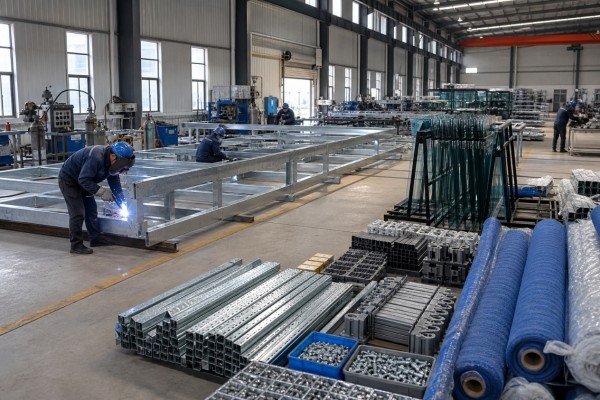
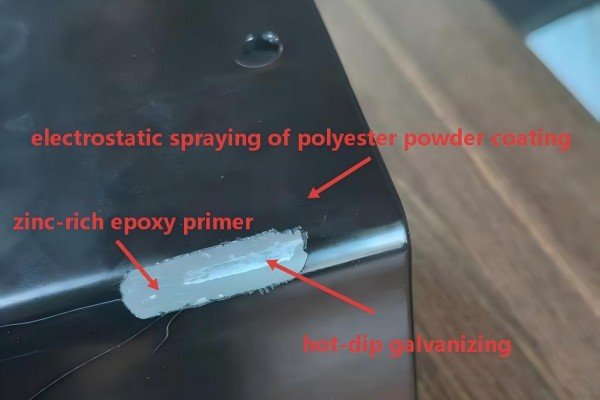
Top padel court suppliers in Indonesia require extreme anti-corrosion treatments, specifically hot-dip galvanizing followed by outdoor powder coating. For coastal sites, an additional zinc-rich epoxy primer is mandatory to protect steel structures against rapid tropical degradation.
Upgrading Steel for Coastal Environments
Standard pre-galvanized pipes are entirely insufficient for Southeast Asia. Moisture easily penetrates standard paint at the welding joints, causing internal rust that structurally weakens the frame. When evaluating equipment, I strictly advise contractors to verify the factory’s coating process.
For Indonesian islands, the steel must undergo a comprehensive three-layer protection system:
- Hot-Dip Galvanizing: The raw steel is submerged in molten zinc, coating both the interior and exterior of the structural profiles.
- Zinc-Rich Epoxy Primer: Crucial for coastal applications, this middle layer seals micro-pores in the galvanized steel and provides extreme chemical resistance against salt spray.
- Outdoor Powder Coating: The final architectural layer provides the aesthetic finish and protects the underlying primers from intense UV degradation.
Turf and Structural Compliance
The artificial grass must also survive the local climate. Heavy monsoon downpours require superior drainage systems. The turf backing must feature adequate perforation holes to prevent waterlogging. Furthermore, the turf fibers require high UV resistance to prevent them from becoming brittle under the equatorial sun.
Additionally, wind resistance cannot be ignored. The massive glass walls of a padel court act like sails during severe tropical storms. Equipment must comply with rigorous structural safety standards. Buyers should request CE certifications and confirm that the tempered glass complies with AS/NZS 4666:2012 for structural integrity. Facilities positioned on exposed coastal cliffs may even require upgraded hurricane-resistant structural designs.
How do you evaluate total cost of ownership (TCO) for imported padel courts?
Comparing supplier quotes based only on the initial unit price is a dangerous procurement strategy. A cheap factory price often hides thin steel profiles, exorbitant shipping fees, and massive future maintenance liabilities for the club operator.
Evaluating TCO involves calculating the landed DDP cost, installation labor time, and the expected lifespan of wear parts. True value comes from securing comprehensive warranty terms, structural compliance, and reliable after-sales support from direct factory padel court suppliers in Indonesia.
Moving Beyond the Initial Quote
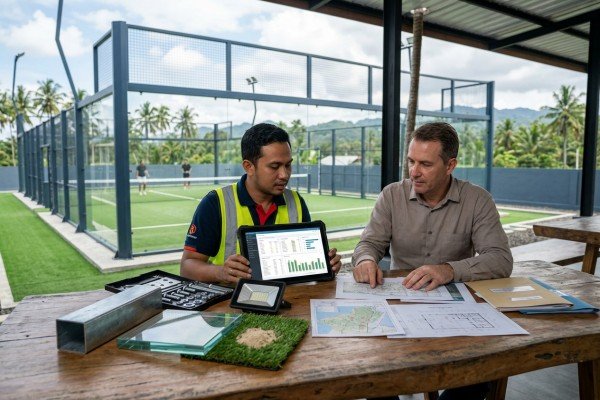
When a distributor or public sector institution evaluates a bid, the initial unit price is merely a fraction of the actual cost. A complete TCO model encompasses the initial equipment, international logistics, local civil works (concrete foundation preparation), installation labor, and projected five-year maintenance expenses.
If you purchase a court with 2mm steel instead of industrial-grade 3mm steel to save money upfront, the structural flexing can cause the heavy tempered glass to shatter. Replacing 12mm certified safety glass locally in Indonesia is incredibly expensive and disrupts facility operations.
Standardizing SKUs for Multi-Site Rollouts
For chain brand operators and regional distributors, standardizing your equipment buys drives down long-term costs. If you commit to a specific Panoramic or Ultra Panoramic design across multiple locations, you streamline your installation process. Your crews learn how to assemble the specific frame efficiently, reducing labor hours per site.
Standardization also allows you to hold a single inventory of spare parts. By keeping extra AS/NZS certified glass panes and CE-certified LED drivers in a local warehouse, you minimize downtime when wear-and-tear events occur.
Partnering with a factory boasting a high production capacity—such as 10 lines outputting 150 courts per month—ensures your standardization strategy is backed by a stable, scalable supply chain. Consistent lead times of 20 to 30 days mean your project timelines remain intact, protecting your return on investment.
Frequently Asked Questions
How long does it take to import a padel court to Indonesia?
Production at a high-capacity factory typically takes 20 to 30 days, depending on the order volume and customization. Ocean freight from China to Indonesian ports generally takes 10 to 15 days, plus an additional week for DDP customs clearance and final inland delivery.
What certifications should Indonesian padel court buyers look for?
Always verify factory compliance with ISO9001. Structural steel and LED lights should have CE marks and meet AS/NZS standards. The tempered safety glass must comply with AS/NZS 2208:1996 or AS/NZS 4666:2012 to guarantee impact safety for players.
Can I customize artificial turf for my local club brand?
Yes, professional factories offer OEM customization for turf colors, Dtex, and density. However, custom turf production typically requires a Minimum Order Quantity (MOQ). For example, customizing turf specifications usually requires an order of at least 6 courts (approximately 1,254 square meters).
Do factory suppliers provide installation teams in Indonesia?
Direct factories typically do not send manual labor crews overseas. Instead, they provide comprehensive digital support, including highly detailed foundation drawings, component installation manuals, packing lists, and online technical guidance meant for your local civil engineering contractors to execute.
Conclusion
Successfully sourcing sports infrastructure in Southeast Asia requires a strategic approach to logistics and engineering. By avoiding the markup of local middlemen and partnering directly with experienced padel court suppliers in Indonesia who offer DDP shipping, you protect your project margins. Demand a zero-missing-parts BOM and verify that all steel coatings and glass components meet rigorous AS/NZS standards to survive the tropical climate.
If you are a contractor or facility developer ready to streamline your procurement with reliable, export-ready court packages, QHPADEL can provide fixed DDP quotes and technical documentation for your next project. Contact Alice Chen at alice@grass-supplier.com or +86 185 7566 0746 to discuss your site requirements.