Are you wondering which country padel is most popular in right now, perhaps to gauge if your local market is ready for a new club? Investors often struggle to decide whether padel is a fleeting trend or a solid global business opportunity. Understanding current market demand is the first step to building a profitable facility.
If you want to know which country padel is most popular in, the top three markets are Spain, Argentina, and Indonesia. Spain and Argentina dominate as mature, historical giants with millions of active players1. Meanwhile, Indonesia leads the explosive growth in Southeast Asia2, representing the sport’s rapid global expansion.
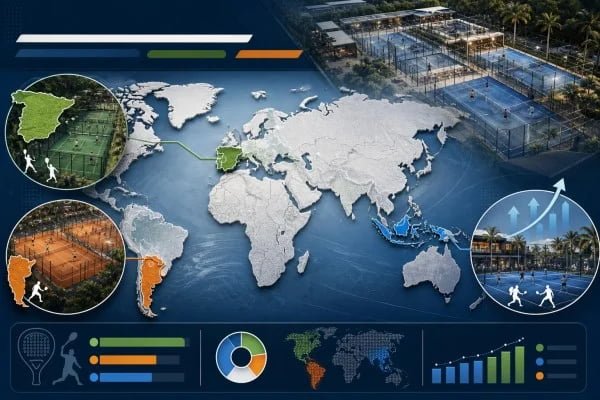
Knowing where the sport thrives is just the beginning. Let us look at how these regional trends impact your local padel club investment and dictate which court models you should actually buy.
Why do Spain and Argentina dominate the global padel market?
It is easy to look at the massive number of courts in Europe and South America and feel intimidated. Competing in a saturated market requires a different strategy than launching in an emerging one. You must understand what drives these mature markets.
Spain and Argentina dominate the global padel market because of decades of deep cultural integration and accessible public infrastructure. These two nations account for the highest concentration of courts globally, making them the standard-bearers for tournament play, equipment innovation, and club management.
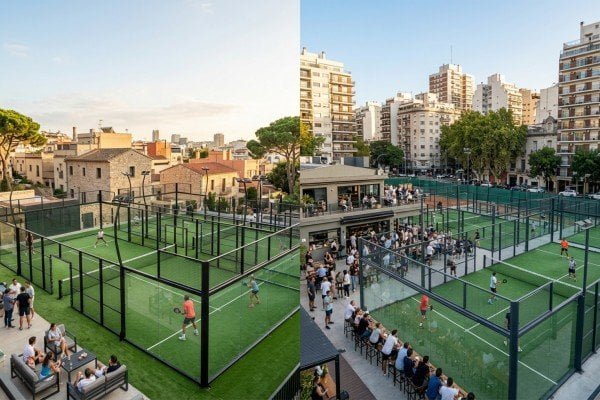
In my experience handling export inquiries over the past nine years, mature markets operate differently. Buyers in Spain or Argentina are not just testing the waters. They are upgrading existing facilities or building elite, competitive venues. We ship a significant portion of our 600+ annual export containers to regions with high existing demand, and the purchasing patterns are very distinct.
The Shift to Premium Aesthetics
When a market reaches maturity, standard courts are no longer enough to attract players. Players have choices, and they prefer clubs with high-end aesthetics and excellent broadcasting capabilities.
To stand out in a country where padel is most popular, investors shift heavily toward premium differentiation. This is precisely why Ultra Panoramic Courts currently make up 40% of our production, while standard Panoramic Courts account for 50%. Club operators in mature markets demand unobstructed views for spectators and high-quality visual branding. They also strictly require safety certifications for tempered glass, such as CE, AS/NZS 4666:2012, and AS/NZS 2208:1996, alongside rigorous bulletproof testing.
Focus on Maintenance and Upgrades
Mature markets also drive consistent demand for maintenance and facility upgrades. Operators frequently replace older artificial turf or upgrade their lighting systems to keep their clubs competitive. Upgrading to CE-certified LED lighting—specifically meeting the AS 61347.2.13:2018 standard—ensures better visibility for evening play and lower energy costs.
Market Stage vs. Buyer Priority
| Market Stage | Typical Countries | Primary Business Goal | Preferred Court Models |
|---|---|---|---|
| Mature | Spain, Argentina | Player retention, premium branding | Ultra Panoramic, Panoramic |
| Emerging | Indonesia, UAE | Fast deployment, market capture | Classic, Roofed, Hurricane |
| Developing | USA, UK | Scaling franchises, VIP experience | Panoramic, Custom OEM |
Understanding this dynamic helps you evaluate your own city. If you are building in an area with several existing clubs, you must adopt the procurement strategies of a mature market to stay competitive.
Which emerging countries are driving new padel court investments?
Missing the wave of a booming sport can mean leaving significant revenue on the table. However, rushing into an unproven region without understanding the environmental and local demands can lead to costly construction mistakes. How do you capitalize on the next big market safely?
While Europe leads historically, emerging regions like Indonesia, the Middle East, and broader Southeast Asia are driving new padel court investments. These areas are experiencing explosive growth, fueled by tourism, expatriate communities, and a rising middle class looking for premium, social sports experiences3.
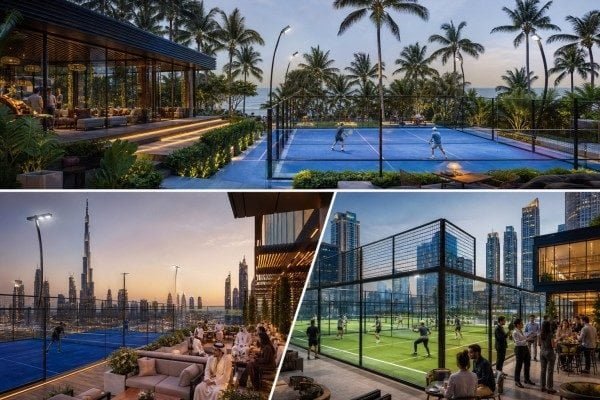
Based on our shipping manifests and daily client conversations, the geographic center of the sport is expanding rapidly. When clients ask me where padel is most popular in terms of new growth, I immediately point to the Middle East and Southeast Asia. These regions represent the most active current buyers for new facility construction.
Adapting to Climate and Geography
These booming markets present unique physical challenges for club operators. You cannot simply drop a standard European court into a tropical or desert climate. High heat, heavy rain, and coastal winds directly dictate the structural requirements of your procurement list4.
Key court adaptations for emerging markets include:
- Roofed Courts: Essential for regions with intense sun or heavy monsoon seasons, like Indonesia. This ensures uninterrupted play and consistent revenue.
- Hurricane-Resistant Courts: Absolutely necessary for coastal areas with high wind loads. Structural integrity cannot be compromised.
- High-Density Artificial Turf: Hot climates require turf with excellent UV resistance and rapid drainage capabilities. We frequently customize turf specifications, including Dtex and density, for our clients (with a minimum order quantity of 6 courts, or 1,254 square meters).
Speed to Market
In these fast-growing regions, speed to market is critical. Investors prioritize manufacturers who offer complete, error-free bills of materials (BOM) and simple installation processes. Missing parts delay grand openings and hurt the bottom line.
Our factory addresses this by utilizing 10 production lines capable of outputting over 1.5 million square meters of artificial turf and 150 complete court systems monthly. For standard orders, we can produce two courts in 20 days, and up to four courts in 20 to 25 days. Fast, reliable lead times allow investors in emerging markets to capture the trend immediately and achieve a faster return on investment.
How does global padel popularity affect your local business plan?
Reading about global sports trends is interesting, but it does not pay your bills. The real challenge is translating international popularity into a bankable business plan for your specific city. You need to know if the trend translates to local profit.
Global padel popularity proves the sport’s long-term financial viability5 and helps operators secure investment capital. By observing which court models and club structures succeed in leading countries, new local businesses can skip the trial-and-error phase and build facilities optimized for their specific climate and player demographics.
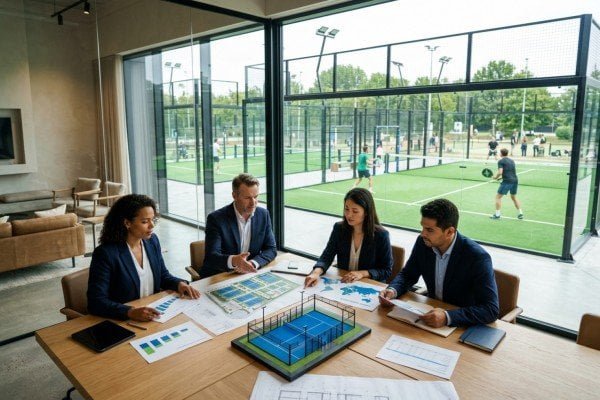
When a potential buyer asks me which country padel is most popular in, I know what they are really asking. They want to know, "Is my region next, and what exactly should I build to capture this momentum?" Validating the business model requires looking at what works abroad and adapting it locally. Let us break down the procurement strategies based on the core buyer profiles we work with every day.
Club Operators & Chain Brands
If you are building a commercial club, you need transparent pricing and reliable timelines. Missing a single box of screws can halt a project. Therefore, working with a factory that provides a complete BOM is non-negotiable. Chain operators also need standardized designs with tiered pricing options to scale across different cities. We always supply installation drawings, foundation drawings, packing lists, and maintenance manuals to ensure the handover is seamless.
Engineering & Civil Contractors
Local installers do not want surprises on the job site. A popular market means busy contractors; they require fast, error-free assembly. They need clear foundation and pre-embedding drawings with specific tolerance requirements. Structural accuracy—such as precise hole positions, clear component numbering, and complete fasteners—is vital. We ensure all screws and accessories come with AD 2000 WO certificates and PED 2014/68/EU quality system approval to guarantee structural safety.
Equipment Distributors & Importers
Distributors thrive on standardized, resaleable SKUs. They need transparent pricing systems covering complete sets, partial sets, and accessories. OEM labeling and authorization support help distributors build local brand equity. A stable delivery schedule is their lifeline. Located just 120 minutes from Tianjin Port, we provide the logistical efficiency distributors need to maintain inventory.
Public Sectors & Institutions
For government, school, or university projects, the focus shifts entirely to compliance and durability. Supplying comprehensive documentation is required for bidding. We provide ISO9001 factory certification, alongside CE and RoHS certificates for artificial turf, to ensure the project passes strict municipal procurement processes.
How do climate conditions in popular padel countries dictate court specifications?
Ignoring local weather is the fastest way to ruin your investment. You might buy the most beautiful court on the market, but if it corrodes in coastal air or floods during a storm, your club will bleed money. How do you protect your physical assets?
Climate conditions directly dictate court specifications by forcing buyers to select appropriate materials. High-wind areas require hurricane-resistant structural posts, tropical regions demand UV-stabilized turf and roofed structures, and coastal zones necessitate advanced anti-corrosion treatments on all steel components.
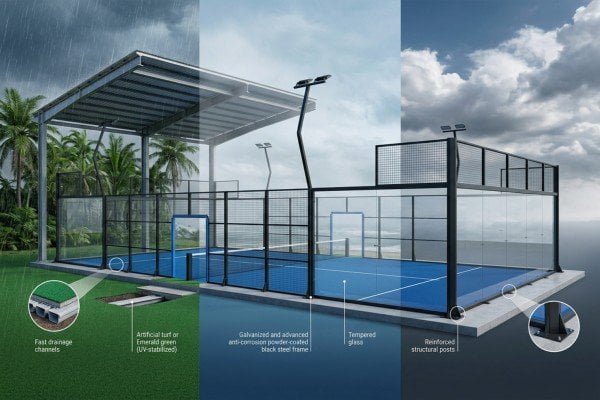
Looking closely at the country padel is most popular in helps us understand material evolution. Spain features a relatively mild climate, allowing for standard outdoor construction. However, as the sport expands globally, suppliers must engineer robust solutions for harsh environments.
Steel Frame and Glass Specifications
Coastal environments, popular for resorts in Southeast Asia and the Middle East, introduce high humidity and salt air. Standard painted steel will rust quickly. We utilize hot-dip galvanized steel frames with high-quality powder coating to ensure longevity. The steel frame structures we export are CE certified, ensuring they meet rigorous international safety standards.
The glass is equally critical. Temperature fluctuations can stress standard glass. We use heavy-duty tempered glass (typically 10mm or 12mm) that undergoes strict bulletproof testing. This guarantees that players remain safe even if a high-speed collision occurs against the back wall.
Turf Durability and Drainage
The playing surface takes the most abuse from both players and weather. In regions with heavy rainfall, inadequate turf drainage creates unplayable puddles, costing operators daily revenue.
Our manufacturing facility produces artificial grass specifically engineered for padel. The CE and RoHS certified turf features advanced backing with high-capacity drainage holes. Furthermore, the turf’s Dtex (yarn weight) and density can be customized via our OEM/ODM services to match local playing preferences and weather endurance needs. Proper sand infill integration during installation further protects the turf fibers from UV degradation and heavy foot traffic.
By aligning your structural procurement with the proven demands of highly popular padel nations, you mitigate investment risk and build a facility engineered for long-term revenue.
Frequently Asked Questions
Is padel growing in the United States?
Yes, the United States is rapidly adopting padel, especially in Florida, Texas, and California. High-end country clubs and dedicated commercial franchises are driving the demand for premium panoramic courts to cater to VIP experiences.
What makes a padel court suitable for tropical climates?
Tropical climates require excellent drainage, UV-resistant artificial turf, and hot-dip galvanized steel frames to prevent rust. Roofed court designs are also highly recommended to protect players from heavy rain and intense sun.
How long does it take to manufacture a padel court?
For standard orders, a reputable factory can produce two courts in 20 days, and up to four courts in 20 to 25 days. Custom styles or larger volume orders usually require up to 35 days for complete production.
What certifications should I look for in padel equipment?
Always verify CE and RoHS certifications for artificial turf, CE marks for steel frame structures, and relevant safety standards (like AS/NZS 2208:1996) for tempered glass to ensure public safety and local compliance.
Conclusion
Understanding which country is padel most popular in provides crucial context for your facility planning. While Spain and Argentina represent the established, mature core of the sport, the rapid expansion into Indonesia, the Middle East, and beyond proves that padel is a robust global business. Your success depends on translating this global momentum into smart local procurement. Choose the right court models, demand proper certifications, and account for your local climate.
If you are ready to evaluate complete padel court packages tailored for your region, contact Alice Chen at alice@grass-supplier.com or via WhatsApp at +86 185 7566 0746 to discuss your project requirements.
-
"International Padel Federation", https://en.wikipedia.org/wiki/International_Padel_Federation. Historical accounts identify Argentina and Spain as central to padel’s international development, while national and federation data provide estimates of their large participant populations. Evidence role: historical_context; source type: research. Supports: The historical diffusion of padel from its origins into Argentina and Spain, together with published estimates of their player bases.. Scope note: Active-player estimates vary according to whether occasional, registered, or regular participants are counted. ↩
-
"Indonesia Padel Growth Report 2025 | PDF", https://www.scribd.com/document/944796241/Indonesia-Padel-Report-2025. Regional facility or participation data can document rapid padel expansion in Indonesia and establish whether it leads Southeast Asia on the selected measure. Evidence role: statistic; source type: institution. Supports: Recent comparative evidence on padel-court growth or participation in Indonesia and other Southeast Asian countries.. Scope note: Rapidly changing court-opening data may not capture informal play or facilities that are not publicly registered. ↩
-
"Motivational Determinants of Recreational Padel Participation", https://pmc.ncbi.nlm.nih.gov/articles/PMC12656352/. Studies of sport diffusion and regional participation may identify social networks, expatriate communities, tourism development, and disposable income as contextual factors associated with padel adoption. Evidence role: mechanism; source type: paper. Supports: Research or regional market evidence associating padel adoption with expatriate populations, tourism-oriented development, and changing consumer demand for social sport.. Scope note: Such associations do not by themselves prove that these factors caused investment growth in every country named. ↩
-
"Design Guide for New Tornado Load Requirements in …", https://www.nist.gov/publications/design-guide-new-tornado-load-requirements-asce-7-22. Structural and durability standards treat design wind loads, corrosion category, ultraviolet exposure, and drainage conditions as environmental inputs to outdoor-facility specification. Evidence role: mechanism; source type: institution. Supports: Engineering principles showing that wind loading, atmospheric corrosion, ultraviolet exposure, and rainfall drainage affect outdoor structure and surface design.. Scope note: Project-specific requirements still depend on local codes, site exposure, soil conditions, and the court’s engineered design. ↩
-
"Indoor Sport Facility Feasibility Study", https://digitalcommons.georgiasouthern.edu/cgi/viewcontent.cgi?article=1086&context=amtp-proceedings_2018. Sports-facility feasibility research indicates that participation trends are one input to demand assessment, whereas financial viability also depends on local utilisation, pricing, competition, capital costs, and operating expenses. Evidence role: general_support; source type: paper. Supports: The distinction between sport-participation growth and the financial feasibility of individual sports facilities.. Scope note: No general market study can prove the long-term profitability of a specific proposed padel club. ↩